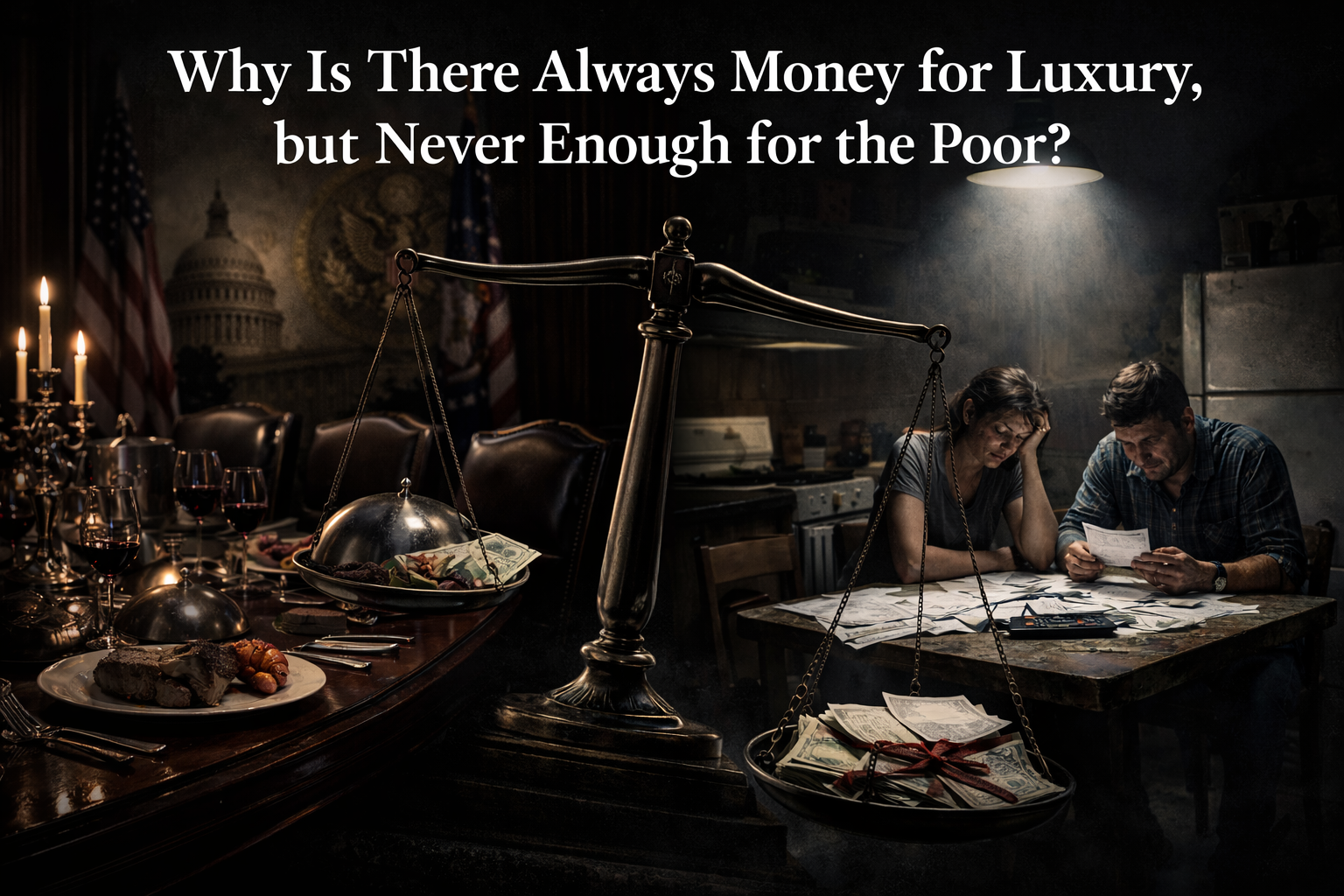
A nonpartisan deep dive into government waste, elite spending, and the painful contradiction of cutting aid for struggling families while public money is spent on luxury and excess.
Nothing fuels public anger faster than this simple question: why does the government always seem to find money for luxury, bureaucracy, and waste, yet suddenly turn “fiscally responsible” when it comes to helping the poor? The image you shared taps directly into that frustration. It highlights a familiar pattern that enrages people across the political spectrum: powerful officials appear insulated from sacrifice, while ordinary families are told to tighten their belts, accept cuts, and survive with less. This article will unpack that contradiction in a hard-hitting, nonpartisan way, focusing on government priorities, public trust, and the moral outrage of trimming benefits for the most vulnerable while lavish spending keeps rolling.
The Real Outrage Is Not Just Waste, It’s the Double Standard
Wasteful government spending is bad enough on its own. But what makes people furious is the double standard wrapped around it. Officials often defend cuts to food aid, housing support, medical help, and safety-net programs by talking about fiscal discipline. They say budgets are tight. They say the nation cannot afford “dependency.” They say everyone has to do more with less.
And then the same public sees stories about luxury offices, premium furniture, expensive travel, bloated consulting contracts, no-bid deals, inflated procurement, endless administrative overhead, and high-level waste dressed up as necessity. That’s where the rage really kicks in.
It is not just about dollars. It is about who is expected to live with discomfort. Poor families are told to accept hardship as realism. Bureaucracies and political power centers are treated like they deserve comfort as a baseline. That is not budgeting. That is a value system.
Austerity Always Seems to Be for Someone Else
Funny how austerity works, isn’t it? It almost never starts with the people making the decisions. It almost never starts with the politically connected. It almost never starts with the consultant class, the contracting pipeline, or the layers of management that multiply while public trust collapses.
Instead, austerity starts with the people who have the least room to absorb it. Cut a benefit from a struggling family and that can mean less food, less medicine, less transportation, less dignity. Cut a luxury expense from a government office and somebody just gets a less impressive chair.
Yet the first option is often treated as serious governance while the second is treated as trivial, symbolic, or somehow not worth bothering with. That tells the public everything they need to know about the moral priorities in play. The issue is not just what gets cut. The issue is who is considered expendable.
The Poor Are Politically Easy Targets
One ugly truth sits underneath a lot of benefit cuts: the poor usually have less political power. They donate less. They lobby less. They have fewer media megaphones. They are easier to stereotype, easier to ignore, and easier to turn into talking points.
Politicians know this. Bureaucracies know this. Consultants know this. It is far easier to slash a program serving vulnerable people than to take on entrenched interests that profit from complexity, opacity, and institutional bloat. The poor can be framed as numbers on a spreadsheet. The powerful show up in person, call lawyers, fund campaigns, and protect their territory.
That’s why the pattern keeps repeating. The people most dependent on public support are the least equipped to defend themselves in the rooms where these decisions get made. So when budget knives come out, those at the bottom are often first in line.
“Fraud Prevention” Is Often the Public-Friendly Excuse
Now let’s be fair: fraud, abuse, and inefficiency do exist in public benefit systems. Of course they do. Every large system has weak points. Taxpayers are right to demand oversight. But here’s where the public gets cynical: “fighting fraud” is often used as a polished excuse for making access harder for legitimate recipients.
A new paperwork rule here. A stricter verification hurdle there. More delays. More denials. More red tape. More hoops for exhausted people already struggling to survive. Suddenly the system becomes so difficult to navigate that even qualified people give up or fall through the cracks.
Meanwhile, white-collar waste, bloated contracting, overpriced procurement, and institutional excess don’t get the same moral theater. Nobody stands at the podium thundering about a fancy office renovation the way they thunder about a struggling parent receiving food assistance. That imbalance is what people notice. It is not accountability when scrutiny only flows downhill.
Lavish Spending Signals a Culture of Immunity

When public money is spent on things that look extravagant, it sends a message, even if defenders can explain part of it on paper. The message is this: the people inside the system do not live by the same rules as the people funding it.
That perception destroys trust. Fast.
Because for ordinary families, every purchase is weighed against rent, groceries, gas, debt, or childcare. Every dollar matters. There is no magical buffer. But government institutions often behave as if money becomes less real once it enters their walls. Costs balloon. Priorities blur. Comfort gets normalized. And the people responsible rarely face consequences that match the scale of public anger.
That culture of immunity is poison. Once taxpayers believe elites are protected from the pain of their own decisions, every claim of “shared sacrifice” starts sounding like a bad joke.
This Is Bigger Than One Party, One Administration, or One Viral Post
Here’s the nonpartisan truth a lot of people do not want to hear: this problem did not begin with one politician, and it will not end with one election. Different parties use different language, but both have participated in systems that protect insiders and shift pain outward.
One side may talk endlessly about cutting social spending while defending other sacred cows. The other may talk compassion while tolerating bureaucratic inefficiency, cozy contracting, and elite insulation. Different slogans, same public frustration. The branding changes. The hierarchy often doesn’t.
That’s why people are tired of partisan blame games. They’ve seen too many officials point fingers while the broader machine keeps humming along. The machine rewards distance from consequences. And as long as that remains true, ordinary people will keep feeling looted, managed, and lied to.
Budget Language Hides Human Consequences

One reason these cuts keep happening is because the language around them is so sanitized. “Expenditure reductions.” “Eligibility tightening.” “Program recalibration.” “Cost containment.” That all sounds neat and bloodless. But in the real world, those phrases can mean skipped meals, untreated illness, missed rent, unstable housing, and children going without.
The language of luxury spending gets softened too. “Procurement.” “Upgrades.” “Operational requirements.” “Administrative needs.” That can hide some truly ridiculous priorities under layers of official vocabulary.
This is how public outrage gets managed: human pain is turned into abstract budgeting, while elite comfort is disguised as technical necessity. Strip away the language and the contrast becomes glaring. One side of the ledger is inconvenience for the powerful. The other is survival for the vulnerable. Those are not morally equal line items.
People Don’t Hate Taxes as Much as They Hate Being Played
A lot of public anger gets misread. Many people are not furious simply because taxes exist. They are furious because they feel the social contract has been broken.
People can tolerate paying in when they believe the system is at least trying to be fair. They can accept shared investment when roads work, schools function, safety nets protect the vulnerable, and leaders show restraint. What they cannot stand is being told their money is desperately needed while watching that same money drift into vanity, waste, indulgence, and insider protection.
That’s the difference. This is not just anti-government sentiment. It is anti-hypocrisy sentiment. Taxpayers do not want perfection. They want evidence that public officials treat public money with more care than they themselves are forced to show in their own homes. That is not an unreasonable demand. It is the bare minimum.
Cutting Benefits Is Often Sold as Tough Love, But It Usually Looks Like Cowardice
Politicians love dressing harsh choices up as courage. They call cuts “tough decisions.” They frame them as proof of seriousness. But there is nothing brave about balancing budgets on people with the weakest political protection. That is not toughness. More often, it is cowardice in a suit.
Real courage would mean aggressively auditing waste at the top. Real courage would mean scrutinizing sweetheart deals, redundant layers, procurement inflation, consultant empires, and protected spending silos that survive because they are politically dangerous to confront. Real courage would mean saying no to the people closest to power, not just the people furthest from it.
But that kind of courage has enemies. It creates backlash from insiders, donors, lobbyists, and institutional players. So instead, leaders often take the easier route: squeeze the voiceless and call it responsibility.
The Moral Test of a Society Is Not How It Treats the Comfortable
Every society reveals its values through its budget. Not its speeches. Not its campaign ads. Not its patriotic slogans. Its budget.
A government can talk all day about family values, dignity, hard work, freedom, or justice. But if it protects comfort for the well-positioned while cutting lifelines for people in crisis, then the real values are already visible. The mask slips. The priorities are exposed.
The poorest citizens are not where a nation should look for easy savings. That should be the line no decent public system crosses lightly. When leaders casually cross it while surrounding themselves with comfort and excuses, they should expect backlash. Not because people are emotional or uninformed, but because the moral contradiction is impossible to miss.
What Real Accountability Would Actually Look Like\
If leaders truly wanted to restore trust, they would stop performing fiscal virtue only when the poor are involved. They would build accountability that starts at the top and works downward.
That means radical transparency on discretionary spending. It means plain-language public reporting, not jargon-filled documents nobody can interpret. It means aggressive review of procurement practices, contracts, office expenses, and administrative luxury. It means independent watchdogs with teeth. It means consequences that go beyond bad headlines. And yes, it means protecting essential benefits unless and until higher-level waste has been seriously confronted.
The principle should be simple: no one in government gets comfort by default while vulnerable citizens are asked to absorb pain by default. Turn that upside down, and public trust might begin to recover.
The Public Has Every Right to Be Furious
Let’s call it what it is. People are angry because they are tired of being treated like the only adults in the room. They budget carefully. They sacrifice. They delay needs. They stretch paychecks. They make impossible choices every single month. Then they watch public officials posture about necessity while preserving a world of padded spending, protected inefficiency, and elite detachment.
That anger is not irrational. It is not fringe. It is not partisan. It is the natural response to a system that seems to demand discipline from the weak and indulgence for the powerful.
And that is the core question at the heart of your blog topic: why can politicians and public institutions spend taxpayer money lavishly while cutting benefits for the poorest? Because too many systems are built to protect power before people. Because the poor are easier to squeeze than the connected. Because public outrage has too often been absorbed rather than answered. And because accountability, when it exists at all, is too often aimed at the bottom instead of the top.
That is why this issue keeps exploding. And until governments prove they can cut vanity before survival, luxury before necessity, and waste before basic human support, the fury is not going anywhere.
FAQs
Why does the government seem quicker to cut benefits than cut waste?
Because benefit recipients often have less political power than entrenched institutions, contractors, and insiders who benefit from the status quo.
Is this problem partisan?
No. Different parties frame the issue differently, but government waste, elite insulation, and selective austerity can appear under many administrations.
Should all viral claims about government spending be believed?
No. Claims should be verified carefully. But even when details are debated, the public anger often comes from a broader and very real loss of trust.
Why do cuts to benefits spark so much anger?
Because those cuts hit people who are already struggling. For many families, even a small reduction in support can mean serious harm.
What would fair accountability look like?
Start with transparency, top-level spending scrutiny, stronger watchdog oversight, and a rule that essential aid should not be first on the chopping block.
Final Thoughts
The deepest public frustration is not that government spends money. It is that government so often spends it with one moral standard for the powerful and another for the poor. That is what makes stories like this hit so hard. People can smell unfairness a mile away, and this issue reeks of it.
A functioning society should never ask hungry families to prove their worth while public systems treat comfort, excess, and institutional waste as normal operating procedure. Until that changes, outrage is not just understandable. It is deserved.
For context on public budgeting and watchdog oversight, readers often look to resources like the Government Accountability Office, the Congressional Budget Office, and nonprofit fiscal watchdog discussions such as Open the Books.