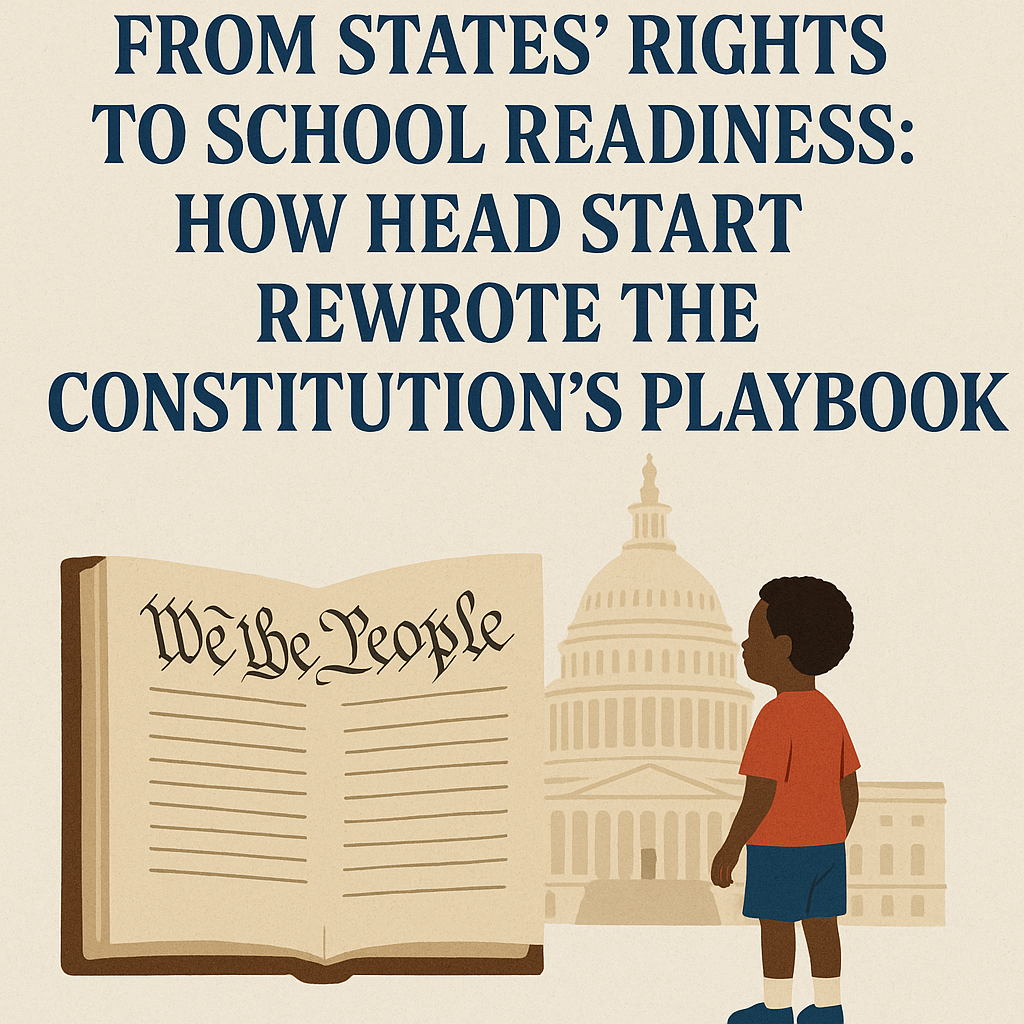
A Christian, Nonpartisan Perspective on Constitutional Change and Child Welfare
In the age of growing political polarization, when newspaper headlines are dominated by arguments about the power of government and the rights of states, it becomes all too easy to recall that some of the federal programs we today take for granted were once thought constitutionally impossible. One of the most potent examples comes in the least likely place: Head Start, the legendary early childhood education system born in 1965 as part of President Lyndon B. Johnson’s War on Poverty. Far from being a typical policy creation, the creation and expansion of Head Start involved a constitutional sea change—and posed profound questions about justice, government, and our moral responsibility to care for society’s most vulnerable.
This article takes a nonpartisan and Christian angle in exploring how Head Start both reshaped early childhood policy and redrew the federal government’s role according to the Constitution. It is in some respects a tale about the confluence between moral responsibility and constitutional evolution, and has something in particular to contribute with regards to governance as stewardship.
A Constitutional Evolution: From Madison to Hamilton
The founders’ initial Constitution limited the scope of federal power and reserved most social welfare services—such as education, welfare, and health care—to the states. Submitting to this “Madisonian” interpretation of the Constitution, the federal government did not possess any power to fund or regulate municipal programs such as preschool. This interpretation slowly evolved, however, in the era of the New Deal, as it was increasingly interpreted together with the Spending Clause in a broad “Hamiltonian” interpretation.
It was solidified in landmark Supreme Court decisions such as United States v. Butler (1936) and Helvering v. Davis (1937), which determined that Congress could tax and spend in support of “general welfare” even in nonstate domains of classic state responsibility. Doing so flung wide the constitutional window to federal programs such as Social Security, Medicaid—and eventually, Head Start.
The Birth of Head Start: Constitutional Power in Action
By 1965, when President Johnson initiated Head Start, the federal government had constitutional authority—under the broadened interpretation it had applied to the Spending Clause—under which it could fund local programs for improving child development in poverty communities. Although the Constitution still doesn’t refer to education or prekindergarten directly, programs like Head Start have become staples of the federal landscape through conditional spending: Congress provides states and communities appropriations and detailed specifications for programs in areas such as health screenings, parental involvement, and requirements about what will be taught.
Its critics argue this process diverts power from states. Its supporters argue it provides the scale and equity necessary to reach children who otherwise will fall through the cracks. Both sides make good points, but as people of the cross and as nonpartisans, the ultimate question here goes deeper than power—it goes deeper in care.
Christian Stewardship and the Moral Mandate to Protect Children
Bibles always teach us to uphold and advocate for the poor, the silent, and the weak. Proverbs 31:8-9 exhorts in us in similar vein: “Speak up for those who cannot speak for themselves…defend the rights of the poor and needy.” Here, government programs that support disadvantaged children are not only legal—they are biblical.
By Christian worldview, government should neither be idealized nor caricatured. It should be employed as an instrument of justice. Government has been designated in Romans 13 as a “servant of God” for good. Well utilized, federal programs like Head Start become agents of mercy and stewardship—most especially for such families with minimal resources and voice. Although the church, the family, and immediate communities have roles in raising children, all children do not end up in homes capable of raising them. Government must therefore intermittently fill in the gaps.
Beyond Partisan Labels: A Call to Moral Governance
Today’s commentary all too often puts support for government programs in partisan terms—a matter of progressive vs. conservative, statist vs. libertarian. But the biblical ethic transcends such terms. We’re Christians, so we’re supposed to discern policy based not on who proposes it but by whom it benefits. Programs that ensure that a kid gets access to preschool, health care, nutrition, and safety aren’t partisan—they’re just.
The rule of subsidiarity, as it’s taught in Catholic social teaching, holds that things should be looked after by the smallest authority capable of doing so. But if the parish or state level doesn’t work—or doesn’t have funds—the federal level can rightly step in so as to uphold human dignity and the common good. Head Start puts this rule in practical action: federal support in support of local efforts in the defense of children’s futures.
Constitutional Fidelity or Covenant Justice? Why Not Both?
Some originalists assert that the exercise in conditional grants by the federal administration distorts the Constitution and frustrates the sovereignty of states. They are important discourses, and constitutional restraint rightly plays the key role in preventing tyranny. But if the Constitution represents a living system for seeking to “establish justice” and “secure the general welfare,” perhaps altering interpretation—like that which allowed Head Start—can bring into reality the Constitution’s moral potential, rather than offend it.
This becomes especially true when such readings help us live out biblical values of compassion, social justice, and stewardship. Justice doesn’t remain static. Society doesn’t either. Government at its best will mirror our covenant responsibility towards one another.
Conclusion: Building a Just Society, One Child at a Time
It’s bigger than an early education program. It’s also a constitutional case study, moral compass, and call to action. It shows, through the lens of Christianity and nonpartisanship, how federal power—when guided by ethical conviction and empathy—can be employed as a force for good.
In the end, we are held accountable not for how rightly we can interpret a document that was written in the 18th century but for how responsibly we treat the most vulnerable in the 21st. Head Start did not so much update the playbook for early childhood education as it helped redefine the moral imagination about what government can—and must—do for the least of these.