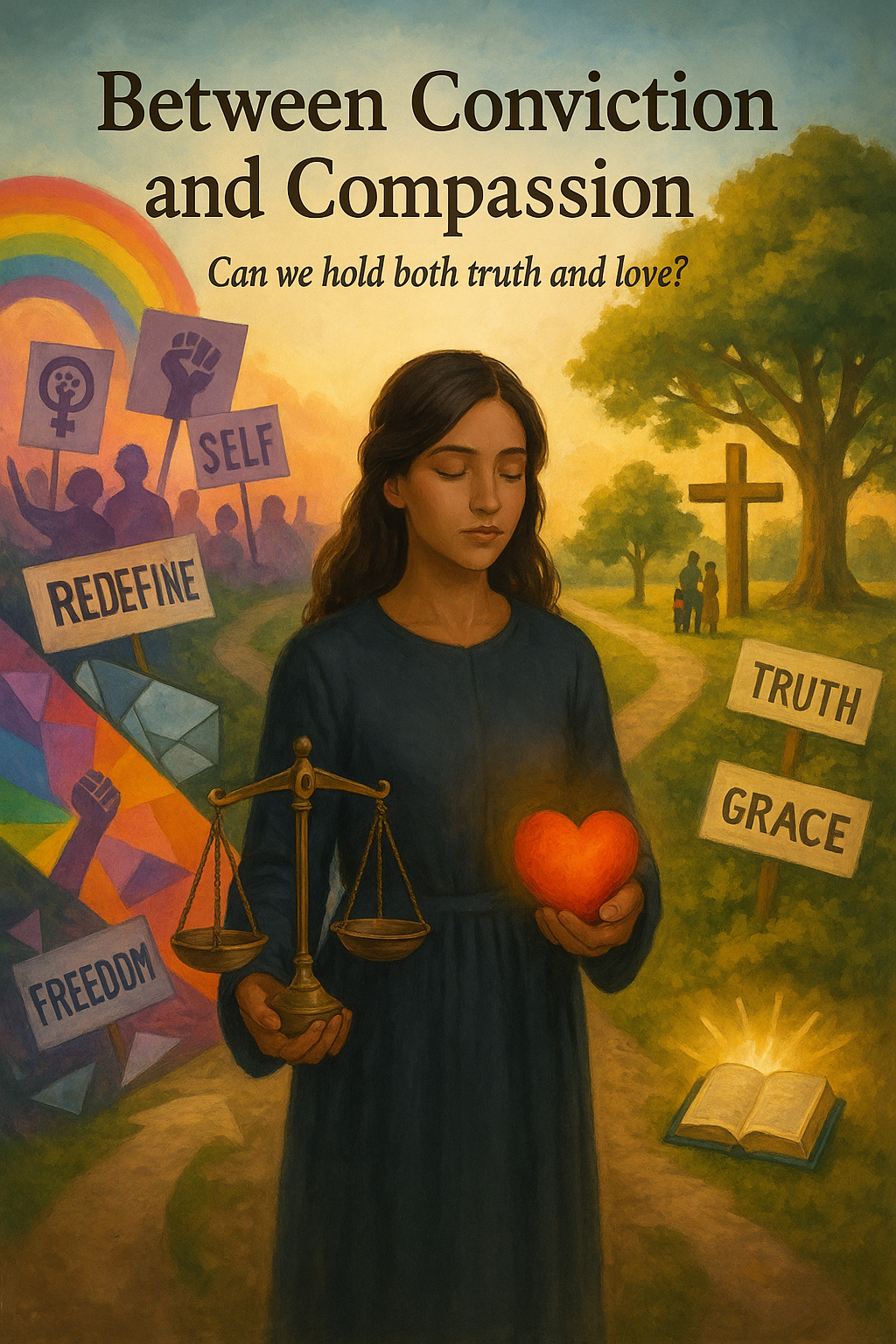
When Worldviews Collide
Culture in Conflict: More Than a War of Words
Few debates today are as emotionally charged—or as spiritually significant—as those surrounding gender, sexuality, and family. What once might have been confined to university seminars or courtrooms now saturates our newsfeeds, schools, churches, and even dinner tables. These aren’t just policy disagreements—they’re deep clashes of worldview.
From the affective imperatives of feminism to the transgressive challenges of queer theory, and the relentless defense mounted by family-friendly Christians, they are all more than propagating slogans. More than that, they are propagating rival answers to life’s final questions:
- Who are we?
- What does it mean to feel female or male?
- How do we define love, freedom, and justice?
- And who gets to decide?
As Christians, we are not here to shirk away from such questions, or respond out of fear or rage. Rather, we are challenged to reflect deeply, speak honestly, and act redemptively. That will involve carrying conviction and compassion together—not as competitors, but collaborators.
Mapping the Terrain: Understanding the Movements
Feminism: From Suffrage to #MeToo
Feminism is not one movement but an evolving and complicated tradition. It started with first-wave feminists advocating for women’s civil rights—such as the right to vote and to own property. Subsequent waves grew to include more:
- Second-wave feminism (1960s–1980s) tackled workplace discrimination, reproductive rights, and patriarchal systems.
- Third-wave feminism introduced intersectionality, asking how race, class, and sexuality shape a woman’s experience.
- Fourth-wave feminism, driven by online activism, advocates for inclusion and meets sexual assault with campaigns such as #MeToo
Feminism, at its best, has fought to expose injustice and demand dignity for women. Yet it has also sparked controversy—especially when linked with abortion rights, radical autonomy, or postmodern definitions of gender.
Queer Theory: Deconstructing Identity
Queer theory, grounded in post-structuralist thought, challenges the categories many take as givens: male and female, straight and gay, masculine and feminine.
Thinkers like Judith Butler and Eve Sedgwick argue that gender and sexuality aren’t fixed truths but social performances shaped by culture, language, and power. Queer theory doesn’t just aim for inclusion—it pushes for a reimagining of identity itself, where fluidity replaces fixed norms.
For some, this opens the door to freedom. But it also raises deep theological concerns. It confronts the biblical view of creation, covenant, and moral truth anchored in God’s design.
The Pro-Family Christian Response
In response, many Christians have rallied around the “pro-family” movement—championing traditional marriage, gender roles, and the sanctity of life. But this movement has its own blind spots. In the effort to defend biblical structures, some have neglected the dignity of those within them—especially women, abuse survivors, and LGBTQ+ individuals.
The result is a cultural standoff marked by extremes, where grace is hard to find and nuance is nearly lost.
Common Ground: Where Conviction Meets Compassion
Despite real and often deep disagreements, there are unexpected points of overlap between biblical values and certain feminist and queer concerns. These shared convictions don’t erase the differences, but they do create space—not for compromise, but for honest, meaningful dialogue.
- The Imago Dei: A Shared Cry for Dignity – Feminism’s claim of equal worth finds an echo in Genesis 1:27: male and female, made in God’s image. This foundational truth dismantles hierarchies of value and affirms the sacred dignity of every human being.
- Justice and Protection for the Vulnerable -Both feminism and Christian ethics stand against the abuse of power. Scripture commands it plainly: “Defend the weak and the fatherless; uphold the cause of the poor and the oppressed” (Psalm 82:3). From domestic violence to wage gaps to sexual exploitation, both frameworks demand justice and accountability.
- Hospitality and Inclusion – Queer theory defies social exclusion and rejoices in chosen family and belonging. Though Christians might take issue with its system, we’re commanded to radical hospitality—to receive the stranger, defend the outcast, and never mistake moral certitude for individual condemnation.
Key Differences: Theological and Philosophical Divergence
Yet we must also name where our convictions diverge:
- Creation and Identity – Bible presents the male and female as not social constructs but creation design from God (Genesis 1:27). Queer theory understands identity to be infinitely fluid, but the Bible presents it as deliberate and rooted in creation.
- Marriage and Moral Order – The biblically defined vision of marriage—covenantal, lifelong, and between one man and woman—is not only tradition but theology (Matthew 19:4–6). Queer theory aims to deconstruct the same framework completely.
- Freedom and Responsibility – Modern theories often define freedom as autonomy: doing what I want. But biblical freedom is found in obedience to God’s good design (Romans 12:2). True liberty isn’t self-invention—it’s transformation by grace.
Repentance and Responsibility: The Church’s Call to Account
Before we critique others, the Church must first examine its own witness. We have too often:
- Silenced women in the name of order
- Turned away survivors in the name of reputation
- Condemned LGBTQ+ people without compassion or understanding
Such failures betray the gospel we claim to uphold. The world doesn’t need louder condemnation—it needs a clearer demonstration of Christ.
Redeeming the Dialogue: A Better Way Forward
What if Christians led not with fear, but with faith? Not with slogans, but with substance? Here’s what a redemptive engagement might look like:
- Speak with Wisdom – Offer biblical truth not as a weapon, but as a well—deep, refreshing, and nourishing.
- Listen with Humility – Don’t assume every feminist is anti-God or every queer theorist is anti-truth. Many are asking real questions that demand real answers.
- Live with Integrity – Let our marriages, churches, and communities be places where women are valued, men are humble, and love is real.
A Better Story: Not to Win, But to Witness
Ultimately, the future of this conversation will not be shaped by who wins the next court case or culture clash. It will be shaped by who lives the better story.
- A story where men and women are equals, not adversaries.
- A story where justice and mercy walk hand in hand.
That is the Church’s call—not to dominate, but to demonstrate. To show that God’s design is not only true—but good. Not only right—but beautiful.
Let us be individuals of conviction and compassion. Let us not be willing to opt for the either/or between clarity and kindness. And let us create a world where the worth of every human being is upheld even where truth is not necessarily agreed upon.
Because that’s what Jesus did—and continues to do.