Segregation Didn’t End—It Evolved: Why Vigilance Is Still Required
Historical Context: Why Desegregation Orders Existed
It was not until 1966 that desegregation orders were issued by federal courts and the Department of Justice to carry through on the Supreme Court 1954 judgment of Brown v. Board of Education, which declared racial school segregation unconstitutional. Despite this verdict, numerous school districts from the South continued to be against integration well into the 1960s, so that the federal government stepped in to enforce court-ordered desegregation measures (Cascio et al., 2010).
The Justice Department’s Cancellation of Desegregation Orders
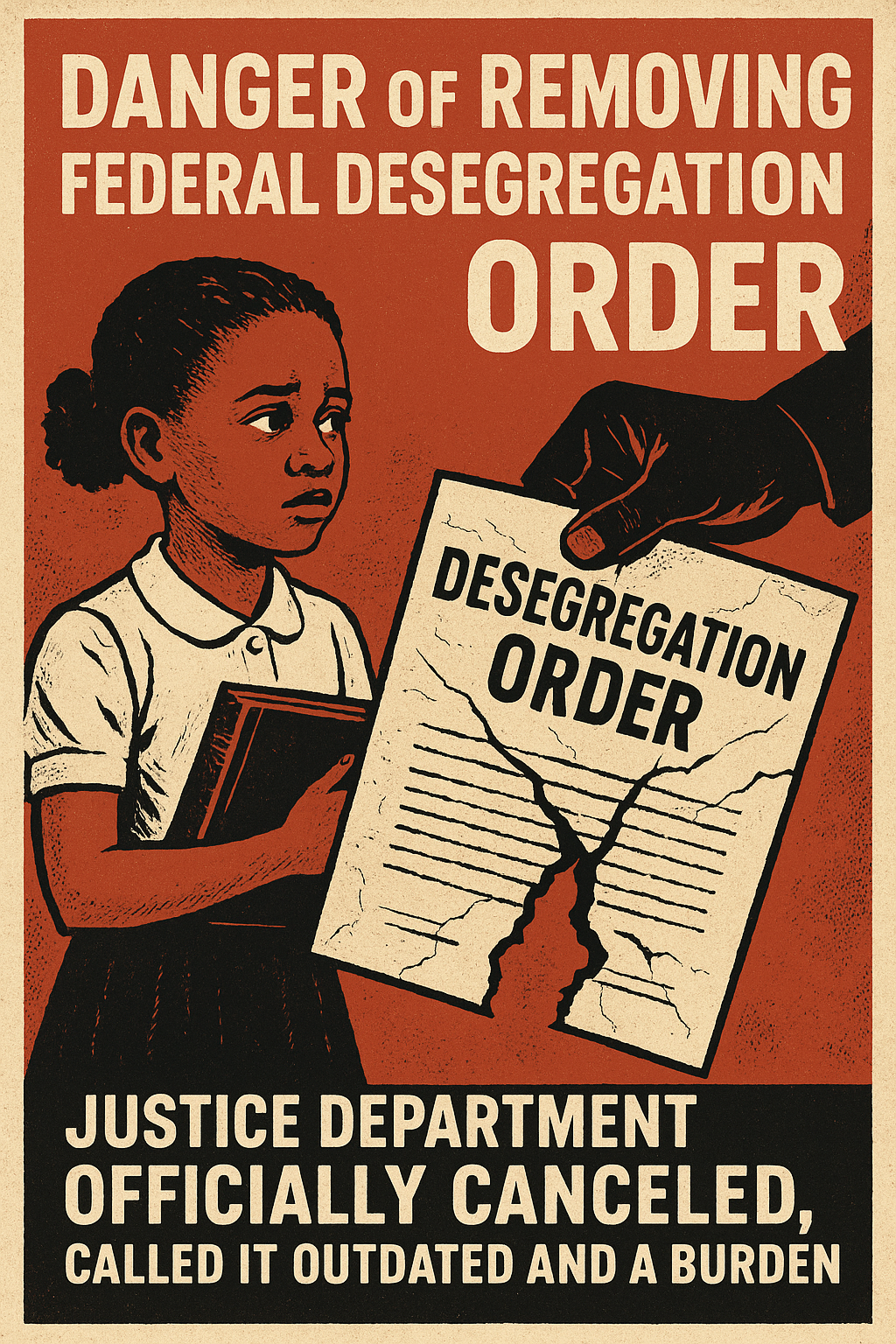
In recent decades, the Justice Department began dissolving or canceling federal desegregation orders, sometimes calling them “outdated” or a “burden.” For example, under multiple administrations, including the Trump-era DOJ, hundreds of school districts were released from federal oversight without requiring proof that they maintained equitable conditions (U.S. Commission on Civil Rights, 2019). This action was justified by claims that:
- The orders were decades old
- Schools had technically complied with the original mandates
- Local control should replace federal intervention
Why Removing Desegregation Orders is Dangerous
Resegregation is a Real and Measurable Threat
Since the rollback of desegregation enforcement began, school segregation has actually increased. According to the UCLA Civil Rights Project (2020), U.S. schools are now more segregated than in the 1970s. Many districts have returned to “separate but unequal” realities due to:
- Residential segregation
- School funding tied to property taxes
- The loss of federal oversight
This trend disproportionately harms Black and Latino students, who are more likely to attend underfunded schools with fewer resources, advanced courses, or experienced teachers (Orfield & Frankenberg, 2014).
Civil Rights Protections Become Politicized Without Federal Enforcement
When desegregation oversight is removed, the responsibility shifts to local and state governments. However, local politics often reflect systemic biases and historical inequalities. In the South and beyond, there is a risk of schools quietly drifting back into patterns of racial and economic division without federal checks (Reardon et al., 2012).
Long-Term Social and Economic Inequality Increases
Integrated schools lead to:
- Better academic outcomes for marginalized students
- Reduced racial bias among all students
- Higher lifetime earnings and college completion rates for students of color (Johnson, 2019)
Undoing desegregation efforts widens achievement gaps and reinforces generational poverty.
Faith and Justice: A Christian Non-Partisan Perspective
This issue is not about partisan politics—it’s about moral responsibility. Scripture teaches that justice is not optional:
- “Woe to those who enact unjust statutes and issue oppressive decrees.” (Isaiah 10:1)
- “Do not pervert justice; do not show partiality.” (Deuteronomy 16:19)
Justice requires active maintenance, not passive neglect. Removing desegregation orders sends the message that equity is no longer a priority.
Conclusion: Justice Is Never “Outdated”
It is illogical and unfair to describe federal desegregation injunctions as ‘outmoded’ or ‘obsolete’ while the systemic imbalances that these injunctions were intended to address continue to persist to this day. Claiming that these constitutional protections are redundant ignores the social and historical reality of recalcitrant racial inequities that are still deep rooted within American schools, neighborhoods, and economic life.
Desegregation orders were never temporary solutions but remedial measures to uproot systems of segregation and inequality. If the root causes of segregation and discrimination have not yet been cured—and all serious studies verify that they haven’t—then doing away with oversight is not only premature but unfair. In which case, the corrective action is not to rescind these protections but to rework, update, and strengthen them to meet new challenges. Justice is not meted out through elimination of the remedy before the cure of the disease. It is meted out through the modification of these remedies with the natural, often shifting, character of systemic bias.
Discussion Questions
- How can local communities balance federal oversight with local control in matters of racial equity?
- What role should churches and faith communities play in advocating for educational justice?
- Are there modern policy solutions that could replace old desegregation orders while still promoting integration?
References
- Cascio, E., Gordon, N., Lewis, E., & Reber, S. (2010). Paying for Progress: Conditional Grants and the Desegregation of Southern Schools. The Quarterly Journal of Economics, 125(1), 445–482.
- Johnson, R. (2019). Children of the Dream: Why School Integration Works. Basic Books.
- Orfield, G., & Frankenberg, E. (2014). Brown at 60: Great Progress, a Long Retreat and an Uncertain Future. UCLA Civil Rights Project.
- Reardon, S. F., et al. (2012). The Widening Academic Achievement Gap Between the Rich and the Poor. Educational Leadership, 70(8), 10–16.
- U.S. Commission on Civil Rights. (2019). Beyond Suspensions: Examining School Discipline Policies and Connections to the School-to-Prison Pipeline.
- UCLA Civil Rights Project. (2020). E Pluribus… Separation: Deepening Double Segregation for More Students.