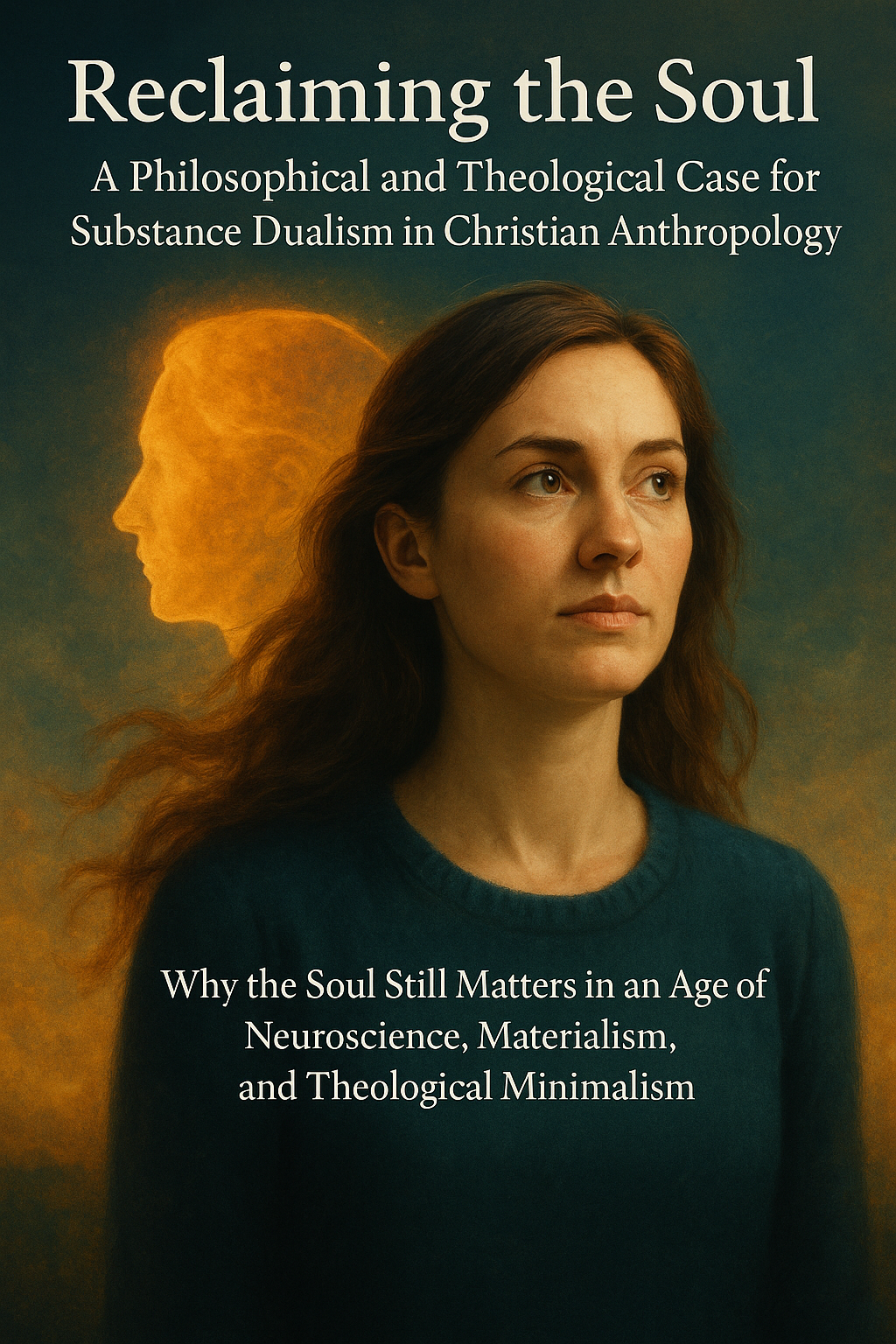
Why the Soul Still Matters in an Age of Neuroscience, Materialism, and Theological Minimalism
Rediscovering the Human Person
In contemporary theology and philosophy, the idea of the soul has come under sustained pressure. Advances in neuroscience, the rise of physicalism, and the suspicion of “Greek metaphysics” have led many Christian thinkers to reject the classical dualist model of human nature in favor of various forms of materialism. Yet this shift raises deep and troubling questions: How can we speak meaningfully of life after death, divine judgment, and the resurrection without a persistent, immaterial self?
This blog article explores a rigorous academic defense of substance dualism—anchored in theology, philosophy, and Scripture—as not only viable but essential for a coherent Christian anthropology. It centers on the innovative concept of the Dual-Stage Ontology, which posits that the human soul survives death and is later reunited with a glorified body, preserving personal identity and theological continuity.
The Historical Case: Soul and Body in Christian Tradition
Classical Christian thinkers such as Augustine, Gregory of Nyssa, and Thomas Aquinas affirmed that human beings are composed of both body and soul—two distinct but united substances.
- Augustine emphasized the soul’s immortality and rational nature as a reflection of eternal truths (City of God).
- Gregory of Nyssa, drawing from both Scripture and Plato, defended the soul’s postmortem survival and reunion with the body (On the Soul and the Resurrection).
- Aquinas, synthesizing Aristotelian thought, taught that the soul is the form of the body but capable of independent existence in the intermediate state (Summa Theologiae, I, Q75–76).
These views were not speculative metaphysics—they were theological necessities grounded in biblical eschatology and doctrinal coherence.
Question for Reflection: How would our understanding of the afterlife change if the soul did not persist after death?
Philosophical Arguments: The Soul and Personal Identity
Modern analytic philosophers have revitalized dualism by engaging deeply with personal identity, consciousness, and modal logic.
- Richard Swinburne uses modal logic to argue that it is logically possible for a person to exist without their body—indicating a metaphysical distinction between the two (Swinburne, 1997).
- J.P. Moreland highlights the irreducibility of mental phenomena like qualia and intentionality, which physicalist explanations fail to fully capture (Moreland, 2000).
- William Hasker proposes “emergent dualism,” where the soul arises from the body but gains distinct ontological status and survives bodily death (Hasker, 1999).
While objections to dualism persist—such as the interaction problem or neuroscientific challenges—these are not insurmountable. Philosophers argue that causation between immaterial and material entities may occur through mechanisms not yet understood or may operate outside strictly physicalist parameters.
Question for Reflection: Can brain science ever fully explain subjective experience, or do we need a metaphysical account of the soul?
Scriptural Witness: The Bible on Body and Soul
Though Scripture does not use philosophical categories like “substance dualism,” it consistently affirms a dualistic view of human nature:
- Genesis 2:7 depicts humanity as both dust (body) and breath (spirit).
- Ecclesiastes 12:7 notes that “the spirit returns to God who gave it.”
- Matthew 10:28 distinguishes soul and body: “Do not fear those who kill the body but cannot kill the soul.”
- 2 Corinthians 5:8 and Philippians 1:23 imply conscious existence with Christ apart from the body.
These passages, along with the doctrine of the intermediate state and resurrection, presume the continuity of a subject—the soul—who persists through death and awaits resurrection.
Question for Reflection: If Scripture repeatedly distinguishes body and soul, what are the theological risks of ignoring this dualism?
Theological Challenges: Why Physicalism Falls Short
Contemporary theologians like Nancy Murphy and Kevin Corcoran have argued for forms of Christian physicalism, where human beings are wholly material but capable of spiritual experience. While these models aim to align with neuroscience and uphold bodily unity, they raise serious concerns:
- Loss of Personal Identity: Without a persistent soul, resurrection becomes a replication, not a restoration.
- Undermining Judgment and Accountability: If the self does not persist, who is judged?
- Biblical Strain: Texts that clearly imply disembodied existence become difficult to interpret without speculative revision.
As John Cooper (2000) argues, without dualism, the coherence of intermediate state, moral continuity, and eschatological justice collapses.
Question for Reflection: Can resurrection and judgment be meaningful without a metaphysical soul to carry moral identity?
The Dual-Stage Ontology: A Modern Rearticulation of Classical Dualism
The blog’s central contribution is the Dual-Stage Ontology, which affirms two phases of postmortem existence:
- Stage One – Disembodied Consciousness: Upon death, the soul exists in a conscious, morally accountable state (cf. Luke 23:43; Philippians 1:23).
- Stage Two – Resurrection and Reunification: At the eschaton, the soul is reunited with a glorified body (cf. 1 Corinthians 15), completing human nature in its fullest form.
This model:
- Retains classical metaphysics (à la Aquinas) without Cartesian excess.
- Solves the identity-over-time problem by locating selfhood in the soul.
- Aligns with biblical teachings on judgment, continuity, and resurrection.
- Offers pastoral hope grounded in doctrinal coherence.
Question for Reflection: What would it mean for the Christian church to recover a robust view of the soul in teaching, ethics, and worship?
Implications: Why This Model Matters
Theological:
- Preserves the coherence of divine judgment and resurrection.
- Affirms the integrity of human nature—both soul and body.
Philosophical:
- Offers a compelling answer to materialist critiques.
- Grounds human dignity and moral agency in a persistent self.
Pastoral:
- Provides comfort regarding life after death.
- Offers a robust theological basis for personhood and care ethics.
Final Thoughts: The Soul Still Matters
In a world dominated by materialist assumptions and metaphysical minimalism, recovering substance dualism is not nostalgic—it’s necessary. The Dual-Stage Ontology presents a holistic, biblically faithful, and philosophically defensible model of the human person. It allows Christians to affirm both the soul’s survival and the hope of bodily resurrection, preserving what matters most: that we are eternal persons, created in God’s image, accountable to God, and destined for eternal life.
References
- Augustine of Hippo. City of God and Confessions. Various editions.
- Aquinas, Thomas. Summa Theologiae. Various editions.
- Gregory of Nyssa. On the Soul and the Resurrection.
- Cooper, John. Body, Soul, and Life Everlasting. Eerdmans, 2000.
- Corcoran, Kevin. Rethinking Human Nature. Baker Academic, 2006.
- Hasker, William. The Emergent Self. Cornell University Press, 1999.
- Moreland, J.P. Body and Soul. InterVarsity Press, 2000.
- Murphy, Nancy. Bodies and Souls, or Spirited Bodies? Cambridge UP, 2006.
- Swinburne, Richard. The Evolution of the Soul. Oxford UP, 1997.
- Van Inwagen, Peter. Material Beings. Cornell UP, 1990.
- Wright, N.T. Surprised by Hope. HarperOne, 2008.
We Want to Hear from You
This conversation on substance dualism and the nature of the human person is far from over—and your voice matters.
Do you resonate with the idea of a Dual-Stage Ontology?
Have you encountered challenges reconciling Christian doctrine with modern science?
What questions, insights, or objections do you have about the nature of the soul, the resurrection, or human identity?
Whether you’re a theologian, philosopher, pastor, student, or curious seeker, we invite you to share your thoughts. Your feedback not only enriches the conversation but helps shape how we collectively understand the intersection of faith, reason, and human dignity.
🗣 Join the dialogue:
- Leave a comment below
- Share this article with your community
- Reach out via our [contact page/email/social media]
Let’s build a thoughtful, respectful space for inquiry and conviction—together.