When Restoration Becomes Contamination: The Hidden Cost of Effluent in Wetland Projects
A Hidden Threat Beneath the Surface
Wetlands are often called the “kidneys of the earth” because they filter pollutants, store floodwater, and provide habitat for wildlife. In recent years, restoration projects have increasingly used treated wastewater (effluent) to replenish or create wetlands, framing this as an eco-friendly, resource-saving solution.
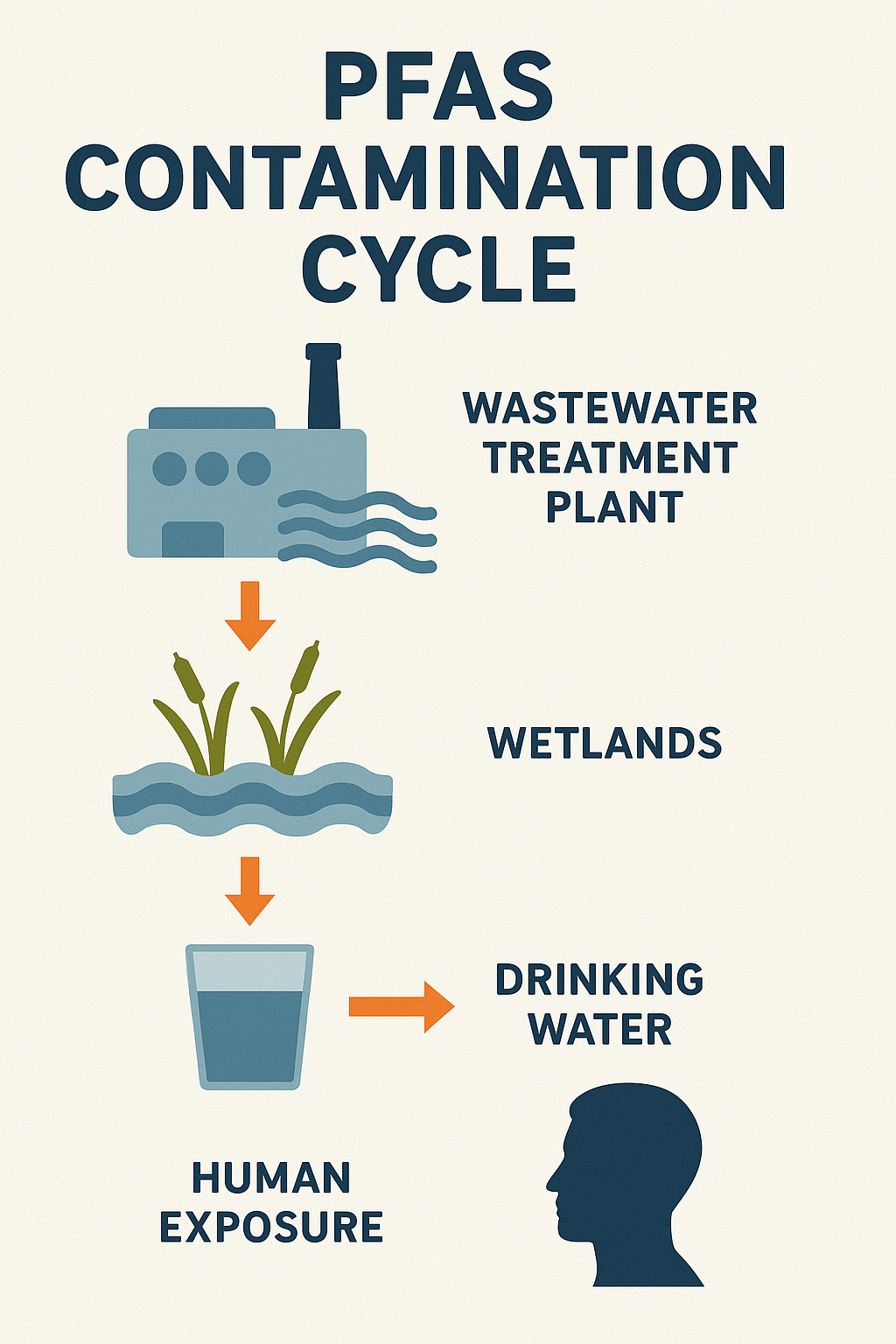
But what happens when that water carries PFAS—per- and polyfluoroalkyl substances—also known as “forever chemicals”? Evidence shows these substances survive standard wastewater treatment and are released directly into ecosystems via restoration efforts (Perkins, 2025). Instead of healing the environment, we may be creating toxic traps.
Why PFAS in Effluent Is a Problem
PFAS are used in everything from nonstick pans to firefighting foam. They are resistant to heat, water, and oil, which also means they do not break down easily in nature (U.S. Environmental Protection Agency [EPA], 2025a). Standard wastewater treatment plants (WWTPs) were never designed to remove them, so PFAS pass through treatment and remain in effluent used for wetland restoration (Perkins, 2025).
Recent investigations have revealed wetlands in several U.S. states, “restored” with treated sewage, are now contaminated with PFAS at levels posing ecological and human health risks (Perkins, 2025).
Health and Ecological Risks
PFAS are bioaccumulative, meaning they build up in the tissues of animals and humans over time (EPA, 2025b). In wildlife, PFAS can impair reproduction, damage organs, and disrupt hormones (Science of the Total Environment, 2024). For humans, long-term exposure has been linked to cancer, immune suppression, thyroid disease, and developmental issues (Inside Climate News, 2025).
The concern is twofold:
- Drinking water contamination – Wetlands often feed into groundwater or surface water sources used for municipal supply.
- Wildlife exposure – Birds, fish, and amphibians in these wetlands become carriers of PFAS throughout the food chain.
Policy Gaps Allow Contamination to Continue
The EPA finalized drinking water limits for six PFAS chemicals in 2024, but there are no federal limits for PFAS in treated wastewater effluent (EPA, 2025a). This regulatory blind spot means restoration projects can legally use effluent containing PFAS—without testing, reporting, or mitigation requirements (Association of State Drinking Water Administrators [ASDWA], 2025).
A proposed EPA rule to create PFAS effluent guidelines was withdrawn in early 2025 (JD Supra, 2025), leaving states and local governments to fill the policy void. Few have done so, and most wetlands restoration guidelines still do not address PFAS contamination risk.
Pathways to Bipartisan Solutions
Addressing PFAS in restoration projects doesn’t have to be partisan. Several solutions appeal across the political spectrum:
- Infrastructure Funding – Investments in advanced wastewater treatment technologies, like reverse osmosis or granular activated carbon, can remove PFAS before effluent is released (SL Environmental Law Group, 2024).
- Engineered Wetlands – Wetlands designed with PFAS-targeted removal systems could restore habitats without introducing contamination (Science of the Total Environment, 2024).
- Local Pilot Programs – Cities can run small-scale PFAS mitigation projects to prove feasibility and secure public trust.
- Transparency & Testing – Mandating PFAS testing for any effluent used in ecological restoration would provide critical data for decision-making.
Call to Action
Wetland restoration should be a net positive for communities and ecosystems—not a long-term source of toxic exposure. You can:
- Contact your local water authority or city council to ask whether effluent used in restoration is tested for PFAS.
- Advocate for “PFAS-safe” wetland projects, using engineered filtration or treatment upgrades.
- Support bipartisan water safety funding that prioritizes contaminant removal at the source.
Questions to Keep the Conversation Going
- How can policymakers ensure PFAS standards extend beyond drinking water to include effluent and restoration projects?
- What role should federal agencies play versus local governments in regulating PFAS in ecological restoration?
- Could public-private partnerships accelerate PFAS removal technology deployment?
- How should “restoration success” be defined when contaminants are present?
References
Association of State Drinking Water Administrators. (2025, January 24). OMB withdraws EPA’s PFAS effluent limitation guidelines and standards proposed rule. https://www.asdwa.org/2025/01/24/omb-withdraws-epas-pfas-effluent-limitation-guidelines-and-standards-proposed-rule/
Inside Climate News. (2025, July 2). Wastewater treatment plants channel “forever chemicals” into waterways. https://insideclimatenews.org/news/02072025/wastewater-treatment-plants-stream-forever-chemicals-into-waterways/
JD Supra. (2025, February 12). The withdrawal of PFAS effluent limits: Implications for wastewater management. https://www.jdsupra.com/legalnews/the-withdrawal-of-pfas-effluent-limits-5649612/
Perkins, T. (2025, July 18). US wetlands “restored” using treated sewage tainted with forever chemicals. The Guardian. https://www.theguardian.com/environment/2025/jul/18/pfas-wetlands-wasterwater-effluent
Science of the Total Environment. (2024, July 15). Constructed wetlands for managing per- and polyfluoroalkyl substances (PFAS): Evidence, mechanisms, and modelling. https://doi.org/10.1016/j.scitotenv.2024.165219
SL Environmental Law Group. (2024, May 13). Removing PFAS from wastewater effluents: Cost-effective treatment. https://www.slenvironment.com/blog/removing-pfas-from-wastewater-effluents
U.S. Environmental Protection Agency. (2025a, May 14). Per- and polyfluoroalkyl substances (PFAS). https://www.epa.gov/sdwa/and-polyfluoroalkyl-substances-pfas
U.S. Environmental Protection Agency. (2025b, December). Potable reuse and PFAS: Questions and answers [PDF]. https://www.epa.gov/system/files/documents/2024-12/pfas-and-reuse-qa_508.pdf