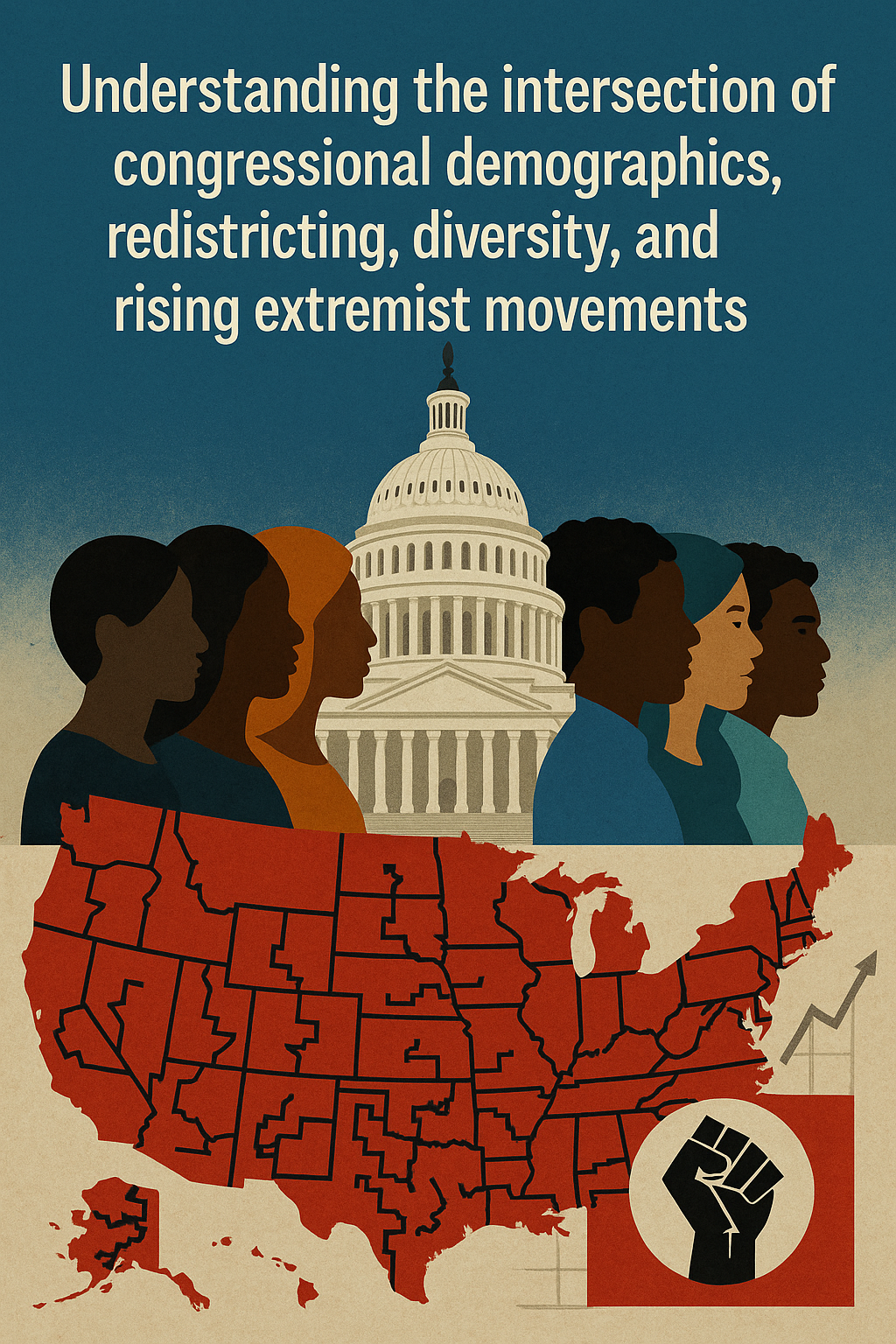
Understanding the intersection of congressional demographics, redistricting, diversity, and rising extremist movements
America is becoming more racially and culturally diverse. Yet at the same time, white supremacy and extremist movements are recharging. This paradox raises urgent questions about the relationship between demographics, political representation, and democratic legitimacy.
Recent debates over nationwide partisan redistricting—and the possibility of dramatically increasing white control in Congress despite demographic decline—highlight the ways structural systems can override population realities. Understanding these dynamics requires looking not just at current numbers, but also at historical patterns of representation gaps and the backlash cycles that often follow progress toward diversity.
Current Congressional Demographics and the Redistricting Hypothetical

Is “Congress 73% white” accurate?
Yes. According to Pew Research Center (2025), about 26% of voting members in the 119th U.S. Congress identify as a race or ethnicity other than non-Hispanic white, meaning roughly 74% are white—matching the “73%” figure often cited (Pew Research Center, 2025a). Among Democrats, 56% are white; among Republicans, over 90% are white, while the national white population is about 58% (WDSU, 2025).
Could “Trump-style” nationwide redistricting raise white control to 87%?
Although theoretically feasible, accomplishing such a dramatic shift—from approximately 75% to 87% white-controlled seats—through gerrymandering is exceedingly unlikely. Redistricting strategies like “packing” and “cracking” can dilute minority voting strength, but executing this nationwide would demand an extraordinary level of coordination and manipulation.
1. Texas’s Aggressive Mid-Decade Redistricting
- In 2025, Texas Republican lawmakers, backed by the DOJ’s acknowledgment that some districts were drawn along racial lines, proposed a new congressional map aimed to add five GOP seats before the 2030 census.
- Critics argue this map employs “packing” and “cracking” tactics—particularly diluting power in Hispanic-majority and urban minority communities, such as in Harris County and the reconfiguration of historically Latino districts.
2. Democratic Countermoves in California
- In response, California Democrats, led by Governor Newsom, are pushing a mid-cycle redistricting ballot measure to redraw maps and potentially gain up to five additional U.S. House seats, bypassing the state’s independent commission.
- The watchdog group Common Cause, historically critical of partisan redistricting, is opting not to oppose this effort—classifying it as a “counterbalancing measure”—though it stipulates that any changes must meet fairness standards, have voter approval, and be temporary.
3. Political Posturing Escalates
- In Texas, Democratic lawmakers staged a dramatic walkout, fleeing the state to stall redistricting—only returning under surveillance-like conditions imposed by state authorities.
- This has rippled into a broader national “redistricting arms race,” as both parties vie for strategic advantages ahead of the 2026 midterms.
Legal & Analytical Barriers to Extreme Results
Voting Rights Act in Court
- In Allen v. Milligan (2023), the U.S. Supreme Court ruled that Alabama’s congressional map likely violated Section 2 of the Voting Rights Act, mandating creation of an additional majority-minority district.
- And in Alexander v. SC NAACP (2024), the Court reversed a lower court’s finding that race predominated in redrawing a South Carolina district—demonstrating the legal complexity and pushback surrounding gerrymandering .
Reform Efforts Offer Checks
- States adopting redistricting commissions have seen reduced distortion. As shown in a 2024 study, reforms that strongly limit partisan control (e.g., Michigan-style) were significantly more effective than weaker models (e.g., Ohio’s).
Real-world Court Actions
- In Wisconsin, the state Supreme Court invalidated deeply gerrymandered legislative maps in 2023, replacing them with competitive ones before the 2024 elections—a notable success for fair representation.
- North Carolina’s legislature faced in-and-out court rulings: a 2022 partisan map was struck down, reinstated in 2023, and is now facing fresh litigation over racial bias.
What Such a Scenario Means for Non-White Americans
If the U.S. population were 40% white but white legislators held 87% of congressional seats, it would signal a deep structural representation gap.
- Representation Gap Would Widen — Political power would be concentrated far beyond what demographics predict, reinforcing the idea that the system—not the people—determines political influence.
- Policy Would Likely Reflect the Overrepresented — Civil rights, immigration, and economic policy could disproportionately reflect white-majority preferences.
- Gerrymandering Could Override Demographics — District manipulation could continue to blunt minority voting power even as diversity grows.
- Democracy’s Legitimacy Could Be Questioned — Extreme disproportionality risks political disengagement but could also spark activism and reform movements.
Historical Parallels: When Representation Lags Behind Demographics
The U.S. has faced such gaps before, and the consequences were profound.
- Reconstruction (1865–1877): 15% of the population was Black; only ~2% of Congress was Black, until Jim Crow dismantled gains.
- Post-19th Amendment (1920s–1960s): Women were 50% of the population; <3% of Congress were women for decades.
- Pre–Voting Rights Act South: States with 30–40% Black populations sent zero Black members to Congress until after 1965 reforms.
- Today: Whites are ~58% of the population but hold ~74% of congressional seats.
Lesson: Demographic majority does not equal political power without equitable voting systems.
Diversity and the Backlash Dynamic
Historically, every major gain in diversity and representation has been followed by organized resistance:
- Perceived Loss of Power — Dominant groups react to shifts by trying to maintain institutional control.
- Social Anxiety — Rapid demographic change can produce fear narratives amplified by misinformation.
- Rule Reshaping — Backlash movements push laws that secure political advantage (e.g., voting restrictions, district maps).
- National Identity Contest — Competing visions emerge: pluralistic democracy vs. cultural dominance.
- Turning Points — These moments can lead to reform (e.g., Civil Rights Act) or regression (e.g., Jim Crow).
Why This Issue Matters
Public Trust — A government visibly unrepresentative of its people erodes confidence in democracy.
Civil Rights — Underrepresentation can block or reverse equity gains.
Policy Outcomes — Disproportionate control often means policies favor the overrepresented group’s priorities.
Stability — Persistent gaps between demographics and representation are historically linked to political unrest.
Proposing Solutions
Fair Redistricting Reforms — Independent commissions to draw districts, reducing partisan and racial gerrymandering.
Strengthen the Voting Rights Act — Restore federal oversight of discriminatory voting changes.
Promote Equitable Turnout — Expand access to voting in historically underrepresented communities.
Representation Audits — Regularly compare demographics to elected bodies, flagging extreme disparities.
Civic Education & Engagement — Build cross-racial coalitions that can influence elections and policy regardless of district design.
Call to Action
Representation is the cornerstone of democracy. Americans—white and non-white alike—must ensure the system reflects the people it governs. This means supporting fair voting laws, rejecting gerrymandering, and engaging in civic life.
Questions for Further Thought
- Should Congress adopt national standards for redistricting to prevent extreme disparities?
- How can we balance majority rule with protections for minority rights?
- What role should the courts play in correcting representation gaps?
- How can coalition politics bridge racial and partisan divides to prevent backlash from dominating policy?
References
Financial Times. (2023). Letter: Across the great divide. https://www.ft.com/content/d4f68cc9-bc99-4c73-b7f0-f832aff60971
Pew Research Center. (2025a, January 21). Racial, ethnic diversity in the 119th Congress. https://www.pewresearch.org/short-reads/2025/01/21/119th-congress-brings-new-growth-in-racial-ethnic-diversity-to-capitol-hill
USAFacts. (2023). Is the US becoming more diverse?. https://usafacts.org/articles/is-the-us-becoming-more-diverse
WDSU. (2025, January 21). New faces on Capitol Hill: Demographics of the 119th U.S. Congress. https://www.wdsu.com/article/119th-us-congress-new-members-age-race-gender/63327142
Wikipedia. (2025a). White Americans. https://en.wikipedia.org/wiki/White_Americans
Wikipedia. (2025b). Demographics of the United States. https://en.wikipedia.org/wiki/Demographics_of_the_United_States