Understanding How Government Works in Everyday Life
Why Civic Literacy Matters
Civic literacy is more than memorizing three branches of government. It is a set of knowledge, skills, and habits that enable people to understand public institutions, evaluate information about them, and participate effectively in shaping collective decisions. At the individual level, civic literacy strengthens political efficacy—the belief that one’s voice and actions can make a difference. At the community level, it improves accountability and policy quality by widening the circle of people who can monitor, question, and collaborate with public officials.
First, civic literacy clarifies who does what in a federal system. Many policy areas—health care, education, disaster response, transportation—are governed through cooperative federalism, where federal standards, state administration, and local implementation interlock. Knowing the basic division of powers (federal, state, and local) helps residents route problems to the right venue: city hall for zoning, the state legislature for curriculum standards, Congress for interstate commerce, and administrative agencies for rulemaking. This reduces frustration, shortens the path to solutions, and prevents important issues from getting lost in the wrong inbox.
Second, civic literacy equips people to use the tools of democracy beyond voting. In practice, this means knowing how to: submit public records requests; offer testimony at a committee hearing; file a public comment on a proposed regulation; read a city budget; track a bill on Congress.gov or a state legislature site; serve on local boards and commissions; and recognize timelines—such as appropriations cycles or regulatory comment periods—when citizen input is most consequential. These are not abstract ideals; they are concrete levers residents can pull to shape outcomes.
Third, civic literacy improves the information environment. Democracies depend on shared procedures even when values diverge. Understanding how a bill becomes law, how courts review agency actions, or why independent auditors scrutinize spending reduces the power of misinformation and demagoguery. People can distinguish normal checks and balances from “crisis,” evaluate claims about constitutional powers, and separate policy disagreement from institutional breakdown. In short, civic literacy inoculates against cynicism by explaining how continuity and change actually occur in a rule-bound system.
Fourth, civic literacy advances equity and inclusion. Gaps in knowledge about government often map onto gaps in participation and representation. When more residents—especially those historically excluded—understand their rights and the mechanics of policymaking, the public agenda reflects broader lived experience. That produces better targeting of services, fairer enforcement, and policies that account for local realities rather than one-size-fits-all assumptions.
Finally, civic literacy is practical stewardship. Communities function best when residents can read the rules, follow the money, and hold leaders to standards. Whether you’re a parent tracking school board decisions, a small business owner navigating permits, a faith or civic leader organizing a service project, or a student learning to evaluate sources, civic literacy turns abstract civics into everyday competence. It is not partisan; it is the operating manual for self-government.s.
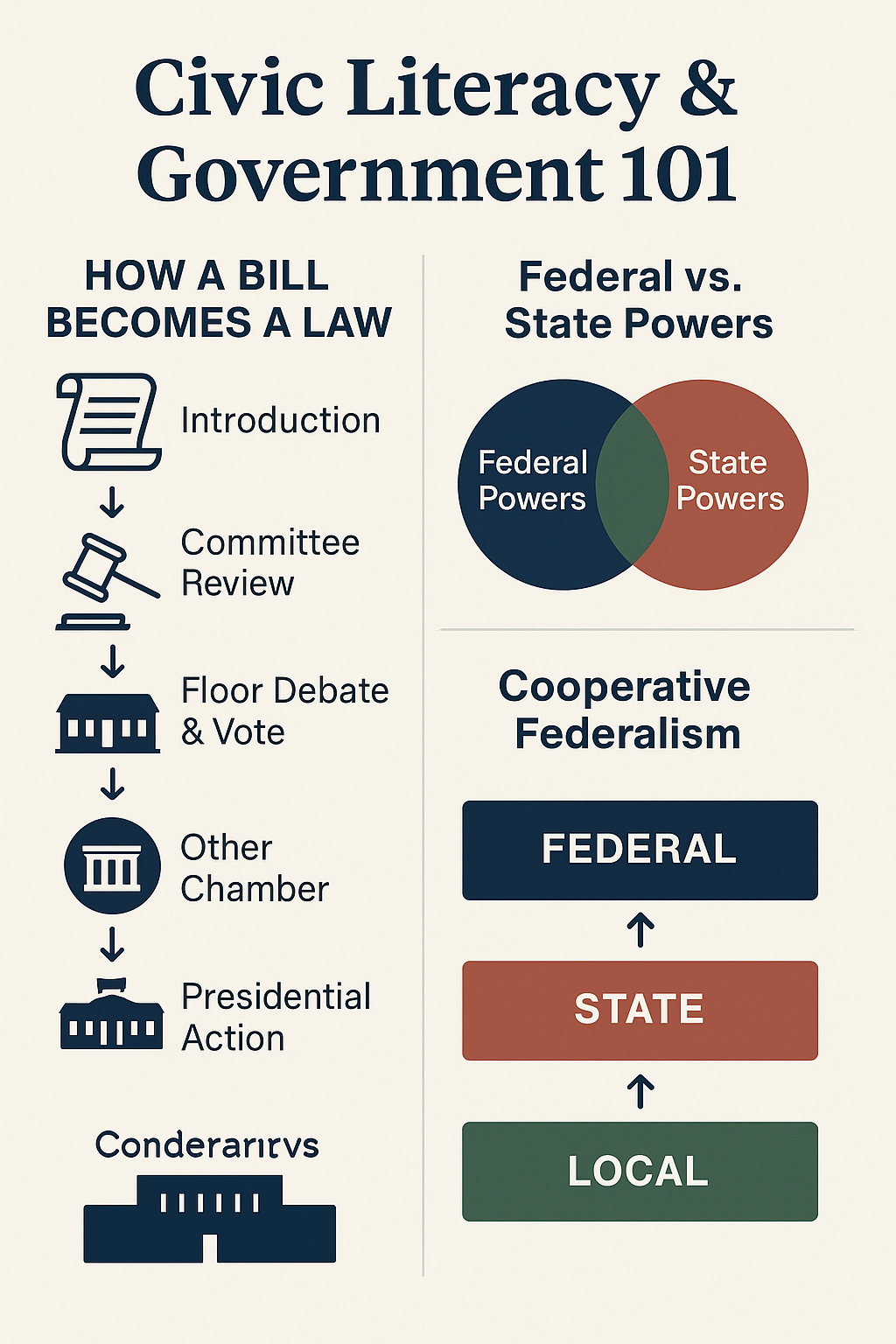
How a Bill Becomes a Law

The legislative process in the United States is often taught as a simple flowchart, but in practice it is a complex negotiation among institutions, interests, and procedures. Understanding these steps is essential for civic literacy because each stage reveals how democratic accountability and policymaking power actually operate.
1. Introduction and Sponsorship.
A bill begins when a member of Congress—either in the House of Representatives or the Senate—formally introduces it. This step is more than symbolic. The identity of a bill’s sponsor (and its co-sponsors) signals political priorities, ideological framing, and potential coalition partners. Introduction also reflects the representational function of Congress: legislators bring the concerns of their districts and states into the national agenda.
2. Committee System.
Most bills never make it out of committee, which is why committees are often described as the “gatekeepers” of Congress. Committees hold hearings, invite expert testimony, draft amendments, and decide whether the bill advances. For students of government, this demonstrates two key dynamics: (a) specialization—members build expertise in policy areas like agriculture or foreign affairs; and (b) interest-group politics—committees are frequent targets of lobbying because their jurisdiction gives them disproportionate influence.
3. Floor Debate and Chamber Vote.
If a bill clears committee, it proceeds to the full chamber. Here, institutional rules matter. In the House, the Rules Committee tightly structures debate, limiting amendments and time. In the Senate, by contrast, traditions of extended debate (filibusters) can empower minorities to block legislation unless a supermajority invokes cloture. This stage exemplifies the tension between majoritarian principles and institutional protections for minority rights.
4. Bicameral Passage.
Because the Constitution requires approval from both chambers, the House and Senate must reconcile differences in their versions of the bill. This “bicameralism” ensures that legislation reflects the perspectives of both population-based representation (the House) and state-based representation (the Senate). The process embodies federalism within Congress itself: laws must gain support across different constituencies and institutional logics.
5. Conference Committee and Final Vote.
When the House and Senate pass different versions, a conference committee negotiates a compromise text. Both chambers then vote on this unified version. This step highlights the iterative and negotiated nature of lawmaking—bills are rarely identical to their original form. Instead, they evolve as legislators trade provisions, seek consensus, and balance political feasibility with policy ambition.
6. Presidential Action.
Once passed by both chambers, the bill is sent to the President, who can sign it into law or veto it. A veto is not absolute: Congress may override with a two-thirds majority in both chambers. This final step reflects the separation of powers: executive authority provides a check on legislative output, while Congress retains the capacity to insist on its will if support is broad enough.
Why This Process Matters.
Studying how a bill becomes law is not just a civics exercise; it illustrates the core design principles of the American system—checks and balances, bicameralism, federalism, and democratic responsiveness. Citizens who understand this process are better equipped to track legislation, know when their input is most influential (for example, during committee hearings or public comment periods), and evaluate claims about how quickly or slowly “Washington acts.”
In short, every step of the legislative process is a window into the logic of self-government: no single actor dominates, compromise is inevitable, and lawmaking is deliberately designed to be both participatory and constrained.
Federal vs. State Powers: Understanding the Balance

The Constitution explicitly grants certain powers to the federal government, particularly in Article I, Section 8. These are often called enumerated powers, and they establish the federal government’s authority to address issues that affect the nation as a whole.
- National defense and foreign affairs: Congress declares war, funds the military, and the President directs foreign policy.
- Monetary system: Only the federal government can print and coin money, ensuring uniform currency.
- Regulating interstate and international commerce: This allows Congress to prevent trade barriers between states and manage economic relations abroad.
- Immigration and naturalization: The federal government sets policies for who can enter and become a citizen.
Beyond these, the Necessary and Proper Clause (also known as the Elastic Clause) allows the federal government to exercise implied powers—those not explicitly stated but deemed necessary to carry out constitutional duties. For instance, establishing the Internal Revenue Service (IRS) to collect taxes.
State Powers (Reserved)
Under the Tenth Amendment, powers not delegated to the federal government are reserved to the states or the people. These are called reserved powers, and they ensure that states retain authority over issues closest to their citizens.
- Education policy: States determine curriculum standards, fund local school systems, and oversee public universities.
- Public safety and policing: States regulate law enforcement, public health, and criminal justice.
- Local governance and elections: States manage voter registration, conduct elections, and determine districting for representation.
- Family and property law: Marriage, divorce, adoption, inheritance, and property rights are largely state-controlled.
This means life can look different from one state to another—for example, driver’s license requirements, health insurance regulations, or even laws on marijuana use.
Shared Powers (Concurrent)
Some responsibilities are shared by both federal and state governments, reflecting their mutual interest in the nation’s stability.
- Taxation: Both can levy taxes on individuals and businesses.
- Infrastructure: Federal and state governments cooperate on building and maintaining highways, bridges, and public works.
- Court systems: States run their own courts, but federal courts ensure national legal standards are upheld.
- Public health and welfare: Programs like Medicaid involve both federal funding and state-level administration.
The Importance of Cooperative Federalism
Although powers are divided, in practice the lines often blur. Federal funding tied to national priorities (such as education or healthcare) gives Washington influence over state policy. This system of cooperative federalism encourages collaboration but also creates ongoing tension about where the boundary between state and federal authority should lie.
A classic example is healthcare: while states manage Medicaid enrollment, federal law establishes minimum eligibility standards and funds much of the program. Similarly, federal civil rights protections override state laws that might permit discrimination.
What is Cooperative Federalism?

Cooperative federalism describes a system in which the federal and state governments work together to solve national and local problems, often sharing responsibilities, costs, and authority. Unlike a rigid “layer cake” model—where each level of government operates in its own distinct sphere—cooperative federalism is often called a “marble cake” model because the roles of federal and state powers are blended and overlapping.

Historical Development
- Founding Era – Dual Federalism: In the early Republic, the relationship between state and federal governments was more separate. States largely managed local affairs, while the national government focused on foreign policy, defense, and interstate commerce.
- The New Deal (1930s): Cooperative federalism took shape during Franklin D. Roosevelt’s New Deal. To respond to the Great Depression, the federal government expanded its role in economic regulation and social welfare programs, but relied heavily on states to administer them (e.g., unemployment insurance, public works programs).
- Civil Rights & Great Society (1960s): The federal government set national standards for civil rights and poverty reduction, but states implemented policies such as Medicaid, food stamps, and education funding. This reinforced a pattern of federal standards + state administration.
Key Features of Cooperative Federalism
- Shared Funding: Federal grants provide money for programs, but states must also contribute. For example, Medicaid requires state-level investment alongside federal funds.
- National Standards with Local Flexibility: Congress sets broad policy goals (such as clean air standards), but states decide how to meet them.
- Intergovernmental Partnerships: Federal, state, and local agencies coordinate to avoid duplication and ensure consistent implementation.
- Conditional Grants & Incentives: The federal government often uses funding to influence state policy. For instance, the federal highway funds in the 1980s were tied to states raising the drinking age to 21.
Benefits of Cooperative Federalism
- Efficiency: Federal government provides resources, while states use their local knowledge to implement programs effectively.
- Innovation: States can experiment with different approaches within national guidelines (“laboratories of democracy”).
- Equity: Ensures minimum standards for civil rights, healthcare, and education across states, preventing extreme inequality.
Challenges and Criticisms
- Blurred Accountability: When federal and state governments share authority, it is often unclear who is responsible when programs fail.
- Federal Overreach: Critics argue that conditional grants allow Washington to pressure states into compliance, eroding state sovereignty.
- Uneven Outcomes: Wealthier states may implement programs more effectively, while poorer states struggle despite federal assistance.
Modern Examples
- Healthcare: Medicaid expansion under the Affordable Care Act highlights cooperative federalism—federal funds were offered, but states could choose whether to expand coverage.
- Education: Programs like “No Child Left Behind” and “Every Student Succeeds Act” set federal standards, but left testing and accountability to the states.
- Disaster Relief: Federal Emergency Management Agency (FEMA) provides resources, while states handle on-the-ground response.
In short, cooperative federalism is the intertwining of national vision and local action—a system where both levels of government depend on each other to govern effectively.
Why This Knowledge Empowers Us

Understanding how government works is not just a matter of academic interest—it is a form of civic power. When citizens know how laws are made, how responsibilities are divided between federal and state governments, and how cooperation between levels of government functions, they are better equipped to protect their rights, hold leaders accountable, and actively shape the communities they live in.
1. Strengthening Individual Agency
Civic knowledge transforms people from passive observers into active participants. For example:
- Knowing the legislative process helps citizens understand when and how to voice support for or opposition to a bill.
- Understanding federal vs. state powers clarifies which elected officials—senators, governors, city council members—can address particular issues.
- Recognizing the dynamics of cooperative federalism reveals how local and national voices converge, ensuring that advocacy efforts are directed at the right level of government.
When people know the “rules of the game,” they can navigate government systems with confidence instead of frustration or apathy.
2. Guarding Against Misinformation
In an age of polarized media and political rhetoric, misinformation thrives when citizens lack clarity about government structures. Knowledge of federalism, constitutional boundaries, and shared powers acts like a filter:
- It helps citizens spot exaggerations or false claims about what government can and cannot do.
- It reduces susceptibility to fear-based narratives that exploit civic ignorance.
- It equips individuals to check sources and engage in fact-based discussions rather than reacting to soundbites.
3. Building Stronger Communities
Civic literacy is contagious. When individuals understand government, they can share that knowledge with neighbors, family, and colleagues, creating a ripple effect. Informed citizens are more likely to:
- Participate in local elections, where turnout is often low but decisions have direct community impact.
- Collaborate with others to petition for change, advocate for fair policies, or volunteer in civic initiatives.
- Support accountability in both state legislatures and Congress, ensuring that elected officials remain responsive to their constituents.
Communities empowered by civic knowledge are harder to divide, easier to mobilize, and more resilient in times of crisis.
4. Advancing Justice and Equity
Historically, marginalized groups have often been excluded from civic processes not only through legal barriers but also through educational gaps in civic understanding. Strengthening knowledge about how power is distributed and exercised can:
- Equip underrepresented voices to advocate for policy reform.
- Help communities identify which level of government to hold accountable for systemic inequities (e.g., education funding disparities or healthcare access).
- Enable citizens to use constitutional mechanisms—like the courts, state constitutions, and federal protections—to demand fairness and equity.
5. Nurturing Democratic Resilience
Finally, civic knowledge is the foundation of democracy itself. A self-governing people cannot make wise choices if they do not understand the structures they are voting to shape. Knowledge empowers us to:
- Distinguish between political disagreement and constitutional violation.
- Recognize when checks and balances are working as intended—or when they are being eroded.
- Participate in reforms that make the system more inclusive, transparent, and accountable.
In short, civic literacy is not abstract trivia—it is practical empowerment. When we understand the “machinery” of government, we realize that we are not merely subjects of politics but stakeholders and stewards of our democracy.
Further the Discussion
Civic literacy goes beyond memorizing facts about government structures or historical dates. It is about applying knowledge to the pressing challenges of our time—bridging the gap between classroom learning and real-world citizenship. True civic understanding equips us to analyze problems, weigh competing solutions, and participate constructively in shaping our democracy.
To put this into practice, consider these reflection questions designed to spark meaningful dialogue:
- Reducing Division: How might stronger civic education programs equip citizens to recognize common ground and reduce the polarization that dominates American politics?
- The Role of Schools: Should public schools take a more active role in teaching students not only about federal vs. state powers but also how those powers impact their daily lives?
- Shared Responsibility: Can cooperative federalism—where state and federal governments collaborate—offer more effective solutions to nationwide issues such as healthcare reform, infrastructure investment, or climate change?
- Trust and Accountability: How could increased civic literacy help restore confidence in government institutions, encouraging citizens to see themselves as partners in governance rather than outsiders looking in?
By engaging with questions like these, we move from being observers of the democratic process to active participants in it. Civic literacy becomes not only a tool for personal empowerment but also a catalyst for stronger communities and a healthier democracy.
We’d love to hear from you!
Share your thoughts in the comments or bring these questions into your next community or classroom discussion. Civic literacy grows stronger when we learn together.