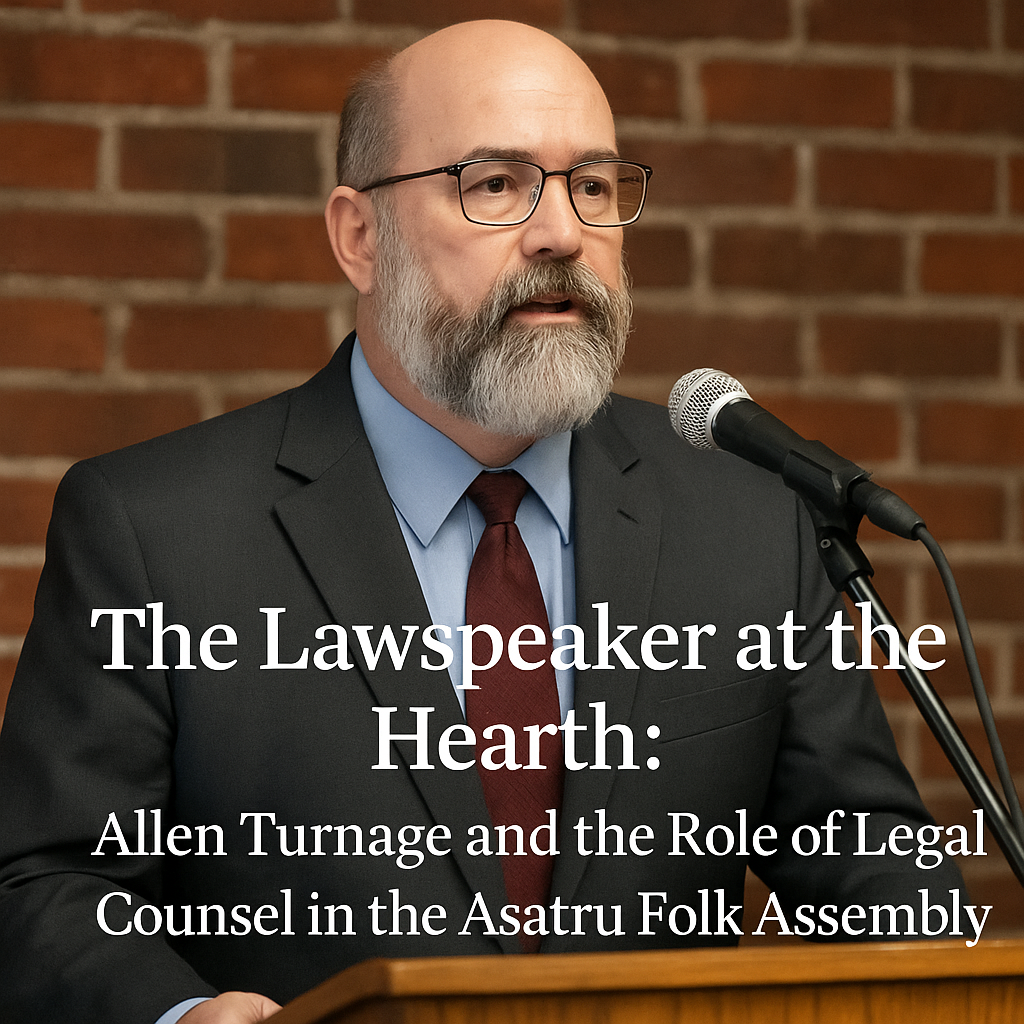
Exploring the Intersection of Faith, Law, and Identity in Modern Heathenry Through the Figure of AFA’s Lawspeaker
Modern Heathen and Ásatrú movements represent a unique convergence of ancient religious revivalism and the bureaucratic realities of the twenty-first century. These movements often strive to reconstruct the spiritual and cultural frameworks of pre-Christian Northern Europe, while simultaneously operating within modern legal, social, and organizational systems. Within this tension between the ancestral and the administrative, symbolic titles such as Lawspeaker are not merely decorative—they function as bridges between historical identity and contemporary institutional governance.
The Asatru Folk Assembly (AFA), one of the most visible and controversial Heathen organizations in the United States, provides a compelling case study of this dynamic. Founded in the 1990s, the AFA situates itself as the modern inheritor of Norse religious tradition, emphasizing ancestry, kinship, and folk identity as sacred principles. At the center of its leadership structure is the position of Lawspeaker—a title drawn directly from early Icelandic legal assemblies (Alþingi) where a lögsögumaðr preserved and recited communal law. In the AFA’s context, this title carries both spiritual and administrative weight, symbolizing continuity with ancient Germanic governance while serving as a modern mechanism for legal oversight and organizational order.
Currently, the position is held by Allen Turnage, a practicing attorney whose dual identity as both legal professional and religious official encapsulates the delicate balance between governance, belief, and ethics in contemporary Ásatrú. Turnage’s role extends beyond ceremonial symbolism; he functions as a legal advisor, spokesperson, and arbiter of internal and external disputes involving the AFA. This blending of legal authority with spiritual leadership raises critical questions about how religious movements that revive premodern traditions adapt to the structural and ethical demands of modern society.
This blog post approaches the subject from a nonpartisan and analytical perspective, examining the Lawspeaker’s role within the AFA as a lens through which to explore broader themes of religious authority, institutional accountability, and identity politics in reconstructed pagan movements. It investigates how the AFA’s leadership model reflects the intersection of ancient custom and modern law, how Turnage’s legal expertise influences the group’s governance and public posture, and what this convergence reveals about the evolving relationship between faith, legality, and social legitimacy in the modern world.
The Role of Lawspeaker: Tradition Meets Administration
Historical Roots of the Lawspeaker
In pre-Christian Nordic societies, the lögsögumaðr—or lawspeaker—occupied one of the most esteemed and indispensable roles within the community’s legal and political structure. Far more than a mere reciter of laws, the lawspeaker served as the living embodiment of societal order and memory, responsible for ensuring that justice was both remembered and enacted in accordance with established custom (Byock, 2001). At a time when written law was scarce and literacy limited, the lawspeaker’s voice functioned as the repository of the community’s collective conscience.
During things—the public assemblies of free men that governed early Scandinavian polities—the lawspeaker stood at the center of deliberation, reciting from memory the laws that bound the people together. His task was not simply to repeat statutes verbatim but to interpret them within the moral and social contexts of the disputes brought before the assembly. The office demanded exceptional intellect, eloquence, and impartiality. The lawspeaker was expected to know the law “by heart,” but also to embody the virtues of wisdom (vit), fairness (réttlæti), and restraint (mildr), ensuring that order prevailed over vengeance and that custom tempered emotion (Byock, 2001; Miller, 1990).
Symbolically, the lawspeaker represented continuity between generations—linking ancestral knowledge to living practice. His recitations at the Alþingi (the Icelandic general assembly) reaffirmed not only the content of law but also the legitimacy of the social order itself. The position thus functioned as both legal and spiritual office: the lawspeaker was the voice through which the community remembered who it was and how it should live. In this sense, he was the moral compass of a culture in which the law was regarded as sacred inheritance rather than state decree.
The prestige of the lawspeaker also reflected the democratic character of early Nordic governance. Unlike monarchs or clerics, he was elected by the free men of the assembly for a fixed term, signaling that law derived its authority from the consent of the governed, not divine mandate or hereditary privilege (Byock, 2001). This made the lawspeaker a bridge between authority and autonomy, between oral tradition and emerging legal consciousness.
In summary, the lögsögumaðr embodied the core values of continuity, wisdom, and justice in Norse society. His presence ensured that collective memory guided communal life, making him both the keeper of law and the guardian of identity. The reverence accorded to this role in ancient Scandinavia explains why modern Ásatrú organizations, such as the Asatru Folk Assembly, have sought to revive the title: it evokes not only ancestral heritage but also the ideal of an ethical leader who unites legal understanding with moral insight.
The Modern AFA Lawspeaker
Within the Asatru Folk Assembly (AFA), the position of Lawspeaker represents both a revival of ancient tradition and a functional cornerstone of modern religious administration. The AFA deliberately draws upon the pre-Christian Nordic concept of the lögsögumaðr, transforming it into a leadership office that integrates the spiritual ideals of ancestral wisdom with the legal and bureaucratic demands of a contemporary nonprofit religious organization. In this capacity, the Lawspeaker serves as a dual figure—both a custodian of the organization’s historical narrative and a practitioner of modern governance.
According to the AFA’s official materials, the Lawspeaker occupies a central role within the organization’s governing body, the Witan, which functions as an advisory council to the Alsherjargothi, or high priest (Asatru Folk Assembly, n.d.-a). The Witan collectively provides oversight and counsel on matters of law, organizational ethics, and policy development, ensuring that the AFA’s operations align with both its ideological mission and the regulatory requirements imposed by U.S. nonprofit law. Within this structure, the Lawspeaker’s explicit function is to offer “knowledge regarding law and legalese” and to interpret those principles in ways that support the AFA’s internal coherence and external legitimacy (Asatru Folk Assembly, n.d.-a).
The current Lawspeaker, Allen Turnage, is a practicing attorney whose professional expertise shapes the contemporary expression of this ancient office (Asatru Folk Assembly, n.d.-b). Turnage’s responsibilities extend beyond ceremonial duties, encompassing the practical aspects of property management, contract negotiation, and compliance with state and federal regulations that govern religious corporations. His role also includes serving as the public legal representative for the AFA in matters of zoning, land use, and public communication—areas that have historically generated controversy and media scrutiny for the organization.
By merging legal expertise with symbolic authority, the Lawspeaker operates as a hybrid figure, one who simultaneously embodies mythic continuity and administrative necessity. On a symbolic level, the title invokes the memory of Norse assemblies and the ideal of law as sacred speech—a moral covenant between the people and their ancestors. On a practical level, however, the modern Lawspeaker is tasked with interpreting secular law, drafting legal documents, and managing the risk assessments necessary to maintain the AFA’s institutional survival. This juxtaposition of sacred heritage and pragmatic governance encapsulates the organization’s attempt to harmonize ancient values with contemporary legal structures.
Moreover, the AFA’s use of the Lawspeaker title reflects a conscious strategy to fuse identity with authority. It situates the group within a lineage that appears both culturally authentic and organizationally stable. Yet, this synthesis also highlights the paradox inherent in many modern reconstructionist religions: in seeking to resurrect the past, they must inevitably translate it through the language of modern legality. The result is a leadership model that functions at two levels—ritual and regulatory—each informing the other in the ongoing project of maintaining religious legitimacy in a pluralistic and legally complex society.
Thus, the Lawspeaker’s office within the AFA stands as a vivid example of how ancient symbolism can be repurposed to meet modern institutional needs. It is at once a tribute to ancestral tradition and an acknowledgment that survival in the modern world requires fluency not only in myth and ritual but also in the legal frameworks that govern contemporary religious life.
Allen Turnage: Public Profile and Representation
Professional and Organizational Identity
Allen Turnage, a licensed attorney based in Florida, plays a pivotal dual role within the Asatru Folk Assembly (AFA), serving not only as the organization’s Lawspeaker—a title rooted in Norse tradition signifying the keeper and interpreter of law—but also as a key legal strategist. As a publicly listed member of the AFA clergy, Turnage provides both spiritual leadership and legal infrastructure, helping to formalize and defend the organization’s often controversial operations. His legal acumen has been central to the AFA’s efforts to acquire property and navigate zoning regulations across multiple states. A notable example of this was his representation of the AFA during a 2020 public hearing in Murdock, Minnesota, where community members raised concerns over the group’s attempt to establish a whites-only worship space in a residential neighborhood. In that hearing, Turnage defended the AFA’s constitutional rights to religious assembly, positioning the group’s activities within the framework of lawful religious expression—despite significant public backlash and accusations of racial exclusionism (Star Tribune, 2020).
Public Controversy and Media Coverage
During the contentious 2020 zoning hearing in Murdock, Minnesota, Allen Turnage—acting both as the Asatru Folk Assembly’s legal representative and its Lawspeaker—openly affirmed that AFA membership is explicitly restricted to individuals of Northern European descent. He justified this exclusionary policy by asserting that Ásatrú, as practiced by the AFA, is “specifically a Northern European religion,” and thus intrinsically tied to ancestral heritage (Star Tribune, 2020). Turnage’s rhetoric, including statements endorsing “strong, healthy white family relationships” and the deliberate exclusion of non-European applicants, ignited widespread public criticism and underscored the group’s ethno-nationalist underpinnings.
Beyond this singular event, Turnage’s influence within the AFA extends to its material expansion. According to the Southern Poverty Law Center (2021), he has played a central role in legal negotiations and structuring real estate acquisitions used to establish “hofs”—AFA’s places of worship—across various U.S. states. The SPLC categorizes the AFA as a “whites-only” religious organization, linking it to a broader trend of racial separatism masked as cultural preservation.
Turnage’s dual function—as both a legal authority and a religious leader—affords him considerable power in shaping how the organization presents itself legally and publicly. His words and actions at public forums like the Murdock hearing serve not only as legal defenses but also as ideological affirmations, demonstrating how legal expertise can be mobilized to legitimize exclusionary religious frameworks. This convergence of legal strategy and religious rhetoric amplifies the AFA’s visibility and helps insulate it from certain legal challenges, even as public backlash and watchdog reports intensify scrutiny of the group’s racially restrictive doctrines.
Function, Challenges, and Tensions
Governance Versus Symbolism
The Lawspeaker’s dual purpose—legal administrator and symbolic guardian—creates structural tension. Modern religious organizations like the AFA must comply with nonprofit law while maintaining internal doctrinal consistency. The Lawspeaker thus navigates between pragmatic legal considerations (e.g., zoning, land ownership, tax status) and ideological commitments to ethnic and ancestral identity (Asatru Folk Assembly, n.d.-b).
This duality raises key questions: To what extent should legal strategy influence theological identity? Can a group claim both heritage exclusivity and equal legal protection?
Ethical and Public Accountability
Given the Lawspeaker’s internal advisory power and public visibility, issues of accountability arise. When the same person provides legal counsel and public defense, transparency becomes vital. Turnage’s public remarks have drawn scrutiny regarding the intersection of religious freedom and racial exclusivity (Southern Poverty Law Center, 2021). Such cases highlight the need for clearer boundaries between legal representation and moral advocacy.
External Perception and Social Legitimacy
The Lawspeaker’s statements during public hearings—while legally framed—shape public perception of Ásatrú in America. In this sense, Turnage’s role extends beyond advising the AFA; it also defines how outsiders understand Heathen faith movements (Star Tribune, 2020). Legal legitimacy and social acceptance, though distinct, increasingly overlap in modern religious institutions.
The Broader Question: Religion, Identity, and Law
The case of the Asatru Folk Assembly (AFA) offers an important lens through which to examine the evolving intersection of law, faith, and identity in the United States. While the Constitution safeguards the free exercise of religion under the First Amendment, that protection becomes complex when religious organizations define their membership through explicitly ethnic or racial criteria (Sullivan, 2018). Such groups inhabit a legally ambiguous terrain — protected as private religious associations in some respects, yet vulnerable to scrutiny when their practices appear to contradict the nation’s broader commitment to equality and nondiscrimination.
This tension is not unique to the AFA but emblematic of broader cultural and legal debates about how far religious freedom can extend when it collides with civil rights norms. The United States’ legal system continually negotiates these boundaries, attempting to balance the right to religious self-definition with the responsibility to prevent exclusionary or harmful practices (U.S. Commission on Civil Rights, 2016).
Religious Freedom vs. Anti-Discrimination Norms
The principle of religious freedom grants organizations considerable latitude in shaping doctrine, leadership, and internal culture. However, this autonomy is not absolute. Courts have consistently ruled that religious entities cannot use belief as a blanket justification for discriminatory acts that harm individuals or communities outside their faith structure (U.S. Commission on Civil Rights, 2016). In the case of the AFA, the group’s racially exclusive membership policies raise a pressing question: where is the line between preserving cultural heritage and engaging in racial exclusion?
This issue underscores a broader legal paradox — while faith groups may claim constitutional protection for religious expression, those protections cannot override the equal protection guarantees that underpin American civil law. As such, religious freedom and anti-discrimination principles remain locked in a delicate and ongoing dialogue.
Symbolism vs. Administration
The AFA’s use of traditional Norse titles, such as Lawspeaker, embodies the desire to link contemporary practice to ancestral heritage. Yet, this symbolic revival can sometimes obscure the bureaucratic reality of modern religious organizations. Beneath the romanticized imagery of ancient councils and sacred law often lie hierarchical power structures, legal incorporation documents, and administrative oversight.
This duality—between mythic symbolism and modern governance—raises important sociological questions about authenticity and authority. When religious movements rely heavily on reconstructed tradition, they risk prioritizing historical aesthetics over transparent, ethical leadership. In the AFA’s case, the Lawspeaker serves not only as a link to Nordic heritage but also as a corporate officer responsible for compliance and legal defense—an intersection where myth meets management.
Internal Accountability
When spiritual leadership and legal authority converge within a single role, as in the office of the Lawspeaker, mechanisms of accountability become crucial. Without internal checks and democratic participation, decision-making can become insular or authoritarian. Concentrating power in dual legal-spiritual offices risks transforming advisory positions into instruments of ideological enforcement rather than reflection.
Transparent governance, peer review, and external consultation are therefore essential safeguards against extremism. In the absence of such measures, organizations like the AFA may unintentionally reinforce echo chambers that validate exclusionary interpretations of faith. This dynamic demonstrates how the concentration of both legal and moral power within one role can compromise the ethical balance that religious institutions must maintain.
Public Legitimacy
Religious legitimacy in pluralistic societies depends not only on theological consistency but also on public trust. When legal representatives or spiritual leaders espouse exclusionary ideologies, they risk alienating broader communities and undermining the moral credibility of their movement. In today’s interconnected media environment, statements made by a single spokesperson can define the entire organization in the public consciousness.
For groups like the AFA, whose doctrines already challenge social norms about inclusion and diversity, public communication plays a decisive role in shaping perception. Legal defense strategies may preserve institutional rights, but moral legitimacy—especially in a diverse society—requires openness, humility, and the capacity for dialogue. Once lost, legitimacy is difficult to regain, regardless of legal standing or constitutional protection.
The AFA’s situation ultimately reveals that the boundaries between law, faith, and identity are neither fixed nor easily defined. Each sphere exerts pressure on the others, forcing religious communities to confront uncomfortable questions about autonomy, ethics, and belonging. In a pluralistic democracy, the measure of true religious freedom is not how far it can stretch to justify exclusion, but how well it coexists with the shared values of dignity, equality, and mutual respect.
Conclusion
Allen Turnage’s tenure as Lawspeaker of the Asatru Folk Assembly (AFA) encapsulates the tension that arises when ancient cultural symbols are recontextualized within modern social and legal systems. The title of Lawspeaker—once a role grounded in communal memory and oral jurisprudence—now operates within a vastly different landscape defined by corporate governance, civil rights law, and media visibility. In this environment, Turnage’s dual role as both attorney and religious officer blurs the boundaries between pragmatic legality and moral philosophy. He embodies a paradox: serving as both a guardian of tradition and a negotiator within a contemporary legal framework that often challenges the very premises of the organization he represents.
The convergence of legal expertise and religious leadership highlights a fragile equilibrium between governance, belief, and ethics. As an attorney, Turnage must navigate legal compliance and constitutional protection; as Lawspeaker, he must uphold a worldview that defines belonging through ancestry and heritage. These dual obligations place him at the crossroads of two systems—one committed to universal legal equality, the other to a particularist notion of faith and identity. The result is a living case study in the limits of religious freedom when belief systems intersect with ideologies that restrict membership based on ethnicity or lineage.
More broadly, Turnage’s role invites reflection on the evolving relationship between religion and law in pluralistic societies. Legal institutions often function as arbiters of fairness, while religious institutions claim authority over moral and cultural meaning. Yet, when these domains overlap, they do not simply coexist—they continually reshape one another. Religious movements must reinterpret ancient traditions to survive within modern constitutional orders, while legal frameworks must continually reassess the boundaries of freedom, tolerance, and discrimination.
Ultimately, the Lawspeaker’s example underscores that neither religion nor law exists in isolation. Each defines and constrains the other, revealing that the ongoing dialogue between faith and legality is not a matter of coexistence, but of continuous negotiation. In Turnage’s case, that negotiation exposes the profound question at the heart of modern pluralism: Can freedom of religion truly flourish when the exercise of belief excludes the very diversity that freedom is meant to protect?
Future Implications and Wider Consequences
The Asatru Folk Assembly’s (AFA) organizational structure and ideological orientation raise far-reaching questions about the evolving relationship between religion, law, and identity in the United States. While the AFA represents a small segment of modern Heathenry, its public visibility, legal battles, and claims to ancestral legitimacy reveal larger cultural trends that may shape the future of religious pluralism and freedom of association. The role of the Lawspeaker—especially when embodied by a licensed attorney such as Allen Turnage—stands at the crossroads of these issues, illustrating how religious movements can both challenge and test the boundaries of democratic tolerance.
1. Legal Precedent and the Future of Religious Autonomy
One significant implication concerns the potential legal precedents surrounding religious freedom versus anti-discrimination enforcement. If groups like the AFA continue to defend racially exclusive membership policies under the First Amendment, courts may be forced to clarify where religious autonomy ends and civil protection begins. This legal friction could influence how future faith-based organizations—both mainstream and alternative—structure their bylaws, membership criteria, and leadership hierarchies.
Cases involving groups such as the AFA may also inform how nonprofit status is evaluated under federal law. The Internal Revenue Service and state regulators could eventually face pressure to reconsider the tax-exempt status of organizations whose exclusionary principles conflict with public policy. The outcome of such challenges would reverberate far beyond Heathenry, potentially reshaping the operational frameworks of religious corporations that assert culturally specific or ethnically bounded identities.
2. The Evolution of Religious Identity in a Pluralistic Society
The AFA’s emphasis on ancestry and ethnicity as sacred categories also forces modern society to grapple with the question of how identity-based spirituality fits into an increasingly multicultural landscape. The organization’s interpretation of Ásatrú—centered on Northern European descent—highlights the broader struggle of many religious movements attempting to reconcile heritage preservation with inclusivity.
In future decades, this tension could lead to deeper divides between “folkish” and “universalist” factions within modern paganism, mirroring the denominational schisms seen in other world religions. Such divisions may redefine what it means to claim authenticity in reconstructed traditions: Is heritage-based faith a legitimate form of cultural self-determination, or does it risk reinforcing exclusionary ideologies under the guise of spirituality? The answer will likely shape the ethical and theological discourse within neo-pagan communities for generations to come.
3. Ethical and Sociopolitical Ramifications
Beyond internal religious debates, the AFA’s ideology has broader sociopolitical implications. By framing racial identity as both sacred and legal category, the group participates in a wider cultural trend that blurs the line between ethnonationalism and spirituality. This intersection raises concerns about the potential normalization of exclusionary ideologies within spaces traditionally protected by religious freedom.
If such ideologies gain institutional legitimacy, other groups may adopt similar frameworks, citing faith as justification for racially or ethnically segregated practices. The result could be a more fragmented civil sphere, where the language of religion is used to shield prejudice from critique. This possibility underscores the need for ongoing public discourse about the ethical responsibilities of both religious leaders and the legal professionals who advise them.
4. Impacts on Public Perception and Interfaith Relations
The AFA’s public image, shaped in part by its Lawspeaker’s statements and actions, also affects broader perceptions of modern Heathenry. Many practitioners of Ásatrú and other pagan traditions distance themselves from the AFA’s exclusionary policies, advocating instead for inclusivity and cultural appreciation. However, the media’s frequent association of Heathen symbols with extremist movements risks tainting the wider pagan community, fostering misunderstanding and mistrust.
Future interfaith collaboration will likely depend on how effectively inclusive Ásatrú groups differentiate their beliefs from racially restrictive ones. If groups like the AFA remain in the public spotlight, their actions could either galvanize reform within Heathen circles—encouraging clearer ethical standards—or entrench polarization by reinforcing stereotypes about paganism and extremism.
5. Philosophical Consequences: The Law as a Mirror of Belief
Finally, the AFA’s model demonstrates how religious and legal frameworks continuously shape one another. When law becomes a tool for protecting exclusivity rather than equality, it reflects not only the limits of legislation but also the moral values of the culture that sustains it. The Lawspeaker’s position—bridging ancient symbolism and modern jurisprudence—therefore becomes a powerful metaphor for the American experiment itself: a system striving to uphold freedom while preventing that very freedom from undermining the principles of justice.
The future of religious freedom will depend on maintaining this balance. The challenge is not simply whether groups like the AFA should be permitted to exist, but how society defines the boundaries between belief as a private right and belief as a public act with social consequences. In this respect, the AFA is not an anomaly but a reflection of ongoing tensions within democracy itself: the struggle to honor diversity without allowing diversity to justify division.
Deeper Thought & Discussion Questions
Religion, Identity, and Law
- How should modern societies balance religious freedom with anti-discrimination laws when a faith community defines itself in racial or ethnic terms?
- To what extent can claims of “ancestral religion” justify exclusivity without crossing into racial discrimination?
- How might the U.S. legal system interpret the AFA’s membership restrictions under the First Amendment?
Ethics and Accountability
- Should attorneys who represent or advise ideological organizations be held to higher ethical scrutiny when their legal work supports exclusionary ideologies? Why or why not?
- What safeguards might religious groups adopt to ensure internal accountability when one person—like a Lawspeaker—holds both legal and symbolic authority?
Public Perception and Representation
- How do public statements by religious leaders influence public trust or mistrust toward minority religions in America?
- Does the media have a responsibility to distinguish between faith-based heritage preservation and racial exclusivity when reporting on groups like the AFA?
Tradition vs. Modernity
- How does reviving ancient titles such as “Lawspeaker” impact the way modern followers perceive religious hierarchy and legitimacy?
- Can a movement simultaneously honor ancient traditions and adapt to pluralistic, modern values without compromising authenticity?
Broader Reflection
- What does the case of Allen Turnage and the AFA reveal about the evolving relationship between law, religion, and identity politics in the 21st century?
We Want to Hear From You
The questions raised in this discussion are complex and often deeply personal. The intersection of religion, law, and identity continues to shape our shared cultural landscape — and your voice matters in that dialogue.
How do you see the balance between religious freedom and social responsibility? Can a group preserve its ancestral heritage without crossing the line into exclusionary ideology? What does it mean for ancient traditions to exist within a modern, pluralistic society?
We invite readers, scholars, practitioners of Ásatrú, and those from other faith or philosophical backgrounds to share their insights and perspectives. Whether you wish to comment on the historical role of the Lawspeaker, the ethical dilemmas of faith-based governance, or the broader implications for religious liberty in today’s world, your reflections contribute to a richer, more nuanced conversation.
Join the discussion in the comments below — or submit a longer response for potential feature in our upcoming “Voices on Faith and Freedom” series. Let’s explore together how ancient wisdom and modern principles can inform one another in shaping the future of belief and belonging.
References
Asatru Folk Assembly. (n.d.-a). Clergy. Runestone. https://www.runestone.org/clergy
Asatru Folk Assembly. (n.d.-b). Contact the Witan. AFA Mail. https://mail.asatrufolkassembly.org/contact/witan.html
Byock, J. (2001). Viking age Iceland. Penguin Books.
Southern Poverty Law Center. (2021). How a whites-only group plans to turn rural Tennessee into its homeland. https://www.splcenter.org/resources/hatewatch/how-whites-only-group-plans-turn-rural-tennessee-its-homeland
Star Tribune. (2020, October 8). Big crowd in Murdock, Minn., grills representative of controversial Nordic heritage church. https://www.startribune.com/big-crowd-in-murdock-minn-grills-representative-of-controversial-nordic-heritage-church/572739031
Sullivan, W. F. (2018). The impossibility of religious freedom (2nd ed.). Princeton University Press.
U.S. Commission on Civil Rights. (2016). Peaceful coexistence: Reconciling nondiscrimination principles with civil liberties. https://www.usccr.gov