A nonpartisan look at the reasoning behind Democrats’ and Republicans’ shutdown strategies—and why partisanship hurts everyone.
Government shutdowns have evolved into a recurrent and disruptive fixture in the American political landscape. While ostensibly triggered by disagreements over federal spending, their underlying causes often run much deeper—anchored in entrenched ideological divides between the major political parties. These standoffs are no longer mere budgeting impasses; they reflect broader philosophical conflicts about the role of government, the scope of public services, and the use of institutional power to advance partisan agendas.
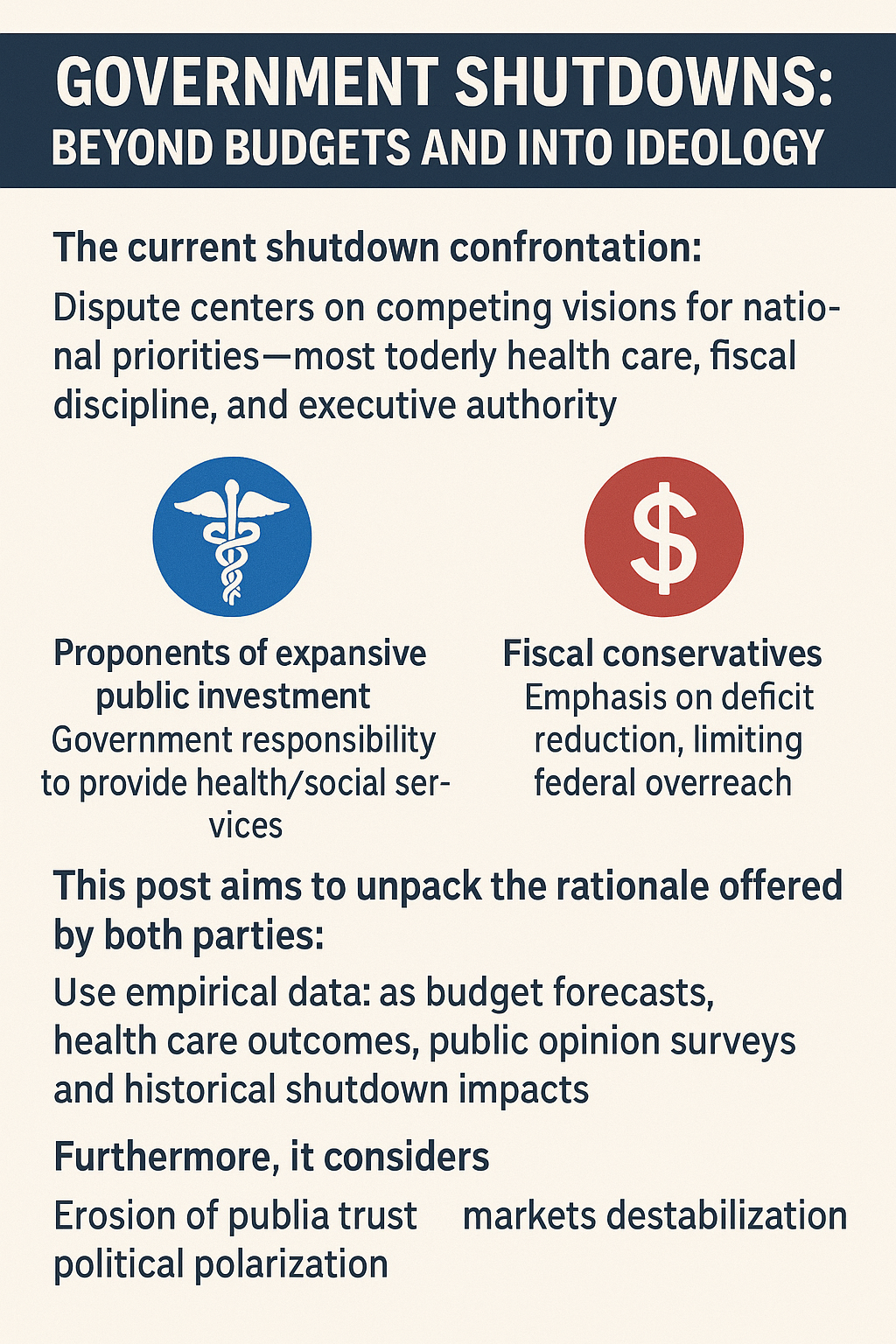
The current shutdown confrontation encapsulates this dynamic. At its core, the dispute centers on competing visions for national priorities—most notably in areas such as health care funding, fiscal discipline, and executive authority. On one side, proponents of expansive public investment argue that government has a moral and economic responsibility to provide robust health and social services, even if it entails increased federal expenditure. On the other, fiscal conservatives emphasize deficit reduction, controlled government spending, and limiting federal overreach, viewing shutdown threats as leverage to curb what they see as unsustainable growth.
This post aims to unpack the rationale offered by both the Democratic and Republican parties in the current impasse. Using empirical data—such as budget forecasts, health care outcomes, public opinion surveys, and historical shutdown impacts—it critically assesses the validity and consequences of each position. Furthermore, it considers how recurring shutdowns erode public trust in institutions, destabilize markets, delay essential government services, and contribute to long-term political polarization.
Ultimately, the goal is to move beyond partisan talking points to offer a balanced, evidence-based analysis of what government shutdowns reveal about the evolving nature of American governance—and what’s at stake if they persist as a political norm rather than an exception.
Democratic Framing of the Government Shutdown: A Defense of Health Equity and Legislative Leverage
In the current political standoff, Democrats present the government shutdown not as a partisan tactic, but as a defensive mechanism to protect foundational pillars of the American social safety net. At the heart of their argument is the preservation of health care access—particularly through sustained funding for Affordable Care Act (ACA) subsidies and Medicaid. Party leaders argue that without renewed federal support, millions of Americans would face unaffordable health insurance premiums, diminished coverage options, or outright loss of care access.

Key Democratic Arguments
1. Preserving Access to Affordable Health Coverage
Central to the Democratic position is the belief that the expiration of ACA tax credits would produce severe consequences for working- and middle-class families. According to Washington Post (2025), without congressional intervention, approximately 4 million Americans could lose their health insurance over the next decade. Democrats stress that rising premiums—especially in competitive health insurance markets—would disproportionately harm vulnerable populations. This aligns with previous analyses by the Congressional Budget Office (CBO, 2024), which concluded that ACA subsidies are a critical tool for reducing the uninsured rate and stabilizing individual marketplaces.
2. Using Legislative Leverage Strategically
Rather than acquiesce to a “clean” continuing resolution (CR)—a temporary funding bill with no policy provisions—Democrats argue that leveraging the shutdown is a rare opportunity to force negotiations on healthcare protections. As Senator Sheldon Whitehouse remarked in a recent interview (Fox News, 2025), “It’s the only lever we have.” This view reflects a broader concern among Democrats that failing to assert negotiating power now could result in long-term structural erosion of federal support for healthcare access.
3. Accountability and Economic Fairness
Democratic leadership has also positioned the shutdown debate within a broader moral and economic justice narrative. House Minority Leader Hakeem Jeffries characterized the impasse as a manufactured crisis created by Republican brinksmanship. He accused the GOP of engineering a “healthcare cost crisis” by threatening to cut ACA and Medicaid funding (Jeffries, 2025). Democrats maintain that defending Medicare, Medicaid, and the ACA is not only politically necessary, but a matter of public accountability and economic equity—particularly for low-income and historically underserved communities.
Empirical and Public Support for Democratic Framing
The Democrats’ position appears to resonate with public opinion. A Reuters (2025) national poll found that 67% of Americans place at least partial blame on Republicans for the current shutdown. This suggests that the public largely views the Democratic framing—as defenders of social programs—as credible and persuasive.
Furthermore, empirical evidence supports their claims about the policy impacts of ACA subsidies. The CBO (2024) has consistently reported that subsidy renewal leads to lower premiums, greater enrollment stability, and reduced federal outlays in emergency care over time—strengthening the case that such programs are not only socially just but fiscally prudent.
Republican Reasoning: Fiscal Discipline and Institutional Integrity in Budget Negotiations
The Republican position in the ongoing government shutdown reflects a broader commitment to fiscal restraint and procedural integrity in congressional budgeting. Rather than allowing contentious policy issues—such as health care funding—to dictate the terms of basic governance, Republicans emphasize that the primary obligation of Congress is to keep the federal government operational through timely passage of funding legislation.
Republican lawmakers are advocating for what they term a “clean continuing resolution (CR)”—a stopgap spending bill devoid of policy riders or controversial add-ons. Their argument is that using the threat of a shutdown to force policy concessions sets a dangerous precedent, one that undermines the regular appropriations process and invites future dysfunction, regardless of which party is in power (Associated Press, 2025).
Key Republican Arguments
1. Fiscal Responsibility and Budget Restraint
At the heart of the GOP’s position is a warning about long-term fiscal sustainability. Republican legislators argue that Democratic proposals—especially the expansion of ACA subsidies and Medicaid coverage—would significantly worsen the national deficit. According to estimates cited by the Washington Post (2025), such policies could add approximately $350 billion to the federal deficit over the next decade. This argument resonates with long-standing Republican concerns that unchecked entitlement growth and deficit spending could crowd out private investment, raise interest rates, and threaten future economic stability.
2. Preserving the Integrity of the Budgeting Process
Many Republicans also frame their opposition as a defense of the traditional appropriations framework. The shutdown, they argue, is a consequence of Democrats seeking to legislate through crisis rather than following regular order. According to a 2025 policy memo from the Brookings Institution, weaponizing funding bills for policy gains has become an increasingly common and dangerous tactic in U.S. politics. Republicans warn that allowing such practices to persist could further erode congressional norms, weakening the institution’s ability to carry out basic functions and negotiate in good faith.
3. Minimizing Broader Economic Disruption
GOP leaders contend that resolving the shutdown is the most immediate way to protect American families, federal workers, and small businesses. By separating funding questions from partisan policy fights, they argue, Congress could restore operational normalcy while creating space for more deliberative debate on health care and other controversial issues. As one Republican spokesperson told AP News (2025), “The shutdown punishes the public for political disputes that should be settled through regular committee work—not brinkmanship.”
Empirical and Political Validation of the Republican Perspective

Empirical evidence lends support to several aspects of the Republican position. Research from the Brookings Institution (2023) shows that government shutdowns typically reduce GDP growth by 0.1 to 0.3 percentage points per week, underscoring the economic damage that prolonged closures inflict. These impacts are especially felt by furloughed federal employees, delayed contractors, and sectors dependent on federal permits and oversight.
In terms of public sentiment, the GOP’s argument that Democrats also bear responsibility for the standoff is not without merit. A Reuters (2025) poll found that 63% of Americans believe Democrats share fair blame for the shutdown. This suggests that while Republicans have often been politically vulnerable during previous shutdowns, many voters today view the conflict as a shared failure of governance, rather than a one-sided obstruction.
Nonpartisan Analysis: What the Evidence Reveals About Shutdowns
From a nonpartisan, evidence-based perspective, government shutdowns are widely regarded as inefficient, disruptive, and ultimately counterproductive tools of political negotiation. While parties often frame them as necessary levers for achieving legislative concessions or signaling moral commitment, the empirical record suggests that shutdowns rarely yield meaningful long-term policy outcomes.
Extensive research on past closures—particularly the 2013 and 2018 shutdowns, which were among the most prolonged in modern U.S. history—shows minimal substantive gains for either party involved. A 2025 report by the Harvard Kennedy School analyzed legislative outcomes following those episodes and concluded that the shutdowns resulted in few, if any, structural policy changes, despite weeks of economic turbulence and public sector disruption. In both cases, the government was reopened under largely the same terms that existed prior to the standoff.
The Measurable Costs of Shutdowns
While the symbolic or rhetorical value of shutdowns may appeal to political bases, their tangible consequences are far more severe:
- Federal Workforce Disruption: Hundreds of thousands of federal employees face furloughs or are forced to work without pay during shutdowns. Back pay, though often authorized retroactively, does not mitigate the immediate financial stress or lost productivity (Office of Personnel Management, 2024).
- Macroeconomic Drag: Studies estimate that each week of a shutdown reduces U.S. GDP growth by 0.1 to 0.3 percentage points due to delayed federal spending, halted agency operations, and downstream effects on private contractors (Brookings Institution, 2023).
- Public Confidence: Consumer sentiment surveys, including those conducted by the University of Michigan, show that shutdowns correlate with temporary declines in consumer confidence, particularly when they involve contentious issues like health care or entitlement reform.
- Delayed Governance: Shutdowns disrupt essential regulatory functions, including food safety inspections, tax processing, environmental enforcement, and immigration proceedings. This deferral of public administration not only delays needed services but may create backlogs that last for months.
Empirical Consensus: Shutdowns Rarely Deliver Reform

There is a growing consensus among policy scholars and institutional analysts that shutdowns are poor instruments for structural negotiation. Reports by both the Brookings Institution (2023) and Harvard Kennedy School (2025) conclude that:
- The leverage gained by shutdowns is largely symbolic and rarely translated into legislative wins.
- The repeated use of shutdown threats has contributed to a decline in institutional norms, making bipartisan budget negotiations more difficult in the long term.
- Shutdowns are often a signal of governance failure, not strategic discipline—eroding international credibility and investor confidence in U.S. political stability.
In essence, while both parties may view shutdowns as necessary or even principled stands, the available data show that these events are more costly than effective. They inflict economic damage, delay essential services, and weaken democratic institutions—all while producing few durable policy changes.
Why Partisanship Is Counterproductive in Times Like These
Contemporary American politics increasingly resembles a zero-sum contest, where one party’s gain is automatically seen as the other’s loss. In such an environment, compromise is no longer a pragmatic tool of governance, but rather a perceived act of betrayal—punished by party bases and exploited by ideological purists. The institutional result is gridlock; the public result is frustration and erosion of trust.
Empirical evidence underscores this trend. A 2024 report from the Pew Research Center finds that bipartisan cooperation is directly correlated with higher levels of public trust in government institutions and significantly improves legislative output. Legislatures that engage in cross-party collaboration tend to pass more bills, deliver more comprehensive policy, and retain greater public legitimacy—even during contentious political cycles.
The Real-World Consequences of Hyper-Partisanship
The costs of entrenched partisanship are especially pronounced during national crises. When political actors prioritize ideological purity over institutional functionality, essential public services become collateral damage. This includes:
- Unpaid federal employees and contractors, many of whom live paycheck to paycheck, facing severe economic hardship during prolonged government shutdowns.
- Delayed veterans’ benefits, cutting off critical support for those who have served the nation.
- Halted food safety inspections and public health operations, increasing risk to consumers and diminishing regulatory oversight.
- Suspended immigration and visa processing, disrupting families, businesses, and international mobility.
- Most significantly, a steady erosion of public confidence in the federal government’s ability to perform basic functions.
Such consequences do not fall evenly; they tend to disproportionately affect low-income communities, dependent populations, and sectors tied to federal oversight. And while political leaders may debate policies in legislative chambers, it is ordinary citizens who absorb the cost of dysfunction.
The Case for Political Moderation and Institutional Restoration

As partisan warfare intensifies, the space for deliberative democracy and pragmatic compromise shrinks. Yet, history offers both warning and guidance. President Dwight D. Eisenhower, a Republican revered for his balanced leadership, once said:
“People talk about the middle of the road as though it were undesirable. Things are not done in the middle of the road. They are done there because it is the path of progress.”
Eisenhower’s words reflect a timeless truth: The center is not a place of weakness—it is a zone of action. It is where governing coalitions are forged, where solutions are crafted that transcend party lines, and where durable progress becomes possible.
In an era of increasing polarization, the middle ground may be under assault, but it remains the only viable terrain for national unity and policy advancement. Rescuing the legitimacy of democratic institutions requires more than winning debates; it demands restoring the ethos of cooperative governance.
Further Implications: The Cost of Governing Through Crisis
As government shutdowns become a recurring feature of American politics, their implications extend well beyond the immediate inconvenience of delayed services or furloughed workers. The deeper consequences of shutdown-driven governance are structural, cumulative, and corrosive to both the economy and democratic legitimacy.
1. Economic Ripple Effects and Market Instability
Shutdowns have a measurable drag on the U.S. economy. According to recent estimates from the Congressional Budget Office (CBO), each week of federal closure reduces national GDP by 0.1 to 0.3 percentage points, depending on the length and scope of the disruption. These losses stem not only from missed government payrolls and halted contracts, but from declines in consumer confidence and private sector investment. Businesses tied to federal operations—such as defense contractors, food suppliers, tourism vendors near national parks, and healthcare providers—experience revenue volatility that can ripple through local economies Moreover, prolonged shutdowns inject uncertainty into financial markets, as investors grow wary of the U.S. government’s fiscal management. Credit rating agencies have previously warned that repeated brinkmanship threatens America’s global credit standing—raising borrowing costs and undermining confidence in U.S. Treasury securities, the cornerstone of global finance.
2. Erosion of Public Trust in Democratic Institutions
Repeated shutdowns signal a failure of the political system to perform its most basic function: governance. As these crises recur, public confidence in democratic institutions—Congress, the presidency, and the civil service—continues to erode. A 2023 study by the Brookings Institution found that shutdowns correlate with declining public trust in government, especially among independents and moderate voters. Citizens begin to view government not as a reliable provider of services or protector of the common good, but as a battlefield for partisan spectacle. This erosion of legitimacy can deepen political cynicism, reduce voter participation, and fuel populist discontent—all of which degrade the democratic fabric over time.
3. Legislative Paralysis and Policy Inertia
Beyond the immediate policy disputes that trigger shutdowns, the broader cost is lost opportunity. Congressional time and political capital consumed by crisis management is time not spent on urgent, long-term national priorities. Issues like infrastructure modernization, education reform, cybersecurity, immigration overhaul, and climate adaptation are repeatedly sidelined in favor of budgetary brinkmanship. This policy inertia creates a dangerous backlog of unresolved challenges. With each shutdown, Congress becomes more reactive than strategic, treating symptoms of dysfunction rather than addressing systemic needs. The U.S. begins to lag in areas where proactive governance is essential for global competitiveness and domestic stability.
4. A Shift from Consensus to Crisis-Driven Governance
The overarching implication is this: governance through crisis is replacing governance through consensus. The U.S. constitutional system—built on checks, balances, and compromise—depends on the assumption that political actors will negotiate in good faith. Yet strategic obstructionism has transformed routine functions like passing a budget into arenas for political hostage-taking. Instead of policy outcomes being shaped by debate and deliberation, they are now often dictated by the ability to endure a shutdown—or to extract short-term leverage from it. This shift undermines the spirit of democratic pluralism and imposes a logic of confrontation in a system designed for accommodation.
In sum, the true cost of shutdown politics is not only measured in dollars or headlines—it is found in the weakening of democratic institutions, the delay of generational reforms, and the normalization of dysfunction as a mode of governance. Reclaiming a stable and forward-looking legislative process will require more than budget agreements; it demands a reinvestment in institutional norms, civic trust, and the idea that compromise is not capitulation, but a prerequisite for progress.
Democracy Begins With Us: Let’s Talk About Shutdowns
A healthy democracy doesn’t run on institutions alone—it depends on an informed, engaged, and active public. In moments of political dysfunction, like government shutdowns, the consequences aren’t abstract—they ripple through local communities, families, and futures.
We want to hear your voice:
- 🔍 How has your community been impacted by a government shutdown? Were there disruptions to services, programs, or jobs that mattered to you or those around you?
- ⚖️ What compromises or trade-offs would you personally accept if it meant preventing another shutdown in the future? Would you support procedural reforms, spending limits, or new negotiation rules?
- 🧭 Do you believe it’s ever justifiable for political parties to use shutdowns as leverage to achieve policy goals? Or does the cost to governance and public trust outweigh the potential gain?
Your experience and opinions matter—not just to policymakers, but to a broader civic dialogue about how we govern ourselves.
💬 Join the conversation by sharing your thoughts in the comments or tagging your posts with #ShutdownDialogue. Let’s rethink how we move from crisis politics to collaborative solutions—together.
Key Questions for a Functional Democracy: Rethinking the Shutdown Cycle
As government shutdowns become more frequent—and more costly—the need for institutional reflection and structural reform becomes urgent. Consider these foundational questions as we work toward a more resilient and accountable system of governance:
🏛️ How can Congress responsibly manage short-term funding needs without abandoning long-term policy goals?
What mechanisms—fiscal, procedural, or political—can ensure that stopgap measures like continuing resolutions (CRs) do not become substitutes for comprehensive budget planning? Should there be guardrails to prevent critical policy areas (e.g., healthcare, national security) from being held hostage to unrelated negotiations? How might bipartisan frameworks support both stability and progress?
📊 What empirical benchmarks should the public use to assess the effectiveness of each party’s shutdown strategy?
Beyond political rhetoric, what data points matter most? Consider metrics such as:
- Economic impacts (e.g., GDP contraction, job losses)
- Service disruption rates (e.g., VA delays, missed SNAP payments)
- Legislative outcomes (e.g., Did the shutdown achieve the stated policy goal?)
- Public opinion shifts (e.g., trust in government, approval ratings)
A well-informed electorate should ask: Which approach minimizes harm while advancing legitimate policy goals?
🔧 Are there structural reforms that could reduce the recurrence of shutdowns—and restore governance by consensus?
Several proposals have gained traction in recent years, including:
- Automatic Continuing Resolutions, which would keep government funding levels constant if Congress fails to act
- Two-year budgeting cycles, to reduce annual brinkmanship
- Penalties for inaction, such as withholding congressional pay during a shutdown
What reforms hold the most promise? What risks might they carry? And would they incentivize consensus—or simply shift political leverage elsewhere?
These are not just policy questions—they are democratic ones. The answers we pursue will shape the credibility, resilience, and functionality of American governance for years to come. – Tobi M
Conclusion: Governing Beyond the Stalemate
At the core of the shutdown debate are two competing visions of responsible governance. Democrats frame their stance as a moral imperative—to protect access to affordable health care, preserve social safety nets, and shield vulnerable communities from economic instability. Republicans, in turn, position their resistance as a matter of fiscal discipline, institutional integrity, and a defense against expanding deficits and policy overreach. Each narrative resonates deeply with its respective political base and is rooted in legitimate, historically grounded concerns.
However, the empirical reality tells a more sobering story. Decades of budgetary brinkmanship—from the 1995-96 standoff to the more recent shutdowns of 2013, 2018, and beyond—have yielded little in the way of lasting policy reform. Instead, they’ve produced measurable economic losses, weakened institutional trust, delayed critical services, and reinforced public cynicism. As documented by independent analyses from the Congressional Budget Office, Brookings Institution, and Harvard Kennedy School, the costs of shutdowns—financial, administrative, and civic—consistently outweigh their gains.
In a political culture that often champions American pragmatism, the reliance on shutdowns as a bargaining chip reveals a troubling shift: from principled negotiation to procedural sabotage. When partisan theatrics take precedence over governance, the consequences extend far beyond Capitol Hill. They are felt in delayed veterans’ benefits, stalled food inspections, missed paychecks, shuttered programs, and a growing sense among citizens that their government is unable—or unwilling—to function.
The path forward does not demand ideological surrender but rather a recommitment to the foundational tools of democracy: deliberation, compromise, transparency, and mutual accountability. Structural reforms—such as automatic continuing resolutions or strengthened budget timelines—may offer a safety net. But without a cultural shift toward constructive engagement, such tools will remain technical fixes to a deeper political fracture.
In a moment defined by institutional stress and political fatigue, the greatest act of leadership may be to govern not with leverage, but with responsibility. The American system was built for disagreement—but it was also built for resolution. The work now is not to eliminate conflict, but to ensure that it produces solutions, not stalemates.
References
- Associated Press. (2025, October 3). Republicans push for clean resolution to reopen government. AP News.
- Brookings Institution. (2023). What is a government shutdown and why are we likely to have another one?https://www.brookings.edu
- Brookings Institution. (2025). Shutdown politics: Lessons from past budget impasses.https://www.brookings.edu
- Congressional Budget Office (CBO). (2024). Federal subsidies for health insurance coverage for people under 65: 2024–2034.
- Fox News. (2025, October 4). Democrats pressed on shutdown leverage remarks.https://www.foxnews.com
- Harvard Kennedy School. (2025). Why government shutdowns keep happening.https://www.hks.harvard.edu
- Jeffries, H. (2025, September 27). Leader Jeffries: If the government shuts down, it’s because Republicans made the decision.https://jeffries.house.gov
- Pew Research Center. (2024). Partisan polarization and public trust in government.https://www.pewresearch.org
- Reuters. (2025, October 9). Who’s to blame for the shutdown? Poll finds Americans blame both parties.https://www.reuters.com
- Washington Post. (2025, October 1). Health care is key for Democrats in shutdown fight.https://www.washingtonpost.com
2 responses to “Shutdown Stalemate: Understanding Both Sides of the Aisle”
A couple weeks ago i attempted to present EMPIRICAL EVIDENCE to a leader who is shutting down something that has had EMPIRICAL IMPACT on thousands of people and even saved the lives of some of us. However, a cute grin, a flutter of the eyes and a nod with the head and a gesture with the had they disregarded the EMPIRICAL EVIDENCE proving him being wrong.
Politicians seem to express the same EMPIRICAL BEHAVIOR. Though this person is no longer mayor elect, when they are wrong the lack of dignity impairs their integrity. “DEMOCRACY BEGINS WITH US: LETS TALK…”
* Community Impact- Anger, resentment and sadness for those that have worked and fought for this organization with no option offered for the continuance of the organizations name and integrity.
* Compromises- No communication is a compromise of integrity that dislocates its dignity.
* Shut Down As Leverage- Using the shut down to command what parties are aloud to communicate with other parties.
* Echo Impact- No continuation of over 20 years years of hardship, embarrassment, great success, or the option for those who have literally worked and fought to make the dream of this organization to become an EMPIRICAL REALITY.
* Service Disruption- Interpretations the spew out a public broadcasting of lies.
* Outcomes- people lose the clan name and the possessions they held within the organization that they worked for and fought for.
* Opinions- Democratic conversations that separate EMPIRICAL EVIDENCE from interpretive opinions.
EMPIRICAL REALITY
When the people express EMPIRICAL EVIDENCE of their dissatisfaction concerning political decisions in hopes to sway leaders to consider leaving the family name intact for the future generations in the fields of momentous to carry on the legacy, it only enrages leaders who then stoop to the level of the public in their outcries for justice. Which in turns impacts the community with service disruption.
Why i choose to the PARTY OF NONPARTISAN: Because in this Republic of Blue and Red both parties have more they share in common than what they do not. Decision making is not easy and it is even harder when there are pressures that compromise the thinking it takes to make hard decisions. Choosing the Party of not being a Party allows me to see that we can make relationships work, when disagreements on hard topics/issues can actually bring us closer together, if we are only willing to TALK ABOUT our differences without our emotional biases compromising our integrity.
At the end of the day the information we left with is limited if we are not directly in the space of conversations that look like a democracy. There are so many decisions that are made and more that should be dealt with, but shutting down our nation is to shut our legacy. And it seems EMPIRICAL that every time there is a shut down, the Red party grows larger, stronger, richer and more influential. It seemingly is the political strategy for the Red to maintain the Makavelian, stoic calm with silence purposefully upsetting the Blue and their followers counting on the Blue to create SERVICE DISRUPTIONS compromising their dignity: Create the firestorm and then try to create calm out of chaos. But that is just my interpretation. It does not mean i am speaking as a prophet.
Politicians hear the people, but if they were listening there would be democracy: compromise: integrity that gives high regard to dignity. Not many of us have that in our darkest hour. God help us: reconciliation seems to be replaced with resentment that purchases our bitterness. We drink the poison with the hope others will become sick. Redeem our nation; redeem or names; redeem our love and present us with opportunity to reopen with purpose, clarity, remorse, and forgiveness.
Grace & Peace
Jim
#shutdowndialogue
I appreciate your passion and the depth of what you’ve shared, but this topic isn’t connected to the purpose or focus of my platform. My space is meant for constructive political discussion and community engagement around the issues I’m addressing — not unrelated situations or personal conflicts.
I’d prefer that we keep the conversation on-topic and aligned with the goals of this platform. If you’d like to discuss your situation further, I encourage you to do so in a space that’s focused on that particular matter. Thank you for understanding and respecting the boundaries of this discussion.