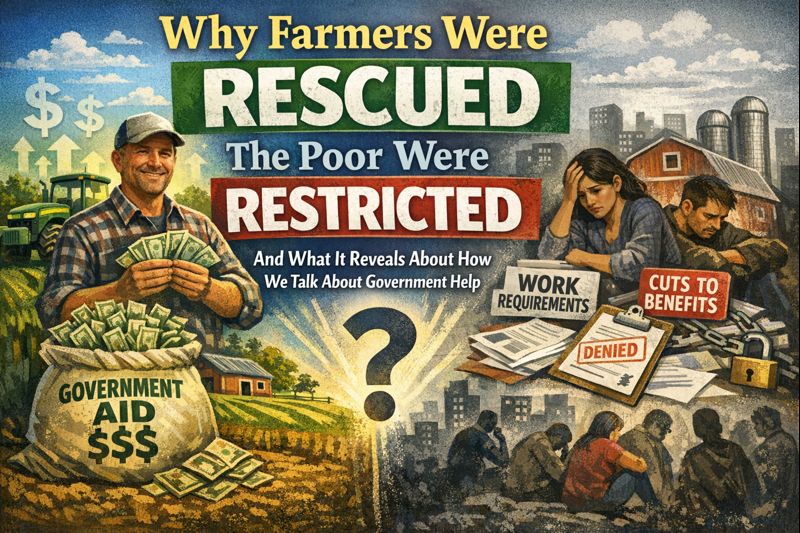
Why farmers were rescued, the poor were restricted, and what it reveals about how we talk about government help
When economic hardship strikes, government intervention often becomes a lifeline. But not all lifelines are treated the same. In recent years, the U.S. faced a major self-inflicted economic shock: an aggressive trade strategy that sparked retaliation from major trading partners. The agricultural sector was hit especially hard. In response, the federal government distributed billions of dollars to farmers to offset their losses.
At the same time, millions of low-income Americans saw tighter rules, added work requirements, and growing administrative hurdles in the programs designed to help them survive. The contrast sparked national debate, but beyond the politics lies a deeper, nonpartisan question: why is government help praised for some groups and criticized for others?
The “Trade War” and Emergency Aid to Farmers
During the 2018–2020 trade conflicts, American farmers suddenly lost access to key export markets. Crops went unsold, prices dropped, and many producers faced the risk of losing their farms entirely. The federal government responded with emergency farm assistance programs that delivered direct payments to farmers to stabilize the agricultural economy.
These payments were framed as “market stabilization” rather than welfare. The logic was that agriculture is vital to national security, food independence, and rural economic survival. This approach wasn’t new—U.S. agriculture has been supported by government programs for decades. In this narrative, farmers weren’t “receiving handouts”; they were being protected from extraordinary market disruption.
The Different Standard Applied to Low-Income Americans
While farmers received rapid relief, low-income Americans encountered a different reality.
Programs like food assistance, cash aid, and housing support increasingly emphasized work requirements, time limits, and complicated eligibility rules. The guiding philosophy behind these policies focused on personal responsibility—the idea that aid should be temporary, conditional, and tightly controlled.
This didn’t begin with one political party or one administration. U.S. welfare reform over several decades has created a system designed more to prevent dependency than to guarantee stability. That structure shaped the response during this period, leading to stricter oversight and fewer expansions for the poorest households—even while other groups received swift, large-scale government support.
Language Matters: “Relief” vs. “Handouts”
One of the most important differences wasn’t just policy—it was language.
When farmers were helped, the assistance was framed as:
- “Market stabilization”
- “Economic protection”
- “Emergency relief”
When poor and working-class Americans were helped, the language more often included:
- “Welfare”
- “Handouts”
- “Entitlements”
This difference in framing changes how the public perceives legitimacy. Help for industries is described as protecting the economy. Help for individuals is often described as charity or failure. This isn’t inherently partisan—it’s a cultural pattern that has existed in American political life for generations.
Are Bailouts and Welfare Really That Different?
On a purely economic level, both farm bailouts and social welfare programs do the same thing: they stabilize systems under stress.
Farm aid prevents collapse of food supply chains and rural economies. Social welfare prevents homelessness, hunger, and long-term poverty fallout. Both are forms of government intervention designed to prevent instability from becoming catastrophe.
The difference lies not in function, but in perception. Society tends to see farmers—and industries more broadly—as contributors temporarily harmed by external forces. Poor individuals, by contrast, are often seen through a moral lens that emphasizes personal choices rather than structural conditions.
The Real Issue: Deservingness and Cultural Narratives
At the heart of this divide is a concept political scientists call “deservingness.”
Who deserves help?
Farmers are culturally framed as hardworking, independent, and essential to the nation’s survival. Poor Americans are often framed as dependent, irresponsible, or invisible. These narratives shape policy more than spreadsheet economics.
This isn’t a story of one party being hypocritical and another being pure. It’s a story of how deeply rooted American values around work, morality, and identity influence which groups are protected and which are pressured to endure hardship without support.
What This Reveals About American Governance
The contrast between farm bailouts and poverty restrictions reveals something larger than any single president or political party: the United States is comfortable with government help when it looks like protecting “us,” and uneasy when it looks like helping “them.”
This is not just a political problem—it is a philosophical one. If the role of government is to stabilize society, the question becomes whether stability is defined by protecting industries alone, or by protecting people as well.
Conclusion: Consistency Is the Real Missing Piece
The story of trade-war farm bailouts and tightened welfare rules isn’t simply about hypocrisy. It’s about inconsistency.
When one group’s suffering is framed as a market failure, help looks reasonable. When another group’s suffering is framed as a moral failure, help looks suspicious. A healthier national conversation would focus less on labels like “socialism” or “handouts” and more on outcomes: stability, dignity, and long-term social health.
A nonpartisan future doesn’t depend on eliminating government support—it depends on applying it consistently, transparently, and fairly.
Call to Action: Moving Toward Fair and Honest Policy Conversations
This conversation doesn’t require choosing political teams — it requires choosing consistency. Readers can play a role by questioning how economic assistance is framed, who is considered “deserving,” and why similar policies are treated so differently in public debate.
Pay attention to the language used in media and political speeches. Ask whether relief is being described as a stabilizing investment or a moral failure. Advocate for transparency in how aid is distributed and evaluated. The more the public demands consistency, the more policymakers are pushed to move beyond symbolic politics and toward practical, evidence-based solutions.
Real change begins when citizens stop asking “Who should we blame?” and start asking “What actually works?”
Call to Action: Moving Toward Fair and Honest Policy Conversations
This conversation doesn’t require choosing political teams — it requires choosing consistency. Readers can play a role by questioning how economic assistance is framed, who is considered “deserving,” and why similar policies are treated so differently in public debate.
Pay attention to the language used in media and political speeches. Ask whether relief is being described as a stabilizing investment or a moral failure. Advocate for transparency in how aid is distributed and evaluated. The more the public demands consistency, the more policymakers are pushed to move beyond symbolic politics and toward practical, evidence-based solutions.
Real change begins when citizens stop asking “Who should we blame?” and start asking “What actually works?”
Future Implications: What This Pattern Could Mean for the Next Crisis
The way the U.S. handled farm bailouts and poverty policy during recent economic shocks offers a preview of how future crises may unfold. Climate change, automation, global supply chain disruptions, and artificial intelligence are likely to cause new waves of economic instability across multiple sectors.
If current patterns continue, industries with strong political and cultural standing may continue to receive rapid, generous support, while vulnerable populations face stricter requirements and slower relief. This risks widening inequality, increasing public distrust, and weakening long-term economic resilience.
However, these patterns are not inevitable. Policymakers have the opportunity to redefine crisis response by grounding decisions in data-driven outcomes rather than cultural narratives. The consistency of future relief efforts may determine not only economic recovery, but public faith in democratic institutions themselves.
We Want to Hear From You
This issue affects real lives in real communities, and thoughtful perspectives don’t belong to one political party.
Have you experienced the impact of trade policy, farm assistance, or social welfare programs in your own life or community? Do you believe government relief should be treated differently depending on the recipient — or should the rules be the same for everyone?
Share your thoughts, experiences, and respectful disagreements in the comments. Constructive dialogue is how better policies are built, and every viewpoint adds depth to the conversation.
References
- Congressional Research Service. (2019). U.S. farm support: Market Facilitation Program payments. https://crsreports.congress.gov
- Center on Budget and Policy Priorities. (2019). Policy basics: SNAP work requirements. https://www.cbpp.org
- Hacker, J. S., & Pierson, P. (2010). Winner-take-all politics: How Washington made the rich richer—and turned its back on the middle class. Simon & Schuster.
- Hoynes, H. W., & Schanzenbach, D. W. (2018). Safety net investments in children. Brookings Papers on Economic Activity. https://www.brookings.edu
- Mettler, S., & Soss, J. (2004). The consequences of public policy for democratic citizenship. Perspectives on Politics, 2(1), 55–73.
- Orden, D., Blandford, D., & Josling, T. (2010). Farm policy reform: Issues and prospects. Oxford University Press.
- Piven, F. F., & Cloward, R. A. (1993). Regulating the poor: The functions of public welfare (Updated ed.). Vintage Books.
- Rothstein, B., & Stolle, D. (2008). The state and social capital. Comparative Politics, 40(4), 441–459.
- U.S. Department of Agriculture. (2020). Market Facilitation Program (MFP) payments report. https://www.usda.gov