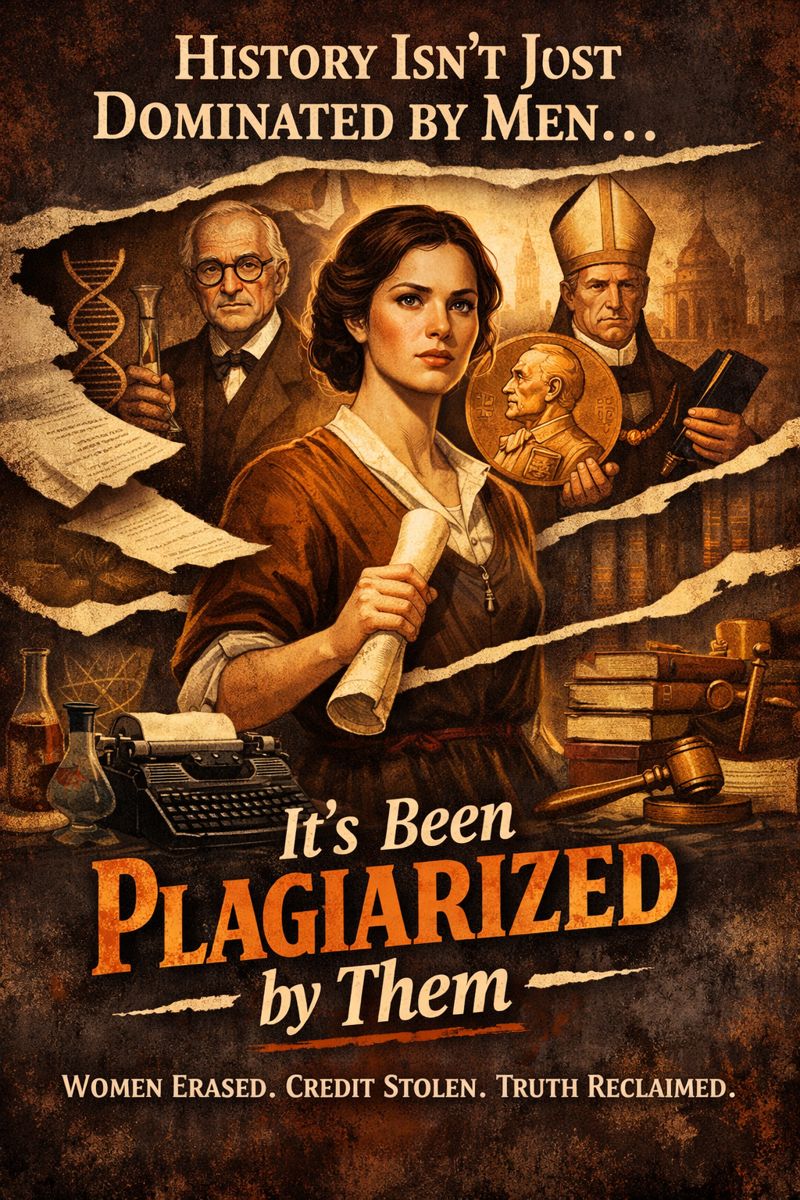
How Women’s Knowledge Was Appropriated, Rebranded, and Erased from the Historical Record
When we say that history is “written by men,” we often frame the issue as one of representation: men held power, men told the story, women were excluded. While this is true, it is incomplete. History has not merely sidelined women—it has absorbed their labor and reassigned credit. In many cases, women were not absent from history at all; their work was present, foundational, and indispensable, only to be claimed, renamed, or legitimized by men once it became valuable.
This is not an argument about individual bad actors. It is about a recurring historical mechanism: women generate knowledge, men institutionalize it, and history remembers the institution—not the originators.
The Political Economy of Credit: Why Recognition Follows Power
Sociologist Margaret Rossiter’s concept of the Matilda Effect describes the systematic misattribution of women’s intellectual contributions to men, particularly in science and academia (Rossiter, 1993). Building on Robert Merton’s “Matthew Effect,” which explains how prestige accumulates among those already recognized, Rossiter demonstrated that gender profoundly determines whose work is seen as original, whose is seen as supportive, and whose is erased entirely.
Authorship, awards, and historical memory do not reflect merit alone. They reflect institutional authority, access to publishing, and control over narrative. Because these structures were historically male-dominated, credit predictably flowed upward—to men—while women’s contributions were absorbed without attribution.
Scientific Discovery and the Myth of the Lone Male Genius
Modern science is saturated with stories of solitary male brilliance. Yet historical evidence repeatedly undermines this narrative.
Rosalind Franklin and the Theft of Data

Rosalind Franklin’s X-ray diffraction image (Photo 51) was crucial to identifying DNA’s double-helix structure. Her data was shared without her consent and used by James Watson and Francis Crick, who later received the Nobel Prize. Franklin’s contribution was framed as technical rather than theoretical—a common gendered distinction used to deny intellectual authorship (Sayre, 1975; Maddox, 2002).
Lise Meitner and Nuclear Fission

Physicist Lise Meitner co-discovered nuclear fission and provided the theoretical explanation for the phenomenon. Despite this, the Nobel Prize was awarded solely to Otto Hahn. Meitner’s exclusion was not due to lack of contribution but lack of institutional power—she was a woman, Jewish, and operating outside Nazi Germany at the time (Sime, 1996).
Nettie Stevens and Genetics

Nettie Stevens discovered the role of sex chromosomes in determining biological sex. Her work was contemporaneous with—and arguably clearer than—that of Thomas Hunt Morgan, who later received the Nobel Prize. Stevens’ findings were absorbed into the field while her name faded from public memory.
These cases reveal a pattern: women produce empirical or theoretical breakthroughs; men receive recognition once those ideas are formalized and canonized.
Computing, Mathematics, and the Feminization of Invisible Labor
The origins of computing tell a particularly revealing story. Early programming was considered clerical work—repetitive, feminized, and low-status. Women dominated the field when it lacked prestige.
Ada Lovelace and Algorithmic Thought
Ada Lovelace authored the first algorithm intended for a machine, articulating principles of computing long before the technology existed. For decades, her work was dismissed as speculative or derivative, only to be recognized much later as foundational (Toole, 1998; Essinger, 2014).
Human Computers and NASA
During World War II and the early space race, women—many of them women of color—served as “human computers,” performing complex mathematical calculations essential to military and aerospace success. As programming gained prestige, men entered the field in greater numbers, leadership roles shifted, and women’s contributions were reframed as auxiliary rather than foundational (Grier, 2005; Shetterly, 2016).
The work did not change. The gender of those claiming credit did.
Philosophy, Sociology, and the Theft of Theory
Intellectual theft was not confined to the natural sciences.
Jane Addams and the Origins of Sociology

Jane Addams developed empirical, community-based theories of social structure, inequality, and democracy. Her work directly influenced the Chicago School of Sociology, yet she was categorized as a reformer rather than a theorist. Male contemporaries were named founders; Addams was remembered as an activist (Deegan, 1988; Lengermann & Niebrugge-Brantley, 2007).
Hannah Arendt and Intellectual Gatekeeping

Even women who achieved recognition faced gendered reinterpretation. Hannah Arendt’s political philosophy was often framed as commentary rather than theory, her originality minimized through gendered critique that male peers did not face.
In academia, theory equals authority. Women’s ideas were often labeled moral, applied, or emotional—terms that stripped them of intellectual legitimacy.
Colonization, Care Work, and Knowledge Extraction
Women’s intellectual labor was also erased through colonialism. Indigenous women’s agricultural, medical, and ecological knowledge was extracted, documented by male anthropologists, and credited to colonial institutions rather than its originators.
Similarly, care work—education, social reproduction, community organization—was feminized, devalued, and excluded from formal histories of innovation and governance, despite forming the backbone of social systems.
Feminist Epistemology: Who Gets to Define Knowledge?
Feminist scholars such as Sandra Harding, Dorothy Smith, and Evelyn Fox Keller argue that knowledge is socially constructed and deeply entangled with power (Harding, 1986; Smith, 1987; Keller, 1985). What counts as “objective,” “rigorous,” or “original” has historically been defined by elite male institutions.
Women’s contributions are more likely to be:
- Treated as collaborative rather than authored
- Labeled practical rather than theoretical
- Absorbed without citation once institutionalized
This is not accidental bias. It is epistemic inequality.
Reclaiming Women’s Work Is Not Revisionism — It Is Historical Accuracy
Correcting the historical record is often dismissed as revisionism or political correctness. In reality, it is an act of intellectual honesty.
History has never been a neutral archive of achievement. It is a record shaped by power—by who could publish, who could teach, who could name discoveries, and who could be remembered.
Women were not missing from history. Their names were removed.
History is not just dominated by men. It has been systematically plagiarized by them—and acknowledging that is the first step toward telling the truth about how knowledge is made.
From Historical Erasure to Modern Dispossession
The historical plagiarism of women’s labor is not a closed chapter—it is an active framework that continues to shape modern society. The same mechanisms that once stripped women of authorship now justify their exclusion from power, autonomy, and authority today.
When women’s contributions are erased from history, it becomes easier to argue that women have never been central to governance, theology, innovation, or leadership. This manufactured absence is then weaponized to rationalize the removal of rights and opportunities in the present.
Loss of Rights as a Continuation of Control
The rollback of reproductive rights is often framed as a moral or legal debate, but it also reflects a deeper historical pattern: women’s bodies and knowledge being regulated by institutions that deny women authority over their own lived experience.
Historically, women were trusted healers, midwives, and decision-makers in matters of reproduction. That authority was systematically dismantled as male-dominated legal, medical, and religious institutions consolidated power. Today’s restrictions on bodily autonomy echo this same transfer of control—away from women and toward institutional authority that claims expertise while disregarding women’s voices.
In this way, the loss of rights is not a deviation from history, but a return to an older system—one that benefits from women’s labor while denying women agency.
Workplace Exclusion and the Devaluation of Women’s Labor
Modern workplace inequities—wage gaps, glass ceilings, lack of credit, and underrepresentation in leadership—are contemporary expressions of historical misattribution.
Women continue to:
- Produce ideas that are credited to male colleagues
- Perform emotional and organizational labor that is deemed “natural” rather than skilled
- Be excluded from authorship, patents, promotions, and decision-making
This mirrors the historical pattern where women built fields only to be pushed out once those fields gained prestige or profit. The problem is not a lack of contribution—it is a denial of ownership.
When women are excluded from leadership, it is often justified by appeals to tradition, merit, or “fit”—the same rationales once used to deny women education, publication, and professional standing.
Religious Arenas and the Sanctification of Erasure
Religious institutions play a powerful role in reinforcing women’s exclusion by presenting patriarchy as divinely ordained rather than historically constructed.
Across traditions, women have served as:
- Spiritual leaders
- Theologians
- Teachers and organizers
Yet religious histories often minimize or omit these roles, emphasizing male authority while framing women as helpers, followers, or moral symbols rather than leaders. This selective memory allows contemporary religious structures to exclude women from clergy, governance, and theological authority while claiming historical or sacred precedent.
When women are erased from religious history, their exclusion in the present is portrayed as obedience rather than oppression.
Why This Connection Matters
The plagiarism of women’s contributions in history is not merely about recognition—it is about power. Who is remembered determines who is believed. Who is credited determines who is trusted. And who is trusted determines who is allowed to lead, decide, and define morality, law, and knowledge.
Modern inequality thrives on historical distortion.
By denying women their place in the past, institutions create the illusion that women’s demands for equality are new, radical, or disruptive—rather than a reclamation of authority that was never rightfully surrendered.
Reclaiming the Narrative Is an Act of Resistance
Correcting historical erasure is not symbolic. It is political. It challenges the foundations upon which exclusion is justified.
When women reclaim authorship—of history, of work, of theology, of their own bodies—they undermine the narratives that sustain inequality today.
History was not only written by men. It was edited, curated, and claimed by them.
And until that truth is acknowledged, women will continue to be treated as newcomers to spaces they helped build.
Call to Action: From Recognition to Reform
Acknowledging historical erasure is only the first step. If women’s contributions were systematically plagiarized to build institutions, then those institutions carry an obligation to repair, not merely recognize, that harm. Repair requires structural change.
Policy Reform: Restore Autonomy and Authority
Policy does not exist in a vacuum—it reflects whose knowledge is trusted and whose lives are regulated.
- Demand policies that center women’s lived experience, particularly in healthcare, reproductive justice, labor protections, and family policy.
- Support legislation that protects bodily autonomy, economic independence, and access to education—especially for women historically excluded from decision-making.
- Require gender-impact assessments in policy design to ensure laws do not reproduce historical patterns of control and exclusion.
- Advocate for women’s representation—not as advisors, but as decision-makers—at every level of governance.
When women are excluded from policy authorship, their lives become subjects of regulation rather than sources of authority.
Workplace Equity: Credit, Compensation, and Power
Workplace inequality persists because institutions still benefit from women’s labor while denying women ownership.
- Insist on transparent pay structures, promotion criteria, and authorship policies that prevent idea theft and misattribution.
- Normalize crediting women publicly for intellectual and emotional labor, particularly in male-dominated fields.
- Support unionization, worker protections, and accountability mechanisms that challenge gendered exploitation.
- Hold leadership accountable for representation—not just in hiring, but in executive and decision-making roles.
Equity is not achieved through inclusion alone. It requires redistribution of power.
Religious Institutions: Confront Tradition with Truth
Religious authority often rests on selective memory. Challenging that memory is not sacrilege—it is honesty.
- Demand historical accountability for women’s leadership, theology, and spiritual labor that has been erased or minimized.
- Support women seeking ordination, leadership, and theological authority across faith traditions.
- Question doctrines and practices that frame exclusion as divine will rather than historical construction.
- Create and protect spaces for women’s spiritual leadership outside institutional approval when institutions refuse reform.
Faith traditions are not timeless—they are shaped by human choices. And human choices can be changed.
The Responsibility of Institutions
Institutions built on women’s uncredited labor do not earn moral authority by denying that history. They earn it by repairing the damage it caused.
Reform begins when women are recognized not as beneficiaries of progress, but as its architects.
The question is no longer whether women contributed.
The question is whether institutions are willing to relinquish the power they gained by erasing them.
We Want to Hear From You
This conversation does not end with this essay—it begins with it.
History lives through the voices of those willing to question it. If you have experienced erasure, misattribution, or exclusion in your workplace, community, faith tradition, or field of study, your story matters. If you know of women whose work was claimed, overlooked, or reframed to benefit others, those stories deserve space and acknowledgment.
We invite readers to:
- Share personal experiences of being excluded, silenced, or denied credit
- Name women—past or present—whose contributions deserve recognition
- Offer reflections on how historical narratives have shaped your understanding of gender, power, and authority
Listening is a form of accountability. Speaking is a form of resistance.
References
- Deegan, M. J. (1988). Jane Addams and the Men of the Chicago School. Transaction Books.
- Ehrenreich, B., & English, D. (1973). Witches, Midwives, and Nurses. Feminist Press.
- Essinger, J. (2014). Ada’s Algorithm. Melville House.
- Federici, S. (2004). Caliban and the Witch. Autonomedia.
- Grier, D. A. (2005). When Computers Were Human. Princeton University Press.
- Harding, S. (1986). The Science Question in Feminism. Cornell University Press.
- Keller, E. F. (1985). Reflections on Gender and Science. Yale University Press.
- Lengermann, P. M., & Niebrugge-Brantley, J. (2007). The Women Founders of Sociology. McGraw-Hill.
- Maddox, B. (2002). Rosalind Franklin. HarperCollins.
- Rossiter, M. W. (1993). The Matthew Matilda Effect in Science. Social Studies of Science, 23(2).
- Sayre, A. (1975). Rosalind Franklin and DNA. Norton.
- Sime, R. L. (1996). Lise Meitner. University of California Press.
- Smith, D. E. (1987). The Everyday World as Problematic. Northeastern University Press.
- Toole, B. A. (1998). Ada, the Enchantress of Numbers. Strand Magazine.