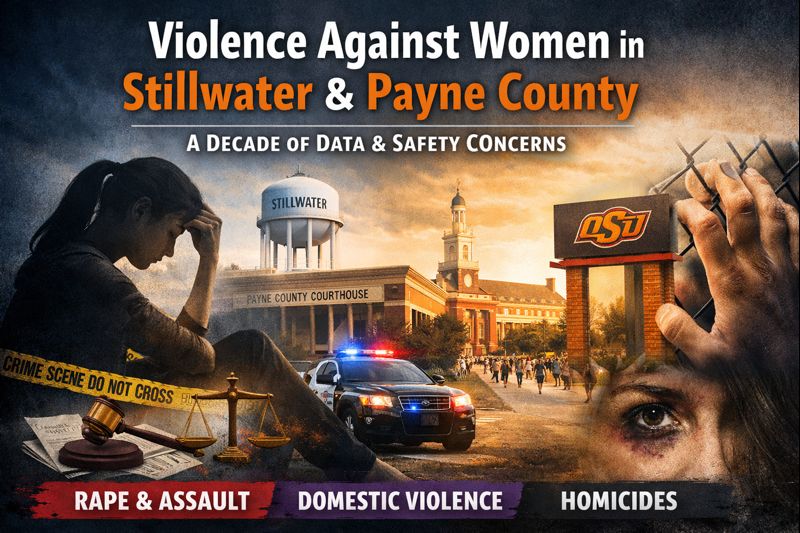
A Nonpartisan Analysis of Violence, Reporting, and Systemic Gaps (2015–2025)
Violence against women and girls is a persistent public safety, public health, and governance issue across the United States. This analysis examines what official data, court reporting, and publicly documented cases reveal about women’s safety in Stillwater and Payne County, Oklahoma, over the past decade. The goal is not to advocate for a political position, but to provide a fact-based foundation for informed civic discussion, policy evaluation, and community decision-making.
Content Note / Survivor Disclaimer
This document discusses topics including sexual assault, domestic violence, child abuse, and homicide. These subjects may be distressing for some readers, particularly survivors of violence. Readers are encouraged to prioritize their well‑being, take breaks as needed, and seek support from trusted individuals or professional resources. Inclusion of this content is intended for public safety analysis and community awareness, not sensationalism. Support resources are listed later in this document for those who may need them.
Scope and Methodology
This review synthesizes information from Oklahoma State Bureau of Investigation (OSBI) crime statistics, FBI Crime Data Explorer aggregates, local law enforcement summaries, court-system reporting limitations, and widely reported criminal cases. Emphasis is placed on reported incidents rather than convictions, reflecting how crime data are officially recorded.
Geographic and Demographic Context
Payne County is home to approximately 82,000 residents, with Stillwater as its largest city and the location of Oklahoma State University. The county’s population includes a significant number of young adults, which influences both crime reporting patterns and service demand related to sexual violence and intimate partner violence.
Rape and Sexual Assault Trends (County Level)
Between 2015 and 2023, Payne County recorded an estimated 500 or more reported rape incidents based on combined OSBI annual reports and FBI aggregated data. Annual counts fluctuated, but consistently reflected dozens of reports each year. These figures represent reported incidents, not adjudicated outcomes, and align with national research indicating that sexual assault remains significantly underreported.
Sexual Violence in Stillwater
FBI Crime Data Explorer summaries indicate that Stillwater accounts for a substantial share of reported rape incidents within Payne County. This concentration reflects population density, nightlife activity, and proximity to a large university. While Stillwater’s overall violent crime rate is below national averages, sexual violence remains a recurring category of concern.
Campus Safety and Reporting at Oklahoma State University (OSU)
Oklahoma State University plays a central role in Stillwater’s population and crime-reporting landscape. As a federally funded institution, OSU is required to publish annual Clery Act reports documenting on-campus and campus-adjacent crimes, including rape, dating violence, domestic violence, and stalking. Over the past decade, OSU’s Clery reports consistently show reports of sexual assault each year, most frequently occurring in residence halls, Greek housing, and off-campus locations associated with student activity.
OSU operates parallel reporting systems: campus police reports, Title IX disclosures, and local law enforcement reports. While this structure is designed to expand reporting options, it can also fragment data. Some incidents are recorded for Title IX compliance without resulting in criminal charges, while others are reported to Stillwater Police without a corresponding university disciplinary process. This dual-track system complicates public understanding of prevalence and outcomes.
Importantly, Clery data reflects only crimes reported to campus authorities or local police and therefore underrepresents actual victimization. National research consistently indicates that college-aged women experience higher rates of sexual violence than the general population, yet many incidents are never formally reported due to fear of retaliation, social consequences, or lack of confidence in institutional response. OSU’s data trends align with this broader national pattern.
The presence of a large student population also affects county-level statistics. Stillwater accounts for a disproportionate share of Payne County’s reported sexual assaults, not necessarily because the city is uniquely unsafe, but because it concentrates young adults, social venues, and mandatory reporting structures. Campus safety, therefore, cannot be evaluated independently from county systems of policing, prosecution, and victim services.
Violence Against Minors
Publicly reported cases in the past decade include multiple convictions and charges involving child sexual abuse, molestation, and possession of child sexual abuse material in Payne County. These cases demonstrate that violence against girls is not limited to peer or dating contexts but includes familial and authority-based abuse.
Domestic and Intimate Partner Violence
Domestic violence represents one of the most prevalent forms of violence against women locally. Community reports indicate hundreds of domestic abuse incidents reported annually in Payne County, with women comprising the majority of identified victims. Service providers report assisting more than a thousand individuals in some years across domestic violence, sexual assault, and stalking cases.
Murders and Lethal Violence Against Women
Homicide rates in Payne County fluctuate year to year, with some years reporting zero murders and others reporting multiple cases. While women constitute a minority of total homicide victims, Oklahoma consistently ranks among the states with the highest rates of women killed by men, often in intimate partner contexts. Payne County cases reflect this broader statewide pattern.
Protective Orders: Availability and Limitations
Protective orders are a key legal tool intended to prevent escalation of violence. However, Oklahoma does not publish centralized, county-level historical totals of protective orders issued. Statewide data indicate roughly 19,000 protective orders are filed annually, but Payne County–specific decade totals require manual court record analysis, limiting transparency and policy evaluation.
Reporting Versus Accountability
A consistent theme across all data sources is the gap between reports, arrests, and convictions. Many sexual assault and domestic violence reports do not result in prosecution, and some high-profile cases have raised public concern about sentencing outcomes. This gap complicates public understanding of risk and justice effectiveness.
Institutional and Data Gaps
Crime statistics are fragmented across OSBI, FBI, courts, and service providers. Victim gender breakdowns, protective order totals, and case outcomes are often unavailable at the county level. These gaps hinder evidence-based policymaking and limit the public’s ability to assess system performance.
Comparison to State and National Patterns
Payne County’s reported rape and violent crime rates are generally comparable to or slightly below national averages. However, Oklahoma’s statewide rates of domestic violence and women killed by men remain among the highest nationally, placing Payne County within a higher-risk state context despite its local variation.
Policy Implications and Nonpartisan Considerations
From a nonpartisan perspective, the data suggest several policy-relevant considerations: improved data transparency, consistent tracking of protective orders, victim-centered reporting systems, and evaluation of sentencing and diversion practices. These considerations are relevant regardless of political ideology and focus on system performance rather than political alignment.
Call to Action: Why Demanding Better Matters
Data alone do not create change. The patterns documented in Payne County and Stillwater raise fundamental questions about transparency, accountability, and public trust. Demanding better does not require assigning blame or advancing partisan agendas; it requires insisting that public institutions function as intended.
Residents, students, and policymakers alike have a legitimate interest in knowing how often violence occurs, how victims are protected, and whether existing systems prevent escalation. When protective order data cannot be easily accessed, when reporting systems are fragmented, and when outcomes are unclear, communities lose the ability to evaluate effectiveness.
A nonpartisan call to action includes advocating for clearer public reporting, stronger coordination between campus and county systems, consistent enforcement of protective orders, and routine public evaluation of outcomes. These steps support victims, strengthen public confidence, and improve safety for everyone.
We Want to Hear From You
Community safety is not solely the responsibility of institutions; it is also shaped by public engagement. Survivors, students, families, service providers, and residents all hold valuable perspectives that data alone cannot capture.
Readers are encouraged to share experiences, concerns, and insights related to safety, reporting, and accountability in Stillwater and Payne County. Constructive dialogue helps identify gaps, challenge assumptions, and inform better decision-making. Listening to diverse voices—especially those directly affected—remains essential to understanding the full scope of the issue and shaping meaningful, evidence-informed responses.
Conclusion
Over the past decade, violence against women and girls in Stillwater and Payne County has been persistent, multifaceted, and incompletely captured by existing data systems. While reported crime rates provide important insight, gaps in reporting, accountability, and transparency limit comprehensive understanding. Addressing women’s safety in this community ultimately depends on accurate data, institutional accountability, and sustained civic engagement.
Resources: Support, Reporting, and Assistance
Access to clear and timely support is a critical component of community safety. The following resources are provided for individuals seeking help, information, or reporting options related to violence, harassment, or safety concerns in Stillwater and Payne County.
Emergency Assistance
- Emergency: 911
- Stillwater Police Department (Non‑Emergency): 405‑372‑4171
- Payne County Sheriff’s Office: 405‑372‑4522
Crisis and Support Hotlines (24/7)
- National Domestic Violence Hotline: 1‑800‑799‑SAFE (7233) or TTY 1‑800‑787‑3224
- RAINN National Sexual Assault Hotline: 1‑800‑656‑HOPE (4673)
- 988 Suicide & Crisis Lifeline: Call or text 988
Campus Resources (Oklahoma State University)
- OSU Title IX Office: Handles reports of sexual harassment
References
Federal Bureau of Investigation. (2024). Crime Data Explorer.
Oklahoma State Bureau of Investigation. (2015–2024). Crime in Oklahoma annual reports.
Oklahoma Office of the Attorney General. (2022–2024). Domestic Violence Fatality Review Board annual reports.
United Way of Payne County. (2024–2025). Community status reports.