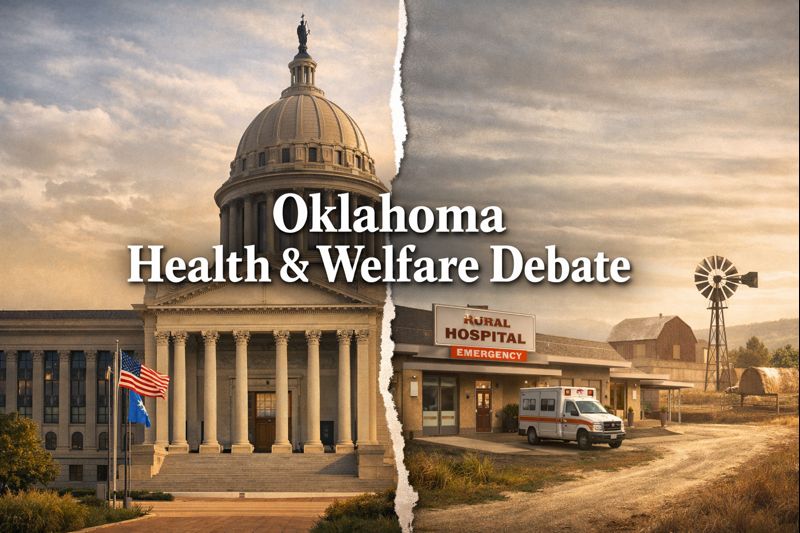
Governor Kevin Stitt’s recent proposal to reduce funding for Oklahoma’s medical and welfare programs could reshape the state’s safety net, with major implications for rural hospitals, low-income families, and long-term budget stability.
This post is written for a nonpartisan audience. The goal is not to cheer for or attack any political figure, but to unpack what’s happening, why it matters, and what the evidence suggests about possible outcomes for Oklahoma.

In early 2026, Governor Kevin Stitt signed an executive order directing state agencies to review major federal welfare programs—such as Medicaid, SNAP, and TANF—with an eye toward reducing reliance on them and promoting work. Supporters describe this as a push for “accountability” and “self-reliance.” Critics worry it could weaken healthcare access and basic supports for low-income Oklahomans, especially in rural areas.
Below, we’ll walk through the key facts, competing arguments, and possible consequences.
Understanding the Executive Order: What Exactly Did Stitt Do?
Key goals: self-reliance, work, and “accountability”
The executive order instructs state agencies to:
- Audit existing welfare programs for error rates, fraud controls, and eligibility rules.
- Identify “benefit cliffs”—income points where working more leads to a sudden loss of benefits.
- Explore federal waivers that could give Oklahoma more flexibility in designing programs.
The stated aim is to increase employment among able-bodied adults, reduce dependency on government assistance, and make sure the safety net is targeted to those deemed most in need.
From a nonpartisan perspective, these goals reflect a longstanding policy tension: How do you balance supporting vulnerable households with encouraging full participation in the workforce?
Which agencies and programs are under review?
The order touches multiple agencies, including:
- The Oklahoma Health Care Authority, which administers Medicaid.
- The Department of Human Services, which oversees SNAP and TANF.
- Health-related agencies involved in WIC, mental health, and other federal grants.
Programs specifically referenced include:
- Medicaid (SoonerCare in Oklahoma)
- Supplemental Nutrition Assistance Program (SNAP)
- Temporary Assistance for Needy Families (TANF)
The order does not itself cut benefits immediately. Instead, it sets up a 90–120 day review process that could lead to changes in eligibility rules, work requirements, or how aggressively the state pursues waivers and “efficiency” measures.

Oklahoma’s Safety Net in Context: Medicaid, SNAP, TANF, and More
How Medicaid works in Oklahoma today
Medicaid covers low-income children, seniors in nursing homes, people with disabilities, and many low-income adults. Since voters approved Medicaid expansion, hundreds of thousands of Oklahomans have gained coverage, including many working adults and rural residents.
Key points:
- Medicaid is a joint federal-state program. When enrollment rises or health costs grow, both levels of government pay more.
- In Oklahoma, Medicaid supports not only hospitals and clinics, but also mental health, substance-use treatment, and long-term care.
SNAP, TANF, and WIC: who relies on them?
SNAP (food stamps) helps low-income households buy groceries; many recipients are children, seniors, or people with disabilities. TANF provides cash assistance to very low-income families, typically with time limits and work expectations. WIC supports pregnant people, infants, and young children with nutrition and breastfeeding assistance.
Most SNAP and TANF recipients who can work already do, but often in low-wage, unstable jobs. Benefits can act as a bridge during layoffs, reduced hours, or family health crises.
Demographics: rural vs. urban Oklahomans in the safety net
Rural counties in Oklahoma tend to have:
- Higher rates of poverty
- Older populations
- Fewer large employers
- Longer distances to hospitals and clinics
These factors mean rural residents are heavier users of Medicaid and SNAP on average, and they have fewer alternatives if benefits are reduced.
Fiscal Pressures: Why This Debate Is Happening Now
State budget trends and healthcare cost growth
Healthcare costs in general have been rising faster than inflation for years. Hospitals face higher prices for staff, drugs, and supplies. States like Oklahoma must balance Medicaid spending against other priorities such as education, transportation, and public safety.
Some rural hospitals and health systems warn that reimbursement rates aren’t keeping up with costs, even as patient needs grow.
The Oklahoma Health Care Authority’s budget needs
The Oklahoma Health Care Authority has asked for hundreds of millions of additional dollars to cover:
- Higher enrollment and utilization
- Increased payments to providers to keep them solvent
- Ongoing integration of mental and physical health services
From a fiscal conservative standpoint, this raises alarms about long-term affordability. From a health-policy standpoint, underfunding these requests can mean reduced access to care and more strain on emergency rooms.
Federal Medicaid cuts and shifting costs to states
At the same time, recent federal legislation (the “One Big Beautiful Bill” and related budget measures) is projected to cut federal Medicaid spending by roughly $1 trillion over a decade, with particularly large impacts in rural areas.
Analyses by organizations like the Kaiser Family Foundation, Families USA, and the American Hospital Association suggest:
- Rural hospitals could lose a large share of their net income
- Millions of low-income Americans might lose coverage
- Uncompensated care (unpaid hospital bills) would spike
That puts extra pressure on Oklahoma to either fill the gap with state dollars or reduce services and eligibility—the crossroads where Stitt’s proposal sits.
Supporters’ Case: Potential Benefits of the Proposal
Encouraging labor-force participation and reducing “benefit cliffs”
Supporters argue that generous or poorly designed benefits can create “benefit cliffs”—points where a small increase in hours or pay causes a big drop in assistance. If the review leads to smoother benefit phase-outs, they contend, more people might be willing to take extra shifts, pursue training, or accept promotions.
From a nonpartisan standpoint, addressing benefit cliffs is a real policy challenge. Many economists across the political spectrum agree that steep cliffs are inefficient and can discourage work.
Targeting fraud, waste, and administrative complexity
Backers of the order also emphasize:
- Reducing duplicate benefits across programs
- Tightening eligibility checks
- Simplifying administration so dollars go further
Fraud rates in programs like SNAP are generally low by federal audit standards, but even small percentages involve real money. A careful audit might identify outdated rules or inefficient processes that can be fixed without cutting truly needed benefits.
Long-term sustainability of state and federal budgets
Some fiscal conservatives see the order as part of a broader effort to slow the growth of entitlement spending, arguing that long-term deficits could hurt economic growth or crowd out other priorities. From this viewpoint, reforms that modestly reduce caseloads or spending now could help avoid more drastic cuts later.
Critics’ Case: Short-Term Savings, Long-Term Health Risks
Coverage gaps, delayed care, and poorer health outcomes
Critics worry that “reducing dependency” could translate, in practice, into tighter eligibility rules, new work requirements, or more red tape that disqualifies people who still genuinely need help.
National research has found that Medicaid cuts tend to:
- Increase the number of uninsured people
- Lead to more delayed care, especially for chronic conditions
- Raise rates of preventable hospitalizations and medical debt
In Oklahoma, where many counties already struggle with provider shortages, losing coverage can effectively mean losing real-world access to care.
Mental health, substance use, and vulnerable populations
Organizations like the Healthy Minds Policy Initiative warn that cuts to Medicaid would reduce funding for mental health and substance-use treatment, areas where Oklahoma already ranks poorly. They estimate that federal Medicaid reductions could mean billions in lost hospital revenue over a decade, with rural hospitals taking a disproportionate hit.
This is especially concerning for:
- People with serious mental illness
- Individuals in recovery from addiction
- Children receiving school-based or community-based behavioral health services
Administrative barriers as “red tape” rather than reform
Critics also stress that efforts to tighten eligibility can create paperwork barriers that hit working families hardest—people juggling jobs, childcare, and transportation. Even if they technically remain eligible, they can lose coverage due to missed deadlines or complicated forms.
From a nonpartisan vantage point, the key question is how reforms are implemented: Are they focused on genuine efficiency gains, or do they make it harder for eligible people to keep benefits?
Rural Hospitals on the Brink
Why so many rural facilities already run in the red
Oklahoma is near the top nationally for rural hospitals at risk of closure. One recent analysis found that roughly two-thirds of the state’s rural hospitals were operating at a loss, and around 22 facilities are at “immediate risk” of closure in the next few years.
Reasons include:
- High fixed costs with relatively low patient volumes
- A payer mix heavily tilted toward Medicare, Medicaid, and uninsured patients
- Difficulty recruiting and retaining medical professionals
How Medicaid and SNAP dollars flow through rural economies
When rural residents use Medicaid, those dollars flow to:
- Local hospitals and clinics
- Pharmacies
- Home-health agencies
- Behavioral health providers
Similarly, SNAP dollars are typically spent at local grocery stores and small retailers, supporting jobs and sales tax revenues.
Research at the national level suggests that Medicaid and SNAP cuts can shrink local economies, particularly in small towns that lack diverse industries.
Travel distances, emergency care, and time-sensitive treatment
If more rural hospitals close, residents may need to:
- Drive an hour or more for emergency care
- Travel farther for maternity services, dialysis, or mental-health treatment
- Rely on overburdened EMS systems for long transports
For conditions like heart attacks, strokes, and complicated births, minutes matter. Longer travel times have been linked to higher mortality and worse long-term health outcomes.

Economic Ripple Effects Beyond the Hospital Walls
Jobs, local businesses, and tax revenues
Hospitals are often top employers in rural communities. When they cut services or close:
- Healthcare workers lose jobs or move away
- Local businesses lose customers
- Counties lose property and sales tax revenue
Even in urban areas, cuts to Medicaid and SNAP can reduce overall consumer spending, as low-income households tend to spend benefit dollars quickly and locally.
Uncompensated care and cost-shifting to privately insured patients
If fewer people have coverage, hospitals provide more uncompensated care—services they are legally or ethically obligated to provide but don’t get paid for. A 2023 study found that uncompensated care is particularly high for rural hospitals and is a major driver of financial distress.
Hospitals often respond by:
- Cutting staff or closing unprofitable units (like maternity or behavioral health)
- Raising charges to private insurers, which can eventually show up as higher premiums for workers and employers
So even residents who never use Medicaid can be indirectly affected.
How Governor Kevin Stitt’s recent proposal to reduce funding for Oklahoma’s medical and welfare programs fits into a national debate
National Medicaid cuts and rural health challenges
Oklahoma’s debate is part of a broader national conversation about the role and size of Medicaid:
- Federal law now reduces Medicaid funding significantly over the next decade.
- Analyses suggest that more than a quarter of rural hospitals nationwide could be at risk, with hundreds facing immediate danger.
At the same time, some federal funds—like new rural transformation grants—aim to help states redesign rural care. Whether those funds are enough to offset cuts is hotly debated.
Lessons from other states’ policy choices
Evidence from other states shows:
- States that expanded Medicaid generally saw fewer rural hospital closures and lower uncompensated care.
- States that imposed strict work requirements sometimes saw large drops in enrollment, often because of paperwork issues rather than people actually finding jobs.
Nonpartisan takeaway: the details of program design—how requirements are implemented, how transitions are managed—matter as much as the headline policy.
Policy Design Choices That Could Reduce Harm
Even if Oklahoma leaders decide to move forward with parts of this agenda, there are ways to mitigate potential damage.
Carve-outs and protections for high-need groups
Policymakers could:
- Exempt people with disabilities, serious mental illness, or caregiving responsibilities from new work rules
- Protect coverage for children, including those with special health needs
- Maintain strong support for pregnant people and postpartum care
Reinvestment strategies and rural-health safeguards
If the review does find savings—for example, by modernizing IT systems or reducing administrative overlap—some or all of those funds could be reinvested to:
- Stabilize rural hospitals at highest risk
- Expand telehealth and transportation services
- Support primary-care and mental-health providers in shortage areas
The Oklahoma Office of Rural Health and similar organizations already map provider shortages and hospital financial stress; their data can guide targeted help.
Transparency, evaluation, and sunset provisions
Good-government principles suggest:
- Publishing clear metrics (coverage rates, hospital closures, uncompensated care, employment outcomes)
- Building in independent evaluations of any policy changes
- Using sunset clauses, so reforms expire or are reconsidered after a few years unless they show positive results
These tools can help keep the debate grounded in evidence rather than rhetoric.
What This Means for Everyday Oklahomans
Perspectives of patients and families
For patients, the key questions are:
- Will I still qualify for Medicaid, SNAP, or TANF?
- Will my local clinic or hospital remain open and staffed?
- Will my out-of-pocket costs go up if I lose coverage or benefits?
Perspectives of providers and hospitals
Providers are watching:
- Whether reimbursement rates will keep pace with costs
- Whether changes create new administrative burdens (more prior authorizations, more paperwork)
- Whether cuts in one area (for example, mental health) drive more patients into emergency rooms and jails
Perspectives of taxpayers and business owners
Taxpayers and employers may ask:
- Do reforms meaningfully slow spending growth, or just shift costs elsewhere (like higher premiums)?
- Will a healthier workforce and more stable hospitals make Oklahoma more attractive for investment and job growth?
- Are we getting solid data on what’s working and what’s not?
A nonpartisan blog like yours can help readers from all these perspectives understand trade-offs without telling them what to think.
FAQs
1. Does the executive order itself cut anyone’s benefits right now?
No. The order launches a review and reform process; it doesn’t instantly remove people from Medicaid, SNAP, or TANF. However, it could lead to future policy changes—such as work requirements, stricter eligibility checks, or different benefit structures—that might reduce enrollment or funding.
2. Why are rural hospitals so sensitive to Medicaid changes?
Rural hospitals see a higher share of patients who are uninsured or covered by Medicaid and Medicare. Their margins are already thin, and many are operating at a loss. When Medicaid funding drops, they lose a key revenue stream and see more uncompensated care, pushing them closer to closure.
3. Could reforms actually help some people get off welfare and into better jobs?
Possibly. If reforms smooth out benefit cliffs, invest in job training, and coordinate with employers, some people may be better able to move into higher-paying, stable work. The risk is that if policy focuses mainly on restricting benefits without addressing transportation, childcare, and local job availability, people may lose support without gaining real opportunities.
4. Are there examples of work requirements going wrong?
In other states, work requirements sometimes led to large drops in Medicaid enrollment mainly because of confusing paperwork and reporting rules, not because recipients suddenly found full-time jobs. Courts have struck down some of these policies when they were shown to undermine Medicaid’s core purpose of providing medical assistance.
5. How can readers evaluate claims about “fraud” or “waste” in welfare programs?
Look for:
- Independent audits or inspector-general reports
- Clear numbers (not just anecdotes)
- Distinctions between honest mistakes, bureaucratic complexity, and intentional fraud
Nonpartisan sources like the Kaiser Family Foundation, the Congressional Budget Office, and state legislative fiscal offices are good starting points.
6. Where can I learn more about rural health in Oklahoma?
The Rural Health Information Hub, the Oklahoma Office of Rural Health, and organizations like the National Rural Health Association provide maps, data, and policy briefs on hospital finances, provider shortages, and innovative care models.
Conclusion: Seeking a Balanced, Evidence-Based Path Forward
Governor Kevin Stitt’s recent proposal to reduce funding for Oklahoma’s medical and welfare programs emerges at a time of real fiscal strain and real concern about the long-term sustainability of safety-net programs. Supporters see a chance to strengthen work incentives, reduce waste, and protect the programs for those most in need. Critics warn that the same changes could accelerate rural hospital closures, deepen coverage gaps, and produce higher costs and worse health outcomes over time.
A nonpartisan way to look at this moment is to focus on trade-offs and design choices:
- Can Oklahoma address benefit cliffs and inefficiencies without cutting off vulnerable people from essential care and nutrition?
- Will any savings be transparent and independently verified, and will some be reinvested in rural health and prevention?
- Are policymakers willing to adjust course if data show harmful unintended consequences?
Call to Action: Stay Informed, Stay Engaged, Stay Nonpartisan
Policy debates like Governor Kevin Stitt’s proposal don’t just happen at the Capitol—they shape real lives in towns, cities, and rural communities across Oklahoma. If you’ve read this far, you’re already doing something important: taking time to understand the issues beneath the headlines.
Here are practical, nonpartisan ways you can stay engaged:
- 1. Read the source documents.
Look up the full text of the executive order, agency reports, and budget requests. Don’t rely only on soundbites—go to the original materials whenever possible. - 2. Talk to people on the front lines.
Ask local hospital staff, clinic workers, social service providers, and community organizations how potential changes might affect care, jobs, and families where you live. - 3. Contact your elected officials—respectfully.
Share your concerns, questions, or support with your state legislators, the governor’s office, and local leaders. Let them know you value evidence-based, transparent decision-making over partisan talking points. - 4. Share this information thoughtfully.
If you found this breakdown helpful, share it with friends, family, and colleagues—online or offline. Encourage discussion that focuses on facts, trade-offs, and real-world impacts, not personal attacks. - 5. Follow the data over time.
Watch what actually happens: coverage rates, rural hospital closures, uncompensated care, state budgets, employment trends. Revisit your views as new information comes in.
Join Our Community of Nonpartisan Readers
If you’d like more calm, fact-driven coverage of complex policy issues:
- ✅ Subscribe to our newsletter for future deep dives on healthcare, budgets, and social policy in Oklahoma and beyond.
- ✅ Bookmark this blog and check back for updates as the welfare review process moves forward.
- ✅ Send us your questions—which parts of this issue are still unclear, or what impacts you’re seeing in your community?
Public policy is too important to leave to slogans. By staying informed, asking tough questions, and engaging in good faith, you help push the conversation toward solutions that are fair, effective, and grounded in reality—no matter your party or ideology.
Policy Synthesis: An Evidence-Based Path Forward for Oklahoma’s Health and Welfare Reform
The core challenge for Oklahoma isn’t simply whether to “cut” or “keep” federal programs. It’s how to re-design the safety net so that:
- People can work and advance economically
- Rural and urban communities retain access to essential care
- The state budget remains sustainable over time
The evidence suggests that some approaches work better than others. Below is a four-pillar package that aims to reconcile Governor Stitt’s stated goals with what research and Oklahoma-specific data tell us.
Pillar 1: Protect Core Coverage and Rural Access While Reforming at the Edges
Fact base
- Around 22–23 rural hospitals in Oklahoma are already at immediate risk of closure, and roughly two-thirds of rural hospitals in the state operate at a loss.
- National analyses show that Medicaid is a major lifeline for rural hospitals; cuts in coverage or reimbursement are strongly linked to more closures, more uncompensated care, and worse financial margins.
- States that expanded Medicaid coverage have generally seen fewer rural hospital closures compared with non-expansion states
Policy direction
- Maintain a strong baseline of Medicaid coverage, especially in rural areas and for high-need groups (children, people with disabilities, seniors in long-term care, and those with serious mental illness). Avoid sudden eligibility rollbacks that would spike uninsured rates and destabilize hospitals.
- Create a Rural Health Stability Fund, financed through a mix of:
- State dollars
- Federal rural transformation grants
- Time-limited provider assessments or matching funds
- Prioritize preventive and primary care in Medicaid and state programs—because treating preventable crises in the ER is consistently more expensive than managing conditions early.
This pillar directly addresses the “do no harm to basic access” problem: you can’t promote self-reliance if people lose the hospitals and clinics they depend on.
Pillar 2: Fix Benefit Cliffs and Strengthen Work Supports (Not Just Work Rules)
Fact base
- “Benefit cliffs” occur when a small pay raise or extra hours at work cause a family to lose benefits so sharply that they end up worse off than before.
- Research finds that cliffs are real in some programs (especially childcare subsidies), but the evidence is mixed on whether they meaningfully reduce work hours overall.
- Policy analysts across the spectrum (including conservative and business-aligned groups) have recommended smoothing these cliffs and pairing reforms with better childcare and transportation supports.
Policy direction
- Smooth out benefit cliffs instead of abrupt cut-offs by:
- Phasing down benefits more gradually as income rises
- Using “earned income disregards” (ignoring part of new earnings for awhile)
- Providing temporary “bridge” benefits when people take a new job or promotion
- Invest in practical work supports that make employment possible:
- Affordable childcare
- Reliable transportation in rural areas
- Short-term training and upskilling tied to local employer needs
- Align SNAP, Medicaid, and childcare rules so families don’t hit different cliffs at different times—something that currently creates confusion and perverse incentives.
This pillar accepts the governor’s premise that work should pay, but uses design changes and supports, not only restrictions, to get there.
Pillar 3: Use Evidence-Based Guardrails on Any Work Requirements
Fact base
- Arkansas’s 2018–19 Medicaid work requirement was one of the best-studied examples. Evaluations found:
- A significant drop in coverage (roughly 13-point reduction for affected adults),
- No measurable increase in employment,
- And major confusion and administrative burden for enrollees.
- Many who lost coverage were still eligible but failed to navigate new paperwork and reporting systems.
Policy direction
If Oklahoma still wants to explore work-linked policies, an evidence-based approach would:
- Focus first on voluntary, incentive-based models, such as:
- “Earnings bonuses” for maintaining employment
- Time-limited rent or childcare supplements tied to job retention
- Coordinated workforce programs that treat health coverage as a platform for work, not a reward for it
- If any mandatory work or reporting requirement is considered, build in strict guardrails:
- Automatic exemptions for people with disabilities, caregivers, older adults, and those in areas with very high unemployment
- Simple, mobile-friendly reporting systems with minimal paperwork
- Presumptive continuous coverage for people clearly working but temporarily between jobs or shifts
- Require a sunset and independent evaluation: if data after 2–3 years show coverage losses with no employment gains—like Arkansas—the policy automatically expires or is redesigned.
This pillar recognizes legitimate concerns about long-term dependency while respecting what the best available evidence says about what does and doesn’t work.
Pillar 4: Modernize Administration and Strengthen Program Integrity
Fact base
- Rural hospitals are under pressure not just from low reimbursement, but also from complex payment rules, prior authorizations, and administrative overhead.
- Analyses of Medicaid and SNAP consistently find that outright fraud rates are relatively low, but bureaucratic complexity generates both errors and costs.
Policy direction
- Invest in modern eligibility and data-matching systems to:
- Reduce duplicate enrollments across programs
- Automatically verify income and employment when possible
- Lower the burden on both caseworkers and families
- Standardize and simplify forms and renewal processes across Medicaid, SNAP, and TANF so people don’t lose benefits just because paperwork is confusing or deadlines are easy to miss.
- Target integrity efforts where risk is demonstrably higher, based on data (for example, high-error categories or providers with unusual billing patterns), instead of blanket hurdles for all recipients.
- Publish clear public metrics on:
- Error and improper-payment rates
- Administrative costs
- Time to process applications and appeals
This pillar offers a way to “tighten up the system” without shrinking it blindly, which speaks to both fiscal conservatives and good-government reformers.
Cross-Cutting Principle: Measure Outcomes, Not Talking Points
Across all four pillars, one norm should guide policy choices: decisions should be revisited in light of data.
Oklahoma could commit to:
- A public dashboard tracking:
- Coverage rates
- Rural hospital closures and margins
- Uncompensated care levels
- Employment and poverty indicators
- Independent evaluations of major policy changes (for example, any new work-linked rules or benefit phase-out structures)
- Regular legislative reviews—say, every 3 years—to adjust course if unintended harm outweighs gains.
That structure doesn’t prejudge the “right” size of government programs. It simply insists that real-world results—on health, work, and community stability—matter more than slogans.
Further reading on Medicaid cuts and rural hospitals
- Republican Medicaid cuts could shutter rural hospitals, maternity care
- What to Know About New Medicaid Cuts: Is Your Local Hospital Closing Soon?
- Democrats use new tactic to highlight Trump’s gutting of Medicaid: billboards in the rural US
- Hospitals’ make-or-break year
References
KOSU – Welfare reform & Stitt’s order
- “Gov. Stitt wants to revamp welfare programs. Some Oklahoma advocates are worried.”
KOSU, Jan. 30, 2026.
Healthy Minds Policy Initiative – Medicaid changes & Oklahoma
- “FAQ: How federal changes to Medicaid will affect mental health services in Oklahoma.”
Healthy Minds Policy Initiative, July 25, 2025.
KOCO / Center for Healthcare Quality & Payment Reform – Oklahoma hospitals at risk
- “Dozens of Oklahoma hospitals are at risk. Managed Medicaid has kept them afloat.”
KOCO 5, March 6, 2025 (citing 23 rural hospitals at immediate risk).
FOX25 OKC (KOKH) – 22 rural hospitals could shutter
- “‘We are at risk’: Report shows 22 rural Oklahoma hospitals could shutter amid challenges.”
Fox 25, Feb. 19, 2024.
KFF – Rural Medicaid cuts under reconciliation package
- “How Might Federal Medicaid Cuts in the Enacted Reconciliation Package Affect Rural Areas?”
KFF, July 24, 2025.
KFF – Medicaid & hospitals
- “5 Key Facts About Medicaid and Hospitals.”
KFF, March 5, 2025.
KFF Health News – One Big Beautiful Bill & rural hospitals
- “‘One Big Beautiful Bill’ Would Batter Rural Hospital Finances, Researchers Say.”
KFF Health News, June 12, 2025.
Axios – Hospitals’ make-or-break year
- “Hospitals’ Make-or-Break Year.”
Axios, Jan. 13, 2026 (summary reposted via Healthcare Dealflow).
Washington Post – Medicaid cuts & rural maternity care
- “Medicaid cuts threaten rural hospitals — and access to maternity care.”
Washington Post, Sept. 1, 2025.
Kiplinger – Local hospitals & new Medicaid cuts
- “What to Know About New Medicaid Cuts: Is Your Local Hospital Closing Soon?”
Kiplinger, 2025.
National Rural Health Association (NRHA) – Medicaid cuts & rural landscapes
- “Critical Condition: How Medicaid Cuts Would Reshape Rural Health Care Landscapes.”
NRHA blog, April 8, 2025.
PubMed Central – Uncompensated care & rural hospitals
- Keesee, E. et al. “Uncompensated Care is Highest for Rural Hospitals and Draws on a Growing Share of their Operating Expenses.”
2023 article on uncompensated care burdens in rural facilities.
American Hospital Association – Medicaid & rural hospitals
- “Medicaid Coverage Supports Rural Patients, Hospitals, and Communities.”
AHA Fact Sheet, June 5, 2025.
KFF – Rural hospitals overview
- “10 Things to Know About Rural Hospitals.”
KFF, April 16, 2025.
The Guardian – Billboards & Medicaid cuts narrative
- “Democrats use new tactic to highlight Trump’s gutting of Medicaid: billboards in the rural US.”
The Guardian, July 27, 2025.
AP News – Governors warning about Medicaid cuts
- “Governor warns Pennsylvanians will lose health care, hospitals will close under GOP cuts to Medicaid.”
AP News, 2025.
Rural Health US / NRHA Blog Hub – Medicaid cuts & rural health
- NRHA blog index on Medicaid block grants and rural hospital impacts (includes “Critical Condition” and related posts).
Healthy Minds Policy Initiative – Research & analysis hub
- Landing pages summarizing Oklahoma-specific Medicaid/mental health work.