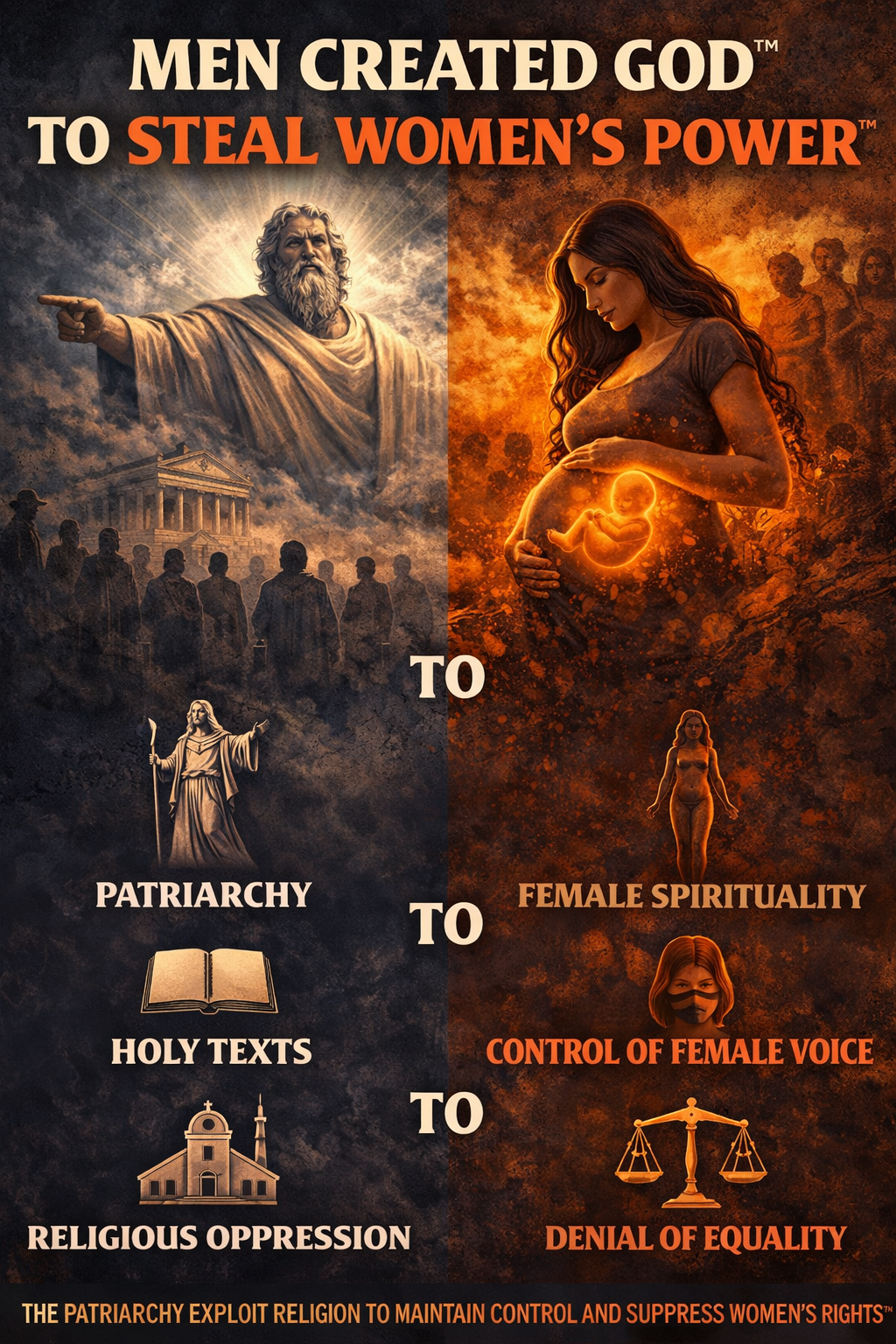
Patriarchy could not out-create women, so it declared itself divine.
Here is the thought women are still not supposed to say out loud:
Men made God male because they could not stand that women are the closest thing to creation they had ever seen.
– Not close to creation in a poetic sense. Not in some soft, symbolic, decorative sense.
-Not in the sanitized language patriarchy prefers when discussing women’s bodies.
In the most literal sense possible. Women create life. Whole human beings are formed in women’s bodies. Blood becomes body. Flesh becomes future. Breath arrives through pain. Humanity passes through women first.
Maybe that truth was always too powerful. Too obvious. Too humiliating to male ego. So patriarchy did what it has always done when women possess a power it cannot replicate:
Stole the meaning of that power, reassigned it to men, and called the theft sacred.
That is what this argument is really about.
– Not whether every religious person is sexist. Not whether all spirituality is fake.
-Not whether every man consciously sat down and invented a sky father to oppress women.
This is about something deeper and older: The possibility that patriarchal civilization could not emotionally tolerate women as the visible source of human life, so it built a world where the ultimate creator had to be male.
Once you see that possibility, whole centuries of religion, gender roles, purity culture, motherhood worship, and female subordination begin to look less like coincidence and more like design.
The Problem Patriarchy Had From the Beginning
Patriarchy’s first problem was not political. It was biological.
The class it wanted to dominate was the class that produced the species. Think about how destabilizing that is.
- Men could organize armies. Women could make people.
- Men could write laws. Women could grow lungs, hearts, brains, and bones.
- Men could claim authority in public. Women carried the private miracle that made public life possible at all.
If you are building a male-dominated society, this is an unbearable contradiction.
How do you convince the world that men are primary when the most undeniable act of creation on earth happens inside women?
You cannot erase the fact. Everyone is born. So you do something more sophisticated. You build a story bigger than biology.
A story that relocates creation away from the female body. A story that says the real source of life is not the woman bleeding in childbirth, but the male power above her.
That story is one of patriarchy’s greatest inventions.
Women Were the First Evidence of Creation
Before doctrine, there was the body. Before scripture, there was pregnancy. Before sermons about who holds authority, there was the oldest human mystery of all: a woman becoming more than one person at once.
Imagine what that must have meant in the ancient world. Before modern medicine, before sonograms, before genetic science, before hormones were named and chromosomes mapped, the female body must have seemed almost incomprehensible in its power.
- A body could swell and split open and another human would emerge.
- A body could feed life from itself.
- A body could survive a pain that has terrified humanity for all of history.
If early humans saw anything on earth that looked like divinity, it was probably that. That is exactly why feminism has every reason to question what happened next.
Somehow, across so much of recorded history, women did not end up recognized as the highest symbol of power. They ended up managed.
- Restricted.
- Interpreted by men.
- Morally regulated.
- Spiritually supervised.
- Politically minimized.
That reversal should disturb anyone paying attention.
The Male Creator Solved a Male Problem
Let’s say it plainly: A male god solves the psychological problem female creation poses to male supremacy.
– If women create life physically, then patriarchy answers by creating a male source of life metaphysically.
– If women are the visible origin of humanity, patriarchy invents a higher invisible origin and makes it male.
– If women have embodied creative power, patriarchy elevates disembodied masculine authority above embodiment itself.
Suddenly, the most important creation is no longer pregnancy. It is command.
- No longer labor. It is decree.
- No longer the womb. It is the word.
- No longer the mother. It is the Father.
That is not a small symbolic adjustment. That is a transfer of civilizational power.
It tells the world: yes, women may produce children, but men remain closer to ultimate authorship. Women may generate life, but male authority defines life’s meaning. Women may do the actual creating, but men still own the story of creation.
That is how patriarchy wins: not just by taking labor, but by taking interpretation.
Patriarchy Never Needed to Destroy Women’s Power Completely
It Only Needed to Rename It
This is one of the oldest tricks in the book. Patriarchy does not always crush women’s power head-on. Sometimes it praises that power just enough to trap it.
- It says motherhood is sacred, but mothers are subordinate.
- It says women are precious, but not powerful.
- It says women are life-givers, but not leaders.
- It says women are morally central, but politically secondary.
- It says women are to be protected, which somehow always means controlled.
This is not reverence. It is containment. Women’s reproductive labor has always been essential. Patriarchy knows that. It relies on it. It cannot survive without it.
But if women ever fully understood the scale of that power—if women were recognized not as support characters in civilization but as its biological foundation—male supremacy would look absurd. So patriarchy reframed the female body as duty rather than power. Sacrifice rather than authority. Service rather than sovereignty.
Above all, it elevated masculine symbols over feminine realities.
That is why this conversation is not fringe. It goes to the center of how domination works.
Every Man Who Claimed Divine Authority Came Through a Woman
There is almost something grotesque about the arrogance of patriarchy when you say the facts plainly enough.
– Every priest who told women to submit came through a woman.
– Every king who ruled over women came through a woman.
– Every theologian who defined women as lesser came through a woman.
– Every man who called God “Father” was carried first by a mother.
Men built entire civilizations on top of women’s bodies and then wrote women out of the throne room of meaning. How is that not theft? How is that not appropriation at the deepest level?
Women made human continuity possible, but men made themselves the interpreters of why life exists. Women sustained generations, but male institutions claimed the right to define morality, truth, law, and the sacred.
That is not natural order. That is power consolidating itself.
“God the Father” Is Not Just Theology
It Is Politics Wearing Eternity
This is where people get defensive. They want religion to feel untouched by history, untouched by gender, untouched by power. But feminist analysis does not grant institutions that innocence.
– Religions are built in societies.
– Societies have hierarchies.
– Hierarchies protect themselves.
So when the sacred is overwhelmingly named in masculine terms, interpreted by men, administered by men, enforced by men, and used to justify male leadership, women are not irrational for asking a dangerous question:
What if male god-language is not simply revelation, but patriarchy speaking in a voice too elevated to question? That is the genius of sacred hierarchy. It makes male rule feel cosmic instead of political.
Then fathers are not just authority figures. They mirror God.
Male leadership is not just tradition. It is divine order.
Female submission is not just social control. It is holiness.
This is how patriarchy launders itself. It turns male dominance into metaphysics.
Once that happens, women are not merely resisting men. They are accused of resisting heaven.
The Female Body Was the First Temple
Patriarchy Turned It Into a Crime Scene
Look at how patriarchal cultures treat the body that creates life.
- Menstruation becomes impurity.
- Sexual autonomy becomes danger.
- Pregnancy becomes obligation.
- Childbirth becomes expected sacrifice.
- Motherhood becomes mandatory virtue.
- Infertility becomes shame.
- Desire becomes suspect.Aging becomes invisibility.
This is not the behavior of a civilization comfortable with women’s power. This is the behavior of a civilization terrified of it. You do not obsess over regulating something that is weak.
You regulate what is powerful. You regulate what can upend your hierarchy. You regulate what you depend on but cannot fully control. You regulate what reminds you, constantly, that your authority may be social while someone else’s power is elemental.
That is why patriarchy surrounds the female body with shame, rules, fear, and moral panic. It is not because women are lesser.
It is because women are too central.
Maybe Men Did Not Hate Women
Maybe They Hated What Women Made Obvious
Some people will reject the word hate. Fine. Replace it with what makes them more comfortable: fear, resentment, insecurity, envy, discomfort, dependence, symbolic panic.
The point remains.
Patriarchal systems have never known how to peacefully coexist with female creative power. They have sexualized it, punished it, romanticized it, confined it, legislated it, moralized it, and turned it into doctrine.
Why? Because women make something men cannot.
Male supremacy is fundamentally unstable if it has to admit that the bodies it devalues are the bodies that make the world possible.
That instability matters. Because once women are understood not as accessories to civilization but as its literal creators, the old hierarchy starts to crack.
Patriarchy has spent thousands of years making sure that crack never widens.
The Most Successful Theft in History Was Symbolic
People talk about stolen labor. Stolen land. Stolen wages. Stolen credit. All of that matters. But there is another kind of theft that may be even more foundational: stolen meaning.
Women’s capacity to create life should have made women central to humanity’s spiritual imagination. Instead, patriarchal culture performed a symbolic inversion.
- It took creation and made it male.
- It took authority and made it male.
- It took transcendence and made it male.
- It took judgment and made it male.
- It took authorship and made it male.
Then it left women with the pain, the risk, the labor, the caregiving, and the expectation to remain grateful.
That is not just oppression. That is narrative conquest.
It is the seizure of reality at the level of symbol. Once symbols are taken, institutions follow.
This Is Why Feminism Frightens Patriarchy More Than It Admits
Feminism is not threatening because it is irrational. It is threatening because it names what patriarchy wants to keep invisible.
- It names that women’s bodies have been exploited while women’s authority has been denied.
- It names that reverence for motherhood often masks contempt for mothers.
- It names that “traditional values” often mean male access to female labor.
- It names that religious symbolism has frequently sanctified the social order men benefited from.
It names the one thing patriarchy most desperately needs women never to fully believe:
- that women are not secondary beings asking for inclusion in a male world.
- Women are the precondition of the world.
- That realization is explosive.
Once women stop seeing themselves as derivative, helpmate, vessel, support system, moral backdrop, or sacred assistant to male power, the whole architecture of patriarchy starts looking like what it is— not divine truth, but a defense mechanism.
The Question That Refuses to Go Away
Here is the question buried underneath all the outrage this argument triggers:
If women create the people, why have men been permitted to claim creation’s meaning?
- Why were women reduced to the body while men claimed the soul?
- Why were women assigned labor while men claimed authorship?
- Why were women made responsible for life while men positioned themselves as the voice of life’s ultimate source?
That is not just a theological question. It is a feminist one.
Yes, it cuts straight through centuries of romantic language, family values rhetoric, religious tradition, and male-centered philosophy.
Because maybe the issue was never that women were too weak to rule. Maybe the issue was that women were too powerful to leave uninterpreted.
The Real Controversy Is Not the Claim
It Is How Much of History It Explains
People will say this argument is too much. Too sharp. Too cynical. Too disrespectful. Too angry. But what exactly is so offensive about it?
- That it questions male authority?
- That it questions religious symbolism?
- That it refuses to sentimentalize patriarchy?
- That it notices a world in which men repeatedly placed themselves above the very people whose bodies made their existence possible?
Maybe the real reason this idea feels scandalous is because it reaches too close to something history has worked very hard to bury. Not the fact that women create life. Everyone knows that.
The fact that male-dominated systems may have been built, in part, to psychologically and politically contain the consequences of that truth.
Once that possibility enters the room, everything changes.
The Line Patriarchy Never Wanted Women to Finish
So let’s finish it. Women create life.
Patriarchy could not tolerate that truth as a foundation of female power. So it built religions, symbols, moral codes, and hierarchies that lifted male authority above female creation.
Then it taught the world to call that natural. That is the argument.
- Not neat.
- Not gentle.
- Not designed to make powerful people comfortable.
Feminism was never meant to comfort power. It was meant to expose it.
The Ending Patriarchy Deserves
Maybe men did not need to create life biologically if they could seize creation spiritually. Maybe they could not become the source of humanity in flesh, so they made themselves the source of humanity in story. Maybe “God the Father” was not only a figure of faith, but patriarchy’s greatest cover story—a way to place men above women without ever having to out-create them.
Because in the end, that may be the oldest patriarchal panic of all: women were already doing the miracle.
Men just claimed the authorship.
Future Implications: What Happens When Women Reclaim the Narrative?
If patriarchy has spent centuries positioning male authority as divine, then one of the most radical acts of the future will be women reclaiming authorship over power, creation, morality, and the sacred.
The implications of that shift are enormous.
When women begin to reject inherited narratives that frame male dominance as natural, holy, or necessary, entire systems begin to crack. Religion is no longer untouchable. Tradition is no longer automatically virtuous. Authority is no longer respected simply because it is old, male, and draped in sanctified language. Once women name the possibility that patriarchy did not merely govern society but shaped the very stories society tells about God, life, and order, it becomes impossible to go back to innocence.
That awakening will not stay confined to theology. It will spill into politics, family structures, reproductive rights, education, culture, and language. It will change how women understand their bodies. It will change how girls understand their worth. It will change how motherhood is discussed, how leadership is imagined, and how spiritual legitimacy is defined. It will force a reckoning with every institution that has used reverence for women symbolically while denying women power materially.
The future implication is not just that women will ask harder questions. It is that women will stop asking permission to ask them.
And when that happens, patriarchal systems will likely respond the way they always have: with ridicule, outrage, moral panic, and accusations of blasphemy, bitterness, selfishness, or extremism. But those reactions are not proof that feminist critique is wrong. They are often proof that it has struck a nerve.
Because the deeper women push into this conversation, the more destabilizing the truth becomes: if women create life, then every ideology that has reduced women to subordinates while relying on women for human continuity deserves to be reexamined from the ground up.
The future will belong to those willing to expose old power in new language. And feminism is doing exactly that.
Call to Action: Stop Protecting the Story That Protected Patriarchy
If this argument angers you, sit with that anger.
Ask yourself why the idea feels so threatening. Ask yourself why questioning male-centered religious power feels more offensive than centuries of women being controlled by it. Ask yourself why women are expected to respect traditions that did not respect women in return.
This is where passive agreement is not enough.
Do not just nod at feminist critique in private and then go silent in public. Do not praise women’s strength while continuing to defend the structures that weakened them. Do not celebrate mothers while ignoring the systems that exploit, shame, regulate, and erase women. Do not call yourself pro-woman while refusing to challenge the sacred language that has historically kept male dominance above scrutiny.
Start naming what you see.
Question inherited narratives.
Question why authority is so often imagined as male.
Question who wrote the rules, who benefited from them, and who was told those rules came from God.
Question every institution that teaches women submission and calls it virtue.
Question every framework that praises women’s sacrifice more than it protects women’s sovereignty.
And most of all, stop treating feminist analysis like it is too dangerous to say out loud.
Share the argument.
Start the conversation.
Write the uncomfortable post.
Say the thing you were taught not to say.
Because patriarchy survives not only through force, but through silence. It depends on women second-guessing themselves, softening their critiques, and shrinking their truths into something more socially acceptable.
Do not shrink this one.
If women create life, then women have every right to challenge the systems that stole the meaning of that power and handed it to men.
That is not extremism.
That is intellectual refusal.
That is political clarity.
That is feminist courage.
FAQ
Is this article saying all religion is fake?
No. This article is not claiming that all spirituality or all faith is false. It is arguing that patriarchal societies have historically shaped religious language, institutions, and authority structures in ways that elevated men and subordinated women. The target here is patriarchal power, not every individual believer.
Is this anti-men?
No. It is anti-patriarchy. Those are not the same thing. Patriarchy is a system that organizes power in ways that privilege male authority and diminish women’s autonomy, labor, and humanity. Critiquing that system is not hatred of men; it is a challenge to dominance.
Are you saying men literally invented God?
The article is making a feminist argument about how male-dominated cultures may have shaped concepts of God, authority, and creation in ways that served patriarchy. It is not claiming there is one simple historical moment where men sat down and consciously fabricated religion. It is saying that the image of a male creator can function as a patriarchal transfer of power away from women’s embodied creative force.
Why focus so much on women’s reproductive power?
Because reproductive power has never been treated as merely biological. Under patriarchy, it becomes social, political, religious, and economic. Women’s bodies have been regulated precisely because they are powerful. This article examines how that power may have been symbolically appropriated and subordinated.
Isn’t this too controversial?
It is controversial because it challenges ideas that have long been protected from feminist scrutiny. But controversy alone does not make an argument false. In many cases, the most controversial feminist ideas are the ones that expose the deepest contradictions in patriarchal culture.
What about women who are not mothers or cannot have children?
This argument is not saying a woman’s worth comes from motherhood. That would repeat patriarchal logic. The point is that patriarchy has historically built itself around controlling women’s reproductive capacity because of its social power. Feminist critique is about exposing that control, not reducing women to biology.
What if someone believes in God and is also a feminist?
Then this article can still be useful. Many feminists are religious or spiritual. The purpose of this piece is not to force women out of faith, but to challenge male-dominated interpretations of faith and to ask whether patriarchy has been mistaken for divine truth.
Why does this argument matter now?
Because women are still living under systems that regulate their bodies, moralize their choices, romanticize their suffering, and deny their full authority. The connection between patriarchy, sacred language, and social control is not ancient history. It is still shaping law, politics, family life, and public debate right now.
References and Intellectual Grounding
This article is a feminist argument and cultural critique, not a claim of single-cause historical certainty. It draws from a long tradition of feminist thought that examines patriarchy as both a political system and a symbolic order. The ideas explored here are informed by feminist critiques of religion, gendered power, embodiment, and social hierarchy. Relevant areas of thought include:
Feminist theology — especially critiques of male god-language, male religious authority, and the exclusion of women from defining the sacred.
Radical feminism — particularly its focus on patriarchy as a foundational system of power that organizes women’s bodies, labor, sexuality, and reproductive lives around male dominance.
Feminist philosophy — including questions about embodiment, authorship, symbolic power, and the relationship between culture and hierarchy.
Women’s history and gender studies — especially scholarship on reproductive control, purity systems, motherhood, inheritance, and the policing of female autonomy.
Cultural criticism — examining how myths, narratives, and symbols normalize social structures and make domination appear natural or divine.