How Having Children Costs Women But Not Men
A Nobel Prize Built on a Simple, Devastating Question
In October 2023, Harvard economist Claudia Goldin became the first woman to win the Nobel Prize in Economics as a sole recipient. Her decades of research answered a deceptively simple question: why, in an era of expanded education and legal equality, do women still earn less than men? The answer, she found, lay not primarily in discrimination against women as a class, but in what happens to individual women the moment they have children.
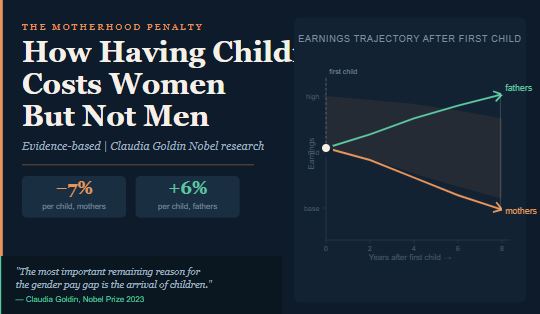
Goldin’s landmark work traced women’s labor force participation across more than a century of American history, identifying what she called the “career-family gap” as the central remaining driver of the gender pay gap. Her research demonstrated that the earnings trajectories of men and women run nearly parallel until the arrival of a first child — at which point they diverge sharply, and largely do not reconverge. This is the motherhood penalty: a measurable, durable, and compounding reduction in earnings, career advancement, and economic security that falls almost exclusively on mothers.
“The most important remaining reason for the gender pay gap is not discrimination. It is the arrival of children.” — Claudia Goldin, Nobel Lecture, 2023
What the Data Actually Show: Sizing the Penalty
The motherhood penalty is not a marginal effect. It is large, consistent across countries and income levels, and well-documented by multiple independent research programs spanning decades.
Research using U.S. Census Bureau Survey of Income and Program Participation (SIPP) data — one of the most granular longitudinal income datasets available — finds that women’s hourly wages fall by roughly 4 percent for each child they have. Over a career with two children, this compounds into a wage trajectory that diverges dramatically from that of childless women or men with children. A 2014 analysis published in the American Sociological Review by Shelley Correll, Stephen Benard, and In Paik put the per-child wage penalty at approximately 7 percent in controlled experimental conditions, where evaluators were shown identical resumes differing only in parenthood status.

Pew Research Center analysis corroborates the magnitude of these findings at the population level. Among adults aged 18–44, Pew found that mothers are far more likely than fathers to have reduced work hours, turned down a promotion, or left a job entirely because of caregiving responsibilities. About 42 percent of mothers reported having done at least one of these things, compared to 28 percent of fathers — and the economic consequences are not symmetrical.
The Fatherhood Bonus: When Children Raise Earnings
If the motherhood penalty is the penalty side of the equation, the fatherhood bonus is the other side — and it makes the asymmetry starker. Numerous studies have found that men’s wages do not fall when they have children. In many cases, they rise.
Sociologist Michelle Budig’s research, drawing on the National Longitudinal Survey of Youth, found that men receive an average wage premium of approximately 6 percent per child. This fatherhood bonus persists even after controlling for education, work experience, and job characteristics. Married fathers, in particular, tend to receive the largest premiums — a finding consistent with employer perceptions that fatherhood signals stability, commitment, and reliability.
Men earn, on average, a 6% wage premium per child. Women face a 4–7% penalty. The same life event produces opposite economic outcomes depending on sex.
The mechanisms behind the fatherhood bonus appear to operate through several channels. Experimental audit studies show that evaluators rate fathers as more competent and more committed to their employers than non-fathers — a perception not extended to mothers, who are frequently rated as less committed regardless of their actual performance record. Additionally, fathers tend to increase their working hours after the birth of a child, while mothers disproportionately reduce theirs — a behavioral response that is itself shaped by wage incentives and structural constraints rather than preference alone.
When the Penalty Kicks In and How It Compounds
One of Goldin’s most important empirical contributions was tracing the precise timing and trajectory of the penalty. Her analysis, drawing on earnings data across professions, found that the divergence between men’s and women’s earnings is not present at career entry. College-educated men and women begin their careers at near-parity and remain close in their twenties. The gap opens decisively in the early thirties — which coincide with prime childbearing years in the professional workforce.
This is not merely a snapshot effect. The penalty compounds over time through several reinforcing mechanisms. In the immediate aftermath of childbirth, many mothers reduce their hours or take leave — whether paid or unpaid — resulting in a direct short-term earnings drop. This break or reduction in work accumulates over the medium term as lost experience and seniority, reducing eligibility for promotions and salary increases. Over the long term, women who interrupted careers to raise children face systematically lower peak earnings, reduced pension accumulation, and greater financial vulnerability in old age.
Data from the Institute for Women’s Policy Research illustrate the lifetime scope of this compounding: the average woman in the U.S. loses approximately $400,000 in lifetime earnings compared to a similarly educated man, much of this attributable to the caregiving years.
The Flexibility Premium: Goldin’s Central Mechanism
A key contribution of Goldin’s Nobel-winning framework is the concept of the “flexibility premium” — the disproportionate reward employers attach to workers who are available continuously, willing to work non-linear hours, and able to prioritize client or employer demands above all else. In many high-earning professions, compensation does not scale linearly with hours: the difference between a 50-hour week and a 60-hour week is not 20 percent more pay, but dramatically more.
This structure is not neutral with respect to parenthood. Mothers — due to both structural realities of childcare availability and deeply embedded social expectations — disproportionately bear the “last resort” caregiver role. When a child is sick, when school closes, when childcare falls through, mothers are more likely to be the one who leaves work. In jobs where such flexibility is penalized heavily, this translates into direct wage consequences.
Goldin’s analysis of professional labor markets found that the gender earnings gap is largest precisely in sectors where the flexibility premium is highest: finance, law, corporate management. It is smallest in sectors where individual hours are substitutable and scheduling is more predictable — notably pharmacy, a profession Goldin used as an illustrative example, where the gender pay gap has narrowed significantly as the profession reorganized work to reduce the premium on individual hour availability.
In pharmacy, where any licensed pharmacist can cover any shift, the gender pay gap has effectively closed. In finance and law, where access to specific individuals commands premium pay, it has not. The difference is structural, not individual.
Race, Class, and the Unequal Distribution of the Penalty
The motherhood penalty does not fall equally across all mothers. Its severity is shaped profoundly by race and class, creating layered disadvantages for women who face multiple structural barriers simultaneously.
Research by Paula England and colleagues has documented that the penalty is largest for high-earning women in professional careers — where the flexibility premium is sharpest and where career interruptions carry the heaviest long-term wage consequences. However, low-income mothers face a different and in some respects more acute version of the penalty: they are least likely to have access to paid family leave, most dependent on unreliable or unaffordable childcare, most likely to work jobs with rigid, unpredictable scheduling, and most likely to lose employment entirely following childbirth rather than simply seeing wages fall.
For Black mothers in the United States, the penalty intersects with a broader racial wage gap. Analysis by the Economic Policy Institute shows that Black women, already earning substantially less than white men at baseline, see the motherhood penalty compound on top of a pre-existing structural disadvantage. Indigenous women and Latinas face similar compounding effects. Asian American women experience somewhat different patterns by subgroup but are not exempt from the general dynamic.
Single mothers are in the most economically precarious position: they face the full wage penalty of motherhood while also carrying the full financial responsibility of a household with no second income to absorb the shock of reduced earnings or career interruptions.
What Causes the Penalty? Separating Myth from Evidence
Popular explanations for the motherhood penalty often locate its source in women’s choices — in their supposed preference for part-time work, less demanding careers, or domestic life. The empirical record tells a more complicated story that does not reduce comfortably to individual preference.
Audit studies — the gold standard in discrimination research, because they hold all other variables constant — consistently find a penalty for motherhood that operates independently of actual productivity or work behavior. In the canonical Correll, Benard, and Paik study, evaluators rating identical fictional resumes offered mothers lower starting salaries, rated them as less competent, and held them to stricter performance standards than childless women or fathers. The mothers in the study had done nothing differently — only the notation of parenthood changed, and it changed outcomes substantially.
This points to a significant component of the penalty that is not driven by women’s behavior at all, but by employer perception and implicit bias. At the same time, the structural reality that mothers disproportionately reduce hours and career involvement is real — and it occurs within a context where unpaid care work falls heavily on women, quality childcare is expensive or unavailable, and paid family leave is limited in the United States relative to peer economies. Separating “choice” from “constrained response to structural conditions” is analytically important.
The evidence suggests both dimensions are real: there is measurable discrimination based on motherhood status, and there are structural conditions that make reduced career engagement a rational, if not freely chosen, response for many mothers. Policy that addresses only one of these roots will be incomplete.
International Comparisons: Why the Penalty Varies
The motherhood penalty is not a fixed law of economics. Its magnitude varies substantially across countries — and these differences map onto policy environments in ways that are analytically instructive.
Scandinavian countries, which combine generous parental leave, subsidized universal childcare, and strong labor protections, show substantially smaller motherhood penalties than the United States. Sweden’s gender earnings gap, while not zero, is among the smallest in the OECD, and research by Claudia Olivetti and Barbara Petrongolo finds that cross-country variation in the motherhood penalty tracks closely with the availability and structure of family support policies.
Importantly, however, the design of parental leave policies matters as much as their generosity. Countries with long, non-transferable maternity leave — where fathers are not incentivized or required to take leave themselves — can actually widen the penalty by reinforcing the assumption that career interruptions are a female concern. The most effective policy combinations appear to be: relatively short maternity leave paired with substantial, non-transferable paternity leave (the “daddy quota” model pioneered by Norway and Iceland), affordable universal childcare that enables earlier return to full-time work, and labor market regulations that limit the flexibility premium in professional jobs.
Norway’s introduction of non-transferable paternity leave quotas — take it or lose it — shifted fathers’ caregiving behavior and reduced, over time, the earnings gap attributable to the caregiving asymmetry at the root of the motherhood penalty.
Policy Interventions With Evidence of Effect
Several categories of policy intervention have demonstrated measurable capacity to reduce the motherhood penalty, though no single instrument eliminates it entirely.
Paid family leave, when well-designed, reduces the immediate earnings hit of childbirth. California’s Paid Family Leave program, implemented in 2004 and one of the few state-level programs with longitudinal data, has been associated with increased maternal labor force attachment and higher earnings in the years following birth among lower-income mothers. Federal paid leave in the United States remains limited by international standards: the Family and Medical Leave Act provides 12 weeks of unpaid leave — effective primarily for workers with sufficient savings and job security to use it.
Subsidized childcare has perhaps the strongest evidence base of any single intervention. Research by economist Francine Blau and colleagues shows that childcare availability is among the strongest predictors of maternal labor force participation. Countries that moved from limited to universal childcare coverage saw measurable increases in women’s employment rates and earnings trajectories. The cost of childcare in the United States — averaging over $15,000 per year per child in many cities — functions as an effective tax on mothers’ employment, often consuming a substantial share of secondary-earner wages.
Wage transparency and pay equity legislation reduce the discrimination component of the penalty by making it harder to systematically underpay mothers without organizational accountability. The UK’s gender pay gap reporting requirements, introduced in 2017, have produced measurable, if gradual, narrowing in reported gaps at the firm level.
Finally, workplace flexibility reform — reducing the structural flexibility premium that Goldin identified as central to the penalty — can narrow the gap in high-earning professions. Where employers restructure work to allow job-sharing, substitutable coverage, and flexible scheduling without earnings penalty, the gap between mothers’ and fathers’ earnings tends to narrow.
Conclusion: A Penalty That Policy Can Shrink
The motherhood penalty is not an inevitable artifact of biology or preference. It is a labor market outcome produced by a specific combination of structural conditions: the concentration of unpaid caregiving on women, the underinvestment in childcare infrastructure, the premium on continuous unlimited availability in professional careers, and implicit bias that treats motherhood as evidence of reduced professional commitment. Goldin’s Nobel Prize-winning framework, buttressed by decades of empirical research from labor economists, sociologists, and policy analysts, makes the mechanisms visible and therefore actionable.
The gender pay gap, in this light, is not primarily a story about women in the aggregate versus men in the aggregate. It is, as Goldin put it, a story about what happens to individual women — and individual men — when they become parents. Until that asymmetry is addressed at the structural level, through paid leave, affordable childcare, non-transferable paternity leave, and workplace redesign, the penalty will persist as one of the most durable and consequential forms of economic inequality in modern societies.
The evidence does not suggest that eliminating the motherhood penalty requires any particular political ideology. It requires taking seriously what the data have shown, consistently, for decades: the labor market, left unreformed, prices parenthood very differently depending on sex. That is a policy problem. It has policy solutions.
The data is clear. The mechanisms are understood. The question now is not whether the motherhood penalty is real — it is whether societies will choose to address the structural conditions that make it inevitable.
KEY SOURCES & FURTHER READING
- Goldin, Claudia. Career and Family: Women’s Century-Long Journey toward Equity. Princeton University Press, 2021.
- Goldin, Claudia. Nobel Prize Lecture: “Why Women Won.” The Royal Swedish Academy of Sciences, December 2023.
- Correll, Shelley J., Stephen Benard, and In Paik. “Getting a Job: Is There a Motherhood Penalty?” American Sociological Review, vol. 112, no. 5, 2007, pp. 1297–1338.
- Budig, Michelle J. “The Fatherhood Bonus and the Motherhood Penalty: Parenthood and the Gender Gap in Pay.” Third Way, September 2014.
- U.S. Census Bureau, Survey of Income and Program Participation (SIPP). Longitudinal earnings data, multiple waves.
- Pew Research Center. “On Pay Gap, Millennial Women Near Parity — For Now.” December 2013. / “Gender and Caregiving.” Multiple reports, 2015–2022.
- Olivetti, Claudia, and Barbara Petrongolo. “The Economic Consequences of Family Policies: Lessons from a Century of Legislation in High-Income Countries.” Journal of Economic Perspectives, vol. 31, no. 1, 2017.
- Economic Policy Institute. “Persistent Racial and Gender Wage Gaps.” 2023.
- Institute for Women’s Policy Research. “The Gender Wage Gap: 2022.” Washington, D.C., 2023.