How Kimberlé Crenshaw’s Foundational Framework Transforms the Way We Design Policy for Everyone
In 1989, a law professor named Kimberlé Crenshaw sat down to write what would become one of the most cited legal articles of the twentieth century. She was trying to explain something that seemed, to her, almost embarrassingly obvious: that a Black woman’s experience of discrimination could not be fully understood by looking at race alone, or at sex alone. You had to look at both — and at the place where they crossed.
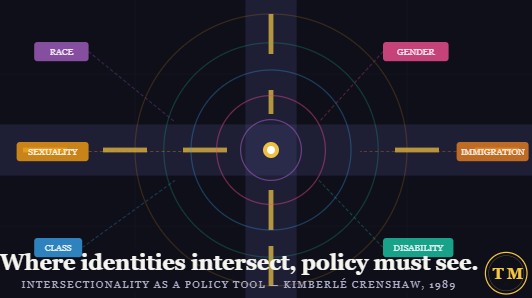
To make her point, she reached for a metaphor. Imagine, she wrote, a traffic intersection. Cars move through it from multiple directions. If someone is struck in that intersection, it matters from which direction the harm came — and sometimes, the harm comes from multiple directions at once. A Black woman standing at the intersection of race and sex could be hit from either direction, or both simultaneously, and the legal system of the time was poorly equipped to recognize any of it (Crenshaw, 1989).
That article, “Demarginalizing the Intersection of Race and Sex: A Black Feminist Critique of Antidiscrimination Doctrine, Feminist Theory and Antiracist Politics,” gave a name to something many people had long felt but struggled to articulate. That name was intersectionality. More than three decades later, the concept has migrated far beyond legal scholarship — into sociology, public health, education, and, crucially, policy design. Yet as the word has traveled, it has accumulated a reputation as ideological jargon, a term deployed more for signaling than for substance.
That reputation is undeserved and, frankly, counterproductive. Intersectionality is not a values statement. It is an analytical tool — one that helps policymakers see the people their programs most often miss.
Where the Concept Came From — and What It Actually Means
To understand intersectionality as a policy instrument, it helps to return to where it began: in the observation that antidiscrimination law, as it existed in the late 1980s, was designed to address single-axis discrimination. You could bring a claim based on race, or a claim based on sex, but the legal framework struggled to process a claim based on both simultaneously (Crenshaw, 1989).
Crenshaw illustrated this with a series of employment discrimination cases. In DeGraffenreid v. General Motors, Black women sued a company whose seniority system had the effect of laying off all Black women first — because the company had only begun hiring Black women after 1964, meaning they had the least seniority. The court refused to recognize the claim. The company hired Black people (mostly men, in the foundry). The company hired women (mostly white women, in clerical roles). Therefore, the court reasoned, there was no discrimination against Black people or women per se. The specific harm experienced by Black women — sitting precisely at the intersection of both categories — was invisible to a framework that could only see one axis at a time (Crenshaw, 1989).
This is what intersectionality, at its analytical core, is about. It is the recognition that social categories — race, gender, class, disability, sexuality, immigration status — do not operate independently. They interact with one another, and those interactions produce experiences and outcomes that cannot be predicted by looking at any single category in isolation. A framework that treats them as independent variables will systematically misunderstand — and therefore misserve — the people who live at their intersections.
From Legal Theory to Policy Analysis
Crenshaw’s original intervention was aimed at law, but the logic extends directly into policy design. Policy, like law, tends to be built around categories. A health program targets “women.” A workforce development initiative targets “minorities.” A poverty-reduction strategy targets “low-income households.” Each of these framings assumes a relatively homogeneous group and designs interventions accordingly.
Intersectional analysis challenges that assumption. It asks: within this target population, are there subgroups whose circumstances differ so substantially from the average that a one-size approach will fail them? It asks who is missing from the data, who falls through the cracks between programs, and whose needs are rendered statistically invisible by aggregation.
This is not, it bears emphasizing, merely a matter of being more inclusive in a vague moral sense. It is a matter of policy effectiveness. Programs that fail to account for intersecting disadvantages tend to produce results that look acceptable in aggregate while concealing deep inequities in distribution. The average improves; the most vulnerable do not (Centers for Disease Control and Prevention [CDC], 2024).
In this sense, intersectional analysis is a precision tool. It disaggregates. It surfaces. It reveals the shape of a problem beneath its average.
Crenshaw’s original intervention was aimed at law, but the logic extends directly into policy design. Policy, like law, tends to be built around categories. A health program targets “women.” A workforce development initiative targets “minorities.” A poverty-reduction strategy targets “low-income households.” Each of these framings assumes a relatively homogeneous group and designs interventions accordingly.
Intersectional analysis challenges that assumption. It asks: within this target population, are there subgroups whose circumstances differ so substantially from the average that a one-size approach will fail them? It asks who is missing from the data, who falls through the cracks between programs, and whose needs are rendered statistically invisible by aggregation.
This is not, it bears emphasizing, merely a matter of being more inclusive in a vague moral sense. It is a matter of policy effectiveness. Programs that fail to account for intersecting disadvantages tend to produce results that look acceptable in aggregate while concealing deep inequities in distribution. The average improves; the most vulnerable do not (Centers for Disease Control and Prevention [CDC], 2024).
In this sense, intersectional analysis is a precision tool. It disaggregates. It surfaces. It reveals the shape of a problem beneath its average.
The Social Determinants Framework as Intersectional Infrastructure
One of the most developed institutional frameworks for thinking about overlapping disadvantage is the social determinants of health (SDOH) model, which the CDC defines as the conditions in the environments where people are born, live, learn, work, play, worship, and age that affect a wide range of health, functioning, and quality-of-life outcomes and risks (CDC, 2024).
The SDOH framework identifies five broad domains: economic stability, education access and quality, health care access and quality, neighborhood and built environment, and social and community context. Each of these domains can independently shape health outcomes. But the framework’s power — and its implicit intersectionality — comes from recognizing that these domains compound one another. A person who lacks economic stability is more likely to live in an under-resourced neighborhood, which affects educational quality, which affects employment prospects, which circles back to economic stability (CDC, 2024).
Now add race. Or disability. Or immigration status. The compounding effects become steeper, the feedback loops tighter, the exit ramps fewer. What intersectional analysis contributes to the SDOH framework is an insistence that these compounding effects are not random — they follow the contours of social categories, and policy responses must be designed with that structure in mind (CDC, 2024).
A health intervention that improves access to care for “low-income women” without accounting for the fact that low-income Black women face documented discrimination within health care settings — affecting both their willingness to seek care and the quality of care they receive when they do — is a policy that will underperform for precisely the people it nominally targets (Crenshaw, 1989).
The Pay Gap as a Case Study in Single-Axis Failure
Few policy issues illustrate the limits of single-axis analysis more clearly than the gender pay gap. The aggregate number — that women earn roughly 83 cents for every dollar earned by men — is real and significant (National Partnership for Women & Families [NPWF], 2023). It is also, from an intersectional standpoint, severely incomplete.
When the pay gap is disaggregated by race, the picture changes dramatically. The National Partnership for Women & Families analysis of wage data reveals that while white, non-Hispanic women earn approximately 79 cents for every dollar earned by white, non-Hispanic men, Black women earn approximately 69 cents, Native American women approximately 59 cents, and Latina women approximately 54 cents (NPWF, 2023). Asian American women, as a group, appear to approach pay parity with white men, but that aggregate itself conceals enormous variation across national-origin subgroups, with some Southeast Asian women earning substantially below the overall average (NPWF, 2023).
These are not minor rounding errors around a stable average. They represent differences of tens of thousands of dollars in lifetime earnings — differences that shape retirement security, housing stability, and intergenerational wealth. A pay equity policy designed around the generic gender gap — one that targets the 83-cent figure as the problem to be solved — will structurally underserve the workers who face the largest gaps. It will optimize for the women closest to the average, who are disproportionately white and college-educated, while leaving the largest inequities largely untouched (NPWF, 2023).
This is not a hypothetical concern. It is a documented pattern in how pay equity legislation has historically been framed, litigated, and enforced (Crenshaw, 1989).
What Intersectional Analysis Reveals That Single-Axis Analysis Misses
The pay gap example points toward a broader principle: intersectional analysis is not merely more granular than single-axis analysis — it reveals a qualitatively different picture of social reality. There are at least three things intersectional analysis surfaces that single-axis approaches systematically obscure.
The first is interaction effects. Race and gender do not simply add their disadvantages together; they interact in ways that can amplify discrimination. Research on hiring discrimination finds, for example, that Black women sometimes face distinct patterns of bias that differ from those faced by Black men or by white women — not simply the sum of racial and gender bias, but a specific form of intersectional discrimination (Crenshaw, 1989). Policy that addresses racial discrimination and gender discrimination as separate tracks will not capture this.
The second is invisibility by aggregation. When data are collected and reported at the group level — “women,” “Black Americans,” “low-income households” — intersecting subgroups are averaged into categories that may not reflect any actual person’s experience. The aggregate looks manageable; the disaggregated reality does not. Intersectional analysis demands that data collection and reporting practices be designed to make intersecting subgroups visible (NPWF, 2023).
The third is policy leakage. Programs designed around single categories often have eligibility criteria, service structures, or delivery mechanisms that systematically exclude people at intersections. A domestic violence program designed primarily around the experience of white middle-class women may inadequately serve immigrant women, who face additional barriers including language access, fear of deportation, and economic dependency — barriers that require intersectionally informed responses (CDC, 2024).
How Policymakers Can Apply Intersectional Analysis in Practice
Acknowledging the theoretical validity of intersectionality is necessary but not sufficient. The harder question is methodological: how do policymakers actually use it?
Several practical approaches have been developed. The first is intersectional data collection. At the most basic level, intersectional analysis requires data that captures multiple dimensions of identity simultaneously. This means collecting and reporting data disaggregated by combinations of race, gender, class, disability status, and other relevant categories — not just separately. The CDC’s SDOH framework, for instance, increasingly supports data collection that links health outcomes to overlapping social determinants rather than treating each determinant in isolation (CDC, 2024).
The second is equity impact assessment. Before a policy is implemented, policymakers can ask: how will this affect different intersectional subgroups? Which groups will benefit most? Which might be left behind? This functions similarly to environmental impact assessment — a structured analytical step that surfaces distributional consequences before they become entrenched.
The third is community-centered design. Crenshaw’s original insight emerged not from abstract theory but from listening to the specific experiences of Black women — people who could articulate the gap between their experience and what existing frameworks recognized (Crenshaw, 1989). Effective intersectional policy design similarly requires meaningful involvement of the communities most affected, not as a perfunctory consultation step but as a substantive source of analytical insight.
The fourth is disaggregated evaluation. Programs should be evaluated not only on average outcomes but on outcomes across intersectional subgroups. If a program produces strong average results while leaving the most vulnerable subgroups unchanged, that is not a success — it is a success for some and a failure for others (NPWF, 2023).
Acknowledging the theoretical validity of intersectionality is necessary but not sufficient. The harder question is methodological: how do policymakers actually use it?
Several practical approaches have been developed. The first is intersectional data collection. At the most basic level, intersectional analysis requires data that captures multiple dimensions of identity simultaneously. This means collecting and reporting data disaggregated by combinations of race, gender, class, disability status, and other relevant categories — not just separately. The CDC’s SDOH framework, for instance, increasingly supports data collection that links health outcomes to overlapping social determinants rather than treating each determinant in isolation (CDC, 2024).
The second is equity impact assessment. Before a policy is implemented, policymakers can ask: how will this affect different intersectional subgroups? Which groups will benefit most? Which might be left behind? This functions similarly to environmental impact assessment — a structured analytical step that surfaces distributional consequences before they become entrenched.
The third is community-centered design. Crenshaw’s original insight emerged not from abstract theory but from listening to the specific experiences of Black women — people who could articulate the gap between their experience and what existing frameworks recognized (Crenshaw, 1989). Effective intersectional policy design similarly requires meaningful involvement of the communities most affected, not as a perfunctory consultation step but as a substantive source of analytical insight.The fourth is disaggregated evaluation. Programs should be evaluated not only on average outcomes but on outcomes across intersectional subgroups. If a program produces strong average results while leaving the most vulnerable subgroups unchanged, that is not a success — it is a success for some and a failure for others (NPWF, 2023).
The Resistance to Intersectionality — and Why It Misunderstands the Tool
Intersectionality has attracted significant political resistance, much of it built on mischaracterizations of what the concept actually claims. Critics often frame it as an assertion that certain groups are inherently oppressed and others are inherently oppressive — a kind of static hierarchy of victimhood. This framing is analytically wrong.
Intersectionality, as Crenshaw developed it, is not a theory of fixed hierarchy. It is a framework for understanding how social structures — employment systems, legal categories, health care institutions, housing markets — interact with social identities to produce unequal outcomes. It does not require claiming that any individual is solely oppressor or solely oppressed; it requires examining how systems operate (Crenshaw, 1989).
The resistance also sometimes takes the form of what might be called the complexity objection: that intersectionality makes policy design impossibly complicated, that you cannot design programs for every conceivable combination of social categories. This objection misunderstands how the tool is meant to be used. Intersectional analysis does not demand that policymakers design a separate program for every subgroup. It demands that policymakers ask whether their programs are inadvertently excluding or underserving specific subgroups — and adjust accordingly. That is not complexity for its own sake. It is due diligence (CDC, 2024).
Intersectionality Across Policy Domains — A Broader View
While the pay equity example is particularly well-documented, the analytical logic of intersectionality applies across virtually every policy domain.
In housing policy, analyses that focus on racial disparities in homeownership or eviction rates without accounting for gender reveal an incomplete picture. Single Black mothers, for instance, face eviction rates significantly higher than those of Black men or white women — a pattern that reflects the intersection of race, gender, and family structure, and that requires policy responses calibrated to that intersection (CDC, 2024).
In criminal justice reform, advocates for sentencing reform have long noted that reform efforts focused primarily on racial disparities in incarceration can obscure the specific situation of women — particularly Black and Indigenous women — whose pathways into incarceration often involve histories of abuse, poverty, and limited access to legal representation that differ substantially from the modal male incarceration pathway (Crenshaw, 1989).
In education policy, achievement gap analyses that disaggregate by race or by income level but not both simultaneously can miss the fact that the intersection of race and poverty is associated with compounding disadvantages in school quality, teacher experience, and disciplinary practices that are not visible when either dimension is examined in isolation (NPWF, 2023).
In each case, the intersectional question is the same: who is being averaged into a category in ways that obscure their specific situation, and what would change about our policy response if we could see them clearly?
Conclusion — Seeing Clearly as a Policy Obligation
Kimberlé Crenshaw named intersectionality to make visible what single-axis frameworks had rendered invisible. The Black women in the cases she analyzed were not missing from the legal system by accident. They fell through the gaps precisely because the categories available to the law — race, sex — had been defined by reference to experiences that were not theirs. The law had a vision problem, not a values problem. Intersectionality was the corrective lens (Crenshaw, 1989).
Thirty-five years later, policy design retains much of the same vision problem. Programs are still routinely designed around modal experiences within broad categories, and the people who sit at intersections — who are often the most disadvantaged precisely because they face compounding barriers — remain the most likely to be underserved. The SDOH framework gives us a vocabulary for the structures that compound disadvantage; intersectional pay data gives us a concrete picture of how compounding plays out in material terms; Crenshaw’s foundational theoretical work gives us the analytical architecture to connect the two (CDC, 2024; Crenshaw, 1989; NPWF, 2023).
The question is not whether intersectionality is too complicated to operationalize. The question is whether policymakers are willing to do the disaggregation, collect the data, and design the evaluations that would make the most vulnerable people in their target populations visible. That is not a theoretical commitment. It is a methodological one — and it is well within the reach of any serious policy institution.
The word has become contentious. The tool has not become less necessary.
References
- Centers for Disease Control and Prevention. (2024). Social determinants of health. U.S. Department of Health and Human Services. https://www.cdc.gov/about/sdoh/index.html
- Crenshaw, K. (1989). Demarginalizing the intersection of race and sex: A Black feminist critique of antidiscrimination doctrine, feminist theory and antiracist politics. University of Chicago Legal Forum, 1989(1), 139–167.
- National Partnership for Women & Families. (2023). America’s women and the wage gap. https://www.nationalpartnership.org/our-work/economic-justice/wagegap/americas-women-and-the-wage-gap.html