As trust in traditional parties declines, nearly half of Americans are charting their own political path.

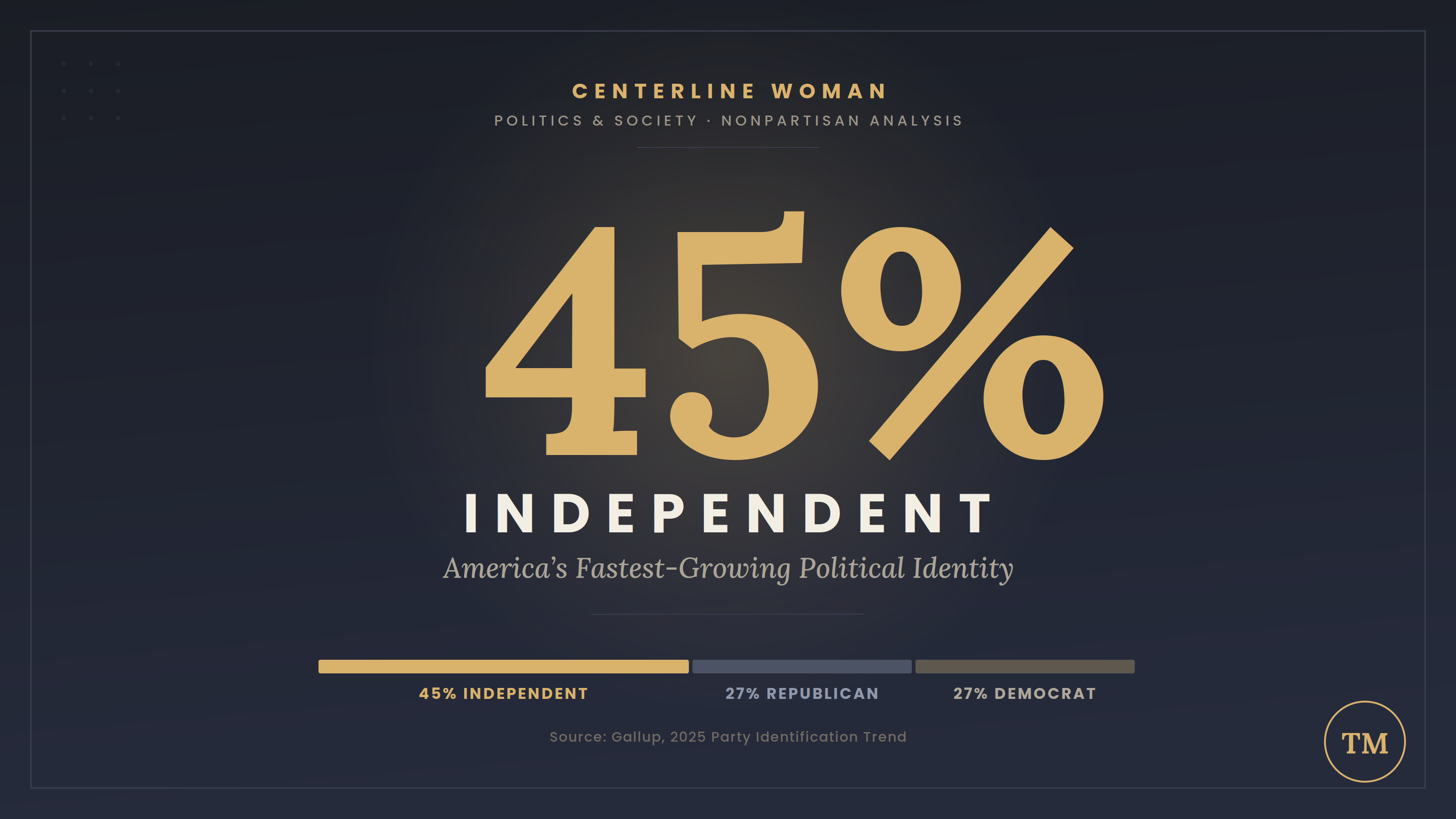
In 2025, a record-high 45% of U.S. adults told Gallup they consider themselves political independents, surpassing the previous high of 43% set in 2014, 2023, and 2024 (Jones, 2026). For context: in that same survey, Republicans and Democrats each pulled in 27% — meaning independents are no longer just a swing bloc wedged between the two parties. They are now, by a wide margin, the single largest political identity in the country, outnumbering each of the major parties by nearly twenty points (Jones, 2026).
This isn’t a one-year blip. Gallup has tracked party identification by phone since 1988, and independents have led the field in most years since, with the share holding at 40% or higher consistently since 2011 — a level the country had never reached before that decade (Jones, 2026). What’s new in 2025 is the scale: nearly half the country now declines to call itself Republican or Democrat.
The natural question is why. Is this exhaustion — people simply tired of the noise? Is it evolution — a generational reshaping of what political identity even means? Or is it something else entirely: a quieter form of disengagement that looks like independence from the outside but feels like something closer to giving up?
This piece doesn’t take a side on which party benefits from the trend, because that’s largely beside the point. What’s more interesting, and more durable, is what the shift says about how Americans relate to political identity itself — and that’s worth examining carefully, with real data, before reaching for a tidy explanation.
Who Independents Actually Are
Myth-Busting: Most “Lean,” But the Label Still Matters

Of the 45% of Americans who call themselves independent, the majority do admit to leaning one direction when pressed: 20 percentage points lean Democratic, 15 lean Republican, and only 10 are true non-leaners with no directional tilt at all (Jones, 2026). For decades, this breakdown led many political scientists to treat “leaners” as functionally identical to partisans — people who vote and behave just like Republicans or Democrats but who, for whatever reason, decline the label.
More recent research complicates that picture. Political scientists Samara Klar and Yanna Krupnikov (2016) argue that a meaningful share of self-described independents are not confused or indecisive at all — they are partisans who deliberately go “undercover.” Their research found that people increasingly perceive party affiliation itself as socially undesirable, something that invites judgment from friends, neighbors, and coworkers, and that this perception leads people with clear partisan preferences to claim independence anyway. In other words, the choice to say “I’m independent” is often not a description of uncertain politics — it’s a social and identity decision in its own right, separate from how someone might actually vote.
At the same time, a 2026 Pew Research Center typology study found a sizable cluster of Americans — researchers labeled them the “Tuned-Out Middle” — who genuinely have low political interest, hold mixed or inconsistent positions, and are roughly evenly split rather than secretly aligned with either party (Pew Research Center, 2026). So the 45% figure isn’t one phenomenon; it’s at least two distinct groups layered on top of each other: people hiding a real partisan lean, and people who are authentically in the middle, disengaged, or unsettled. It’s also worth noting that Pew’s own ongoing tracking, using a different survey methodology, puts the comparable independent-or-“something else” figure at 41% as of its most recent measurement — close to Gallup’s number, but a reminder that the exact figure shifts somewhat depending on how the question is asked (Pew Research Center, 2025).
Demographics: Younger Generations Driving the Shift

The growth in independent identification is not evenly distributed across age groups. In 2025, majorities of both Gen Z and millennial adults identified as independents, along with more than four in ten Gen X adults — while only a third or less of baby boomers and Silent Generation adults did the same (Jones, 2026).
What makes this a structural shift rather than a temporary mood is the comparison across time at the same life stage. Today, 56% of Gen Z adults identify as independent. That’s notably higher than the 47% of millennials who said the same back in 2012, when millennials were the age Gen Z is now, and well above the 40% of Gen X adults who identified as independent in 1992 (Jones, 2026). Each successive generation is starting its adult political life less attached to a party than the one before it — and research suggests these patterns, once formed, tend to persist as people age (Jones, 2026).
A 2025 study of Gen Z independents in Arizona reinforces this picture with more texture: independent-identifying Gen Z voters were found to participate in elections at meaningfully lower rates than their partisan peers, and their issue positions didn’t map neatly onto either party — agreeing with Democrats on some questions and Republicans on others (Reilly & Hunting, 2025). That pattern — split allegiance plus lower turnout — suggests that for younger independents, the label may reflect a genuine absence of party fit, not just a generic “none of the above.”
Why People Are Leaving the Labels

Distrust of Institutions Across the Spectrum
Independence doesn’t form in a vacuum. It tends to track with how much people trust the institutions parties are supposed to represent — and on that score, the news has been bleak for years. In 2025, Americans’ average confidence across nine core U.S. institutions Gallup has tracked since 1979 — including Congress, the presidency, banks, and organized religion — sat at just 28%, the fourth consecutive year below 30% (Gallup, 2025b).
What’s notable for the independent story specifically is how differently that erosion shows up across party lines. Confidence among Republicans jumped sharply in 2025, reaching 37%, while Democratic confidence fell to a new low of 26% — producing the widest partisan confidence gap Gallup has measured in 46 years of tracking (Gallup, 2025b). Independents, by contrast, held essentially flat at around 25% confidence, regardless of which party controlled the White House (Gallup, 2025b). Gallup’s broader analysis found the same pattern in trust toward the federal government specifically: independents’ trust hasn’t moved much over the past two years, staying closer to whichever party is currently out of power than to the party in charge (Gallup, 2025c). For partisans, in other words, trust in government seems to depend heavily on who’s running it. For independents, distrust appears more constant — less about who’s currently winning and more about institutions in general.
Negative Partisanship Fatigue
A second force is what political scientists call negative partisanship — political identity defined more by opposition to the other side than affection for one’s own. The concept traces to influential 2012 research by Shanto Iyengar and colleagues, which found that Americans’ feelings toward the opposing party had grown markedly more hostile over recent decades, even in periods when feelings toward one’s own party hadn’t grown any warmer (Iyengar et al., 2012). Subsequent research has tried to measure how this plays out at the ballot box directly: an analysis of the 2020 presidential election found that roughly one in three American voters cast a ballot driven more by opposition to a candidate than support for one — true “negative voting” (Garzia & Ferreira da Silva, 2022).
There’s a plausible link between this dynamic and the rise of independents. If political identity for many people is mostly about who they’re against, then claiming a party label can start to feel like signing on to a fight rather than expressing genuine belief. Gallup’s own 2025 data illustrates the mechanism: independents shifted away from the party in power as presidential approval declined over the course of the year, which is consistent with a pattern in which independents are persuaded less by what either party stands for and more by dissatisfaction with whoever currently holds power (Jones, 2026). Declining to claim either team may be, for some, a way of opting out of a contest that runs on mutual dislike rather than competing visions.
The Social Cost of Party Identity
Party identity also carries real social weight, and increasingly, that weight feels heavier to carry. A 2025 workplace survey of more than 900 U.S. employees found that 68% are uncomfortable discussing politics at work, and 51% said they would consider leaving their job if their employer publicly expressed political views they disagreed with (Monster Worldwide, 2025). Political identity isn’t just costing people comfort at the office — it’s straining personal relationships, too. A 2025 national survey found that 37% of Americans report having experienced a “political breakup” at some point — the end of a relationship driven by political differences. Among those who’d had one, 62% lost a friend over politics, 40% lost a family member, 29% lost a coworker relationship, and 10% lost a romantic partner (University of California, Irvine, 2026).
This is precisely the social terrain Klar and Krupnikov (2016) describe: people increasingly perceive partisan identity as something that invites conflict, judgment, or even the loss of relationships, and many respond by avoiding the label altogether — regardless of what they actually believe. Seen this way, the rise of the independent identity isn’t purely about ideology. For a meaningful share of Americans, it may be a form of social self-protection: a way of staying in the room with people who disagree with you, without wearing a label that turns every conversation into a referendum.
What It Changes

Primaries, Polling, and the Trouble With Reaching Unaffiliated Voters
The practical consequences of this shift show up most clearly in how elections are actually run. As of February 2026, primary election rules vary enormously by state: 14 states require open primaries, 13 require closed primaries, 10 use a semi-closed system, five use a top-two format, and in 11 states, individual parties get to decide their own rules (Ballotpedia, n.d.-b). In closed-primary states, independents — now the largest bloc of voters nationally — are barred from participating in the contest that, in many safely partisan districts, functions as the only election that actually matters (GovFacts, 2025). Closer to home, Oklahoma defaults to closed primaries, though state law gives each party discretion to let registered independents vote in its primary if it chooses to (Ballotpedia, n.d.-b) — a reminder that the rules independents face aren’t uniform even within a single state’s borders, let alone across the country.
This creates a genuine strategic puzzle for campaigns. Independents don’t carry a stable voting history that pollsters and campaign strategists can use to predict turnout or candidate preference the way they can with registered partisans. That makes the country’s largest voting bloc, paradoxically, one of its hardest to model, poll accurately, or target with traditional campaign outreach — a gap that grows more consequential every year the independent share keeps climbing.
The Open vs. Closed Primary Debate
The debate over how to handle this dilemma breaks down into two genuinely competing values, and reasonable people land on different sides depending on which one they weigh more heavily.
The case for open primaries rests on inclusion and moderation. Supporters argue that because candidates in an open system must appeal to a broader electorate — not just the most ideologically committed members of their own party — the process tends to reward more centrist, consensus-building nominees, and gives the country’s largest voting bloc a voice in choosing the candidates who’ll appear on the general election ballot (GovFacts, 2025). It’s worth noting, though, that the research on whether open primaries actually produce more moderate nominees in practice is genuinely mixed — some studies find a real moderating effect, others find little difference compared with closed systems (GovFacts, 2025).
The case for closed primaries rests on freedom of association. Parties, in this view, are private organizations with a constitutional right to choose their own standard-bearers without interference from people who aren’t members — a principle the U.S. Supreme Court has upheld in cases involving party primary rules (Ballotpedia, n.d.-a). Proponents also argue closed primaries protect against strategic “raiding,” in which voters from the opposing party cross over specifically to nominate a weaker candidate for the other side, and that closed systems don’t reliably produce more extreme nominees than open ones do (Ballotpedia, n.d.-a). Neither argument is frivolous: one prioritizes the democratic principle of broad participation, the other prioritizes the associational rights of voluntary political organizations. The country hasn’t settled the question, and with independents now a plurality, the stakes of leaving it unsettled keep rising.
What It Says About Us

There’s a genuinely hopeful reading of all this data, alongside a more sobering one, and both deserve airtime.
The hopeful version: Americans haven’t necessarily given up on politics — they may simply want more options than the current binary offers. Gallup polling from late 2025 found that most Americans continue to say the country needs a third major party, even though enthusiasm for actually voting for one remains soft in practice (Gallup, 2025a). That combination — wanting more choices while hesitating to act on it — looks less like apathy and more like frustration with a system that feels stuck, paired with realistic skepticism about whether a new option could actually win. Read generously, rising independent identification could reflect a desire for solutions over team loyalty: people who want their concerns addressed and are less interested in which jersey gets credit for addressing them.
The more sobering context: the dissatisfaction fueling this shift is broad and longstanding. Gallup has asked Americans to name the nation’s most important problem since 1939, and “government” — encompassing dissatisfaction with elected officials, Congress, and dysfunction broadly — has dominated the list for most of the past decade, registering historically high concern again in early 2026 (Gallup, 2026). One year-end review of Gallup’s national concerns data placed “national disunity” itself among the top five issues Americans named, just behind government, immigration, and the economy (WAMC, 2026). That’s a striking thing to sit with: a meaningful share of the country now lists the fact that we don’t get along as one of the country’s biggest problems — which is a different kind of worry than concern over any single policy fight, and arguably a harder one to legislate away.
Both readings can be true at once. People may be walking away from party labels because they’re tired of a system defined by mutual distrust and a sense that the country itself is coming apart at the seams — and, at the same time, hoping that something better than the current two options might eventually take its place.
Future Implications

Two Theories, Same Data
Political scientists have specific vocabulary for what might be happening here, and the distinction matters because it points toward very different futures. Dealignment describes voters drifting away from party loyalty altogether, without converging on a clear replacement — a long-studied pattern in American electoral behavior (Dalton, 2013). Realignment describes something different: a durable reshuffling in which voters move from one party to another and the system eventually resettles into two camps, just with different members in each (Sundquist, 1983). Both are live possibilities, and the data in this piece is consistent with either one.
The case for dealignment: independents have held a plurality of the country for over a decade without consolidating into any kind of organized third force (Jones, 2026). The case for eventual realignment: the generational pattern in Section II — each cohort entering adulthood more independent than the last, and not reverting to a party as it ages — is exactly the kind of durable shift that, historically, has sometimes preceded a major reshuffling of the two-party system (Sundquist, 1983). Sundquist’s own historical analysis offers a useful caution either way: prior surges in independent identification, including the one driven by Ross Perot’s third-party bids in the 1990s, eventually receded once economic anxiety pulled voters back toward the major parties. It is genuinely too early to know which pattern the country is living through.
The Live Battleground: Primaries and Ballots
While political scientists debate the underlying dynamic, a more concrete fight is already playing out in state legislatures and at the ballot box: whether independents get a meaningful vote before the general election even starts. As of early 2026, seventeen states had passed laws banning ranked-choice voting outright, most of them preemptively, before any ranked-choice election had taken place there (LegalClarity, 2026). At the same time, the system continues to expand at the local level — roughly fifty jurisdictions nationwide now use it for municipal races, Washington, D.C. adopted it alongside open primaries in a 2024 ballot measure that took effect this year, and organizers in Michigan are collecting signatures for a 2026 constitutional amendment that would bring it to one of the country’s largest swing states (FairVote, 2026).
Oklahoma has its own version of this fight underway. State Question 836 would have replaced the state’s closed primary system with a top-two open primary, letting every registered voter — independents included — vote in the same primary regardless of party. Organizers submitted roughly 209,000 signatures, but the Secretary of State’s office certified only 142,567 as valid against a required 172,993, and the measure fell short of the 2026 ballot; its backers are now appealing that signature count to the Oklahoma Supreme Court (Ballotpedia, n.d.-c; KOSU, 2026). Whatever the outcome, the fact that a campaign like this could gather that many signatures at all is its own kind of data point about how this issue is landing closer to home.
A Caveat About Forecasts Like This One
It’s worth being honest about the limits of any forward-looking claim, including the ones above. Some independent-focused advocacy organizations describe the current moment in far more definitive terms — one group argues that independents could outright surpass both major parties in raw numbers by 2028, completing a realignment it says has been building since 2012 (Independent Center, 2025). That’s a genuine perspective, but it comes from an organization whose explicit mission is mobilizing independents as a political bloc, which is a different thing from a neutral projection. The more cautious academic read is that the same historical record showing independence rising also shows it falling back whenever a galvanizing economic or political event pulls people toward a major party again (Sundquist, 1983). Both outcomes remain plausible, and it will likely take several more election cycles before anyone can say with confidence which one the country is actually living through.
So — Do You Still Claim a Label?

Whatever the precise mix of causes — institutional distrust that doesn’t ebb and flow with who’s in charge, exhaustion with negative partisanship, the very real social cost of wearing a party label at work or around the family dinner table, or a genuine generational rethinking of what political identity should mean — the result is a structural fact about the country that’s hard to argue with: independents are no longer a swing bloc wedged between two larger groups. They’re the largest single political identity in America, full stop.
We’d genuinely like to know where you land. Do you still claim “Republican” or “Democrat” as part of how you describe yourself — and if so, why does that label still feel worth keeping? Or have you, like a growing share of the country, set it down? Tell us in the comments, or find us on the Centerline Woman podcast with Pip and Mara, where we’ll be picking this question back up.
References
Ballotpedia. (n.d.-a). Arguments for and against closed primaries. Retrieved June 17, 2026, from https://ballotpedia.org/Arguments_for_and_against_closed_primaries
Ballotpedia. (n.d.-b). Primary election types by state. Retrieved June 17, 2026, from https://ballotpedia.org/Primary_election_types_by_state
Gallup. (n.d.). Most important problem: Historical trends. Gallup News. Retrieved June 17, 2026, from https://news.gallup.com/poll/1675/most-important-problem.aspx
Gallup. (2025a). Americans see need for third party, but offer soft support. Gallup News. https://news.gallup.com/poll/696521/americans-need-third-party-offer-soft-support.aspx
Gallup. (2025b). Democrats’ confidence in U.S. institutions sinks to new low. Gallup News. https://news.gallup.com/poll/692633/democrats-confidence-institutions-sinks-new-low.aspx
Gallup. (2025c). U.S. trust in government depends upon party control. Gallup News. https://news.gallup.com/poll/697421/trust-government-depends-upon-party-control.aspx
Gallup. (2026). Government still leads as nation’s top problem. Gallup News. https://news.gallup.com/poll/702719/government-leads-nation-top-problem.aspx
Garzia, D., & Ferreira da Silva, F. (2022). The electoral consequences of affective polarization? Negative voting in the 2020 US presidential election. American Politics Research. https://doi.org/10.1177/1532673X221074633
GovFacts. (2025, December 5). Primary elections: Open, closed, and everything in between. https://govfacts.org/elections-voting/elections-systems/primary-elections-caucuses/primary-elections-open-closed-and-everything-in-between/
Iyengar, S., Sood, G., & Lelkes, Y. (2012). Affect, not ideology: A social identity perspective on polarization. Public Opinion Quarterly, 76(3), 405–431. https://doi.org/10.1093/poq/nfs038
Jones, J. M. (2026, January 12). New high of 45% in U.S. identify as political independents. Gallup News. https://news.gallup.com/poll/700499/new-high-identify-political-independents.aspx
Klar, S., & Krupnikov, Y. (2016). Independent politics: How American disdain for parties leads to political inaction. Cambridge University Press.
Monster Worldwide. (2025, October 14). Nearly 7 in 10 workers are uncomfortable discussing politics at work [Press release]. PR Newswire. https://www.prnewswire.com/news-releases/nearly-7-in-10-workers-are-uncomfortable-discussing-politics-at-work-302580869.html
Pew Research Center. (2025, December 16). Party affiliation fact sheet (NPORS). https://www.pewresearch.org/politics/fact-sheet/party-affiliation-fact-sheet-npors/
Pew Research Center. (2026, June 10). Tuned-out middle: The 2026 political typology. https://www.pewresearch.org/politics/2026/06/10/tuned-out-middle/
Reilly, T., & Hunting, D. (2025). Understanding the Gen Z independent voter: An exploratory study. Politics & Policy, 53(3), Article e70038. https://doi.org/10.1111/polp.70038
University of California, Irvine. (2026, May 7). New study finds increase in “political breakups.” UCI News. https://news.uci.edu/2026/05/07/new-study-finds-increase-in-political-breakups/
WAMC. (2026, January 5). Our nation’s biggest problem is also its potential solution. https://www.wamc.org/commentary-opinion/2026-01-05/our-nations-biggest-problem-is-also-its-potential-solution