
Centerline Woman Blog
The public demonstration organized by Patriot Front in Washington, D.C., on July 4, 2026, during the United States’ 250th Independence Day celebration generated widespread national attention and renewed debate over domestic extremism, constitutional rights, misinformation, and democratic accountability. Hundreds of masked participants marched through the nation’s capital carrying organizational banners, American flags, and Confederate flags while chanting “Reclaim America.” The event occurred alongside official Independence Day celebrations, placing two competing visions of American identity into the same public space.
Public reaction was immediate and polarized. Some observers viewed the demonstration as evidence of a growing white nationalist movement, while others questioned whether the event had been staged or manipulated by political opponents. Within hours, social media platforms circulated unsupported claims alleging that the march was a “false flag” operation involving left-wing organizations, undercover federal agents, or advocacy groups. At the same time, professional journalists, photojournalists, and law enforcement agencies documented the demonstration as a Patriot Front event led by members of the organization, including its founder, Thomas Rousseau.
The rapid spread of conflicting narratives illustrates a broader challenge facing democratic societies. Political events increasingly unfold within an information environment in which verified reporting competes with speculation, emotionally charged commentary, and algorithmically amplified misinformation. Communication researchers have shown that individuals are more likely to accept information that reinforces existing beliefs, even when contradictory evidence exists (Lewandowsky et al., 2020). This phenomenon—commonly described as confirmation bias—contributes to political polarization by encouraging selective acceptance of information that aligns with prior attitudes (Nickerson, 1998).
This article does not seek to defend or condemn any political party or ideology. Rather, its purpose is to examine the July 4 demonstration through historical evidence, empirical research, constitutional principles, and documented reporting. A nonpartisan approach requires evaluating evidence consistently regardless of whether it confirms or challenges one’s political preferences.
Political extremism is not a new phenomenon in American history. Since the nineteenth century, the United States has experienced recurring waves of organized extremist activity, including violent campaigns associated with the Ku Klux Klan, neo-Nazi organizations, revolutionary movements on the far left, anti-government militias, and religiously motivated extremists (Federal Bureau of Investigation [FBI], 2024). While these organizations differ substantially in ideology, researchers consistently observe common patterns of radicalization, identity formation, propaganda, and recruitment (McCauley & Moskalenko, 2017).
Understanding organizations such as Patriot Front requires distinguishing between constitutionally protected expression and the content of that expression. The First Amendment broadly protects peaceful political speech, including speech that many citizens find offensive or reprehensible. Simultaneously, constitutional protection does not shield ideas from public criticism, scholarly analysis, or democratic debate. The ability to reject extremist ideologies peacefully is itself a defining feature of democratic society.
The following sections examine Patriot Front’s origins, leadership, historical context, and the broader implications of the July 4 demonstration while emphasizing evidence over speculation.

Patriot Front: Origins and Organizational Development
Patriot Front emerged in August 2017 following the violent “Unite the Right” rally in Charlottesville, Virginia. The organization was created after Thomas Rousseau separated from Vanguard America, another white nationalist organization that had received extensive public attention following the Charlottesville violence. Rather than abandoning the underlying ideological framework, Rousseau reorganized former members into what became Patriot Front, adopting new branding, stricter organizational discipline, and a more carefully managed public image.
Researchers at the George Washington University Program on Extremism describe Patriot Front as a white nationalist and fascist organization advocating for an ethnically homogeneous American nation while rejecting multiculturalism, immigration, and demographic diversity. The organization frequently promotes conspiracy theories related to the so-called “Great Replacement,” a false claim alleging that demographic changes are part of a coordinated effort to replace White Americans with minority populations. These narratives have been identified by scholars as recurring themes within contemporary white nationalist movements (George Washington University Program on Extremism, n.d.).
Unlike many earlier extremist organizations, Patriot Front has emphasized visual branding and disciplined public presentation. Members typically appear in coordinated uniforms consisting of khaki pants, navy shirts, white face coverings, baseball caps, and sunglasses. Marches often feature synchronized movement, banners, drums, and professionally designed graphics. Researchers argue that this highly structured appearance is intended to communicate organizational strength, discipline, and legitimacy while concealing individual identities (Anti-Defamation League [ADL], 2025).
The organization’s propaganda strategy reflects broader shifts in extremist communication. Historically, white supremacist organizations relied heavily on printed newsletters, local meetings, and public rallies. Patriot Front instead combines physical demonstrations with sophisticated digital dissemination through encrypted messaging platforms, social media, professionally designed graphics, and coordinated video production. These methods enable rapid distribution of ideological messaging while limiting exposure of individual members.
Data compiled by the Anti-Defamation League have repeatedly identified Patriot Front as one of the most active distributors of white supremacist propaganda in the United States in recent years. Propaganda incidents documented by the organization include banner drops, flyers, stickers, demonstrations, and coordinated public appearances designed to maximize media attention while minimizing direct confrontation. Although the ADL is an advocacy organization rather than a government agency, its annual tracking reports are frequently cited in scholarly literature examining domestic extremist movements.
One notable feature of Patriot Front is its emphasis on anonymity. Face coverings are mandatory during public demonstrations, and members are generally discouraged from revealing their identities. According to researchers studying the organization, anonymity serves multiple functions: protecting members from public identification, reducing personal accountability, and reinforcing group identity over individual identity. Social psychology research suggests that anonymity within groups may increase conformity and reduce individual perceptions of responsibility, a process known as deindividuation (Festinger et al., 1952; Zimbardo, 1969).
The July 4, 2026 demonstration reflected these organizational characteristics. Approximately 400 participants marched in coordinated formation through Washington, D.C., carrying Patriot Front flags, Confederate flags, and American flags while chanting slogans emphasizing exclusionary definitions of national identity. Professional photojournalists documented the event extensively, including images showing Thomas Rousseau participating in the march. These photographs contributed to public discussion because they provided direct visual evidence linking the organization’s publicly identified leadership to the demonstration.
Thomas Rousseau and Leadership

Thomas Ryan Rousseau founded Patriot Front at age 18 following internal divisions within Vanguard America. Unlike many leaders of extremist organizations who attempt to remain anonymous, Rousseau has publicly acknowledged his leadership role and has become the principal public face of Patriot Front. Researchers note that he has sought to rebrand white nationalist activism by replacing overt neo-Nazi symbolism with imagery rooted in American nationalism, patriotic iconography, and references to the nation’s founding traditions.
Political scientists describe this strategy as one of ideological reframing. Rather than changing underlying ideological objectives, organizations alter symbols, language, and public messaging to broaden appeal and reduce social stigma (Mudde, 2019). Patriot Front’s use of American flags, references to patriotism, and emphasis on “reclaiming America” reflects this communication strategy.
Rousseau has also emphasized centralized organizational control. Academic studies of extremist organizations suggest that hierarchical leadership structures often facilitate message discipline, coordinated propaganda campaigns, and standardized recruitment practices (Blee, 2018). Patriot Front’s consistent appearance across multiple demonstrations—including identical clothing, coordinated marching formations, and uniform messaging—illustrates this organizational approach.
Understanding Rousseau’s leadership is important because extremist organizations are rarely spontaneous collections of individuals. They typically develop through structured leadership, ideological training, and strategic communication. Examining these organizational dynamics allows scholars to analyze how extremist movements evolve without conflating them with broader political communities or assuming that they represent any larger population.
Historical Development of White Nationalism in the United States
Understanding Patriot Front requires placing the organization within the broader historical development of white nationalist movements in the United States. Although the ideology promoted by contemporary extremist organizations differs in presentation from earlier movements, historians have documented recurring themes involving racial hierarchy, exclusionary definitions of citizenship, anti-immigrant sentiment, and the use of patriotic symbolism to legitimize discriminatory beliefs (Berlet & Lyons, 2000; Belew, 2018).
The origins of organized white supremacist violence in the United States can be traced to the period immediately following the American Civil War. During Reconstruction, organizations such as the Ku Klux Klan emerged to resist newly established civil rights for formerly enslaved African Americans through intimidation, violence, and terrorism. Congress ultimately responded through the Enforcement Acts of 1870 and 1871, commonly known as the Ku Klux Klan Acts, which expanded federal authority to prosecute organized political violence (Foner, 1988).
The twentieth century witnessed additional waves of organized extremism. During the 1920s, the second Ku Klux Klan expanded beyond the South, attracting millions of members by combining racial prejudice with anti-Catholic, anti-Jewish, and anti-immigrant rhetoric. Historians note that this movement framed itself as defending “Americanism,” illustrating how extremist organizations have frequently adopted patriotic language while advocating exclusionary policies (MacLean, 1994).
Following World War II, openly pro-Nazi organizations became politically marginalized. However, white supremacist activism did not disappear. Instead, it evolved through fragmented organizations, including neo-Nazi groups, segregationist movements opposing the Civil Rights Movement, skinhead organizations, and later anti-government militia networks (Belew, 2018).
A significant transformation occurred during the rise of the internet. Digital communication dramatically reduced barriers to recruitment by allowing geographically isolated individuals to connect with ideological communities online. Researchers describe this process as “networked extremism,” in which decentralized digital platforms facilitate ideological dissemination without requiring formal organizational membership (Conway, Scrivens, & Macnair, 2019).
Contemporary organizations such as Patriot Front operate within this digital environment. Unlike earlier extremist groups that relied primarily on local meetings and printed newsletters, modern organizations combine online propaganda with carefully staged public demonstrations designed to generate widespread media attention. This hybrid strategy reflects broader changes in political communication rather than a fundamentally new ideological framework.
Importantly, scholars emphasize that extremist organizations remain numerically small relative to the overall American population. Their visibility often exceeds their membership because highly public demonstrations, coordinated propaganda campaigns, and social media amplification generate disproportionate public attention (Miller-Idriss, 2020). Consequently, public visibility should not be interpreted as evidence of widespread public support.
The July 4, 2026 March in Washington, D.C.
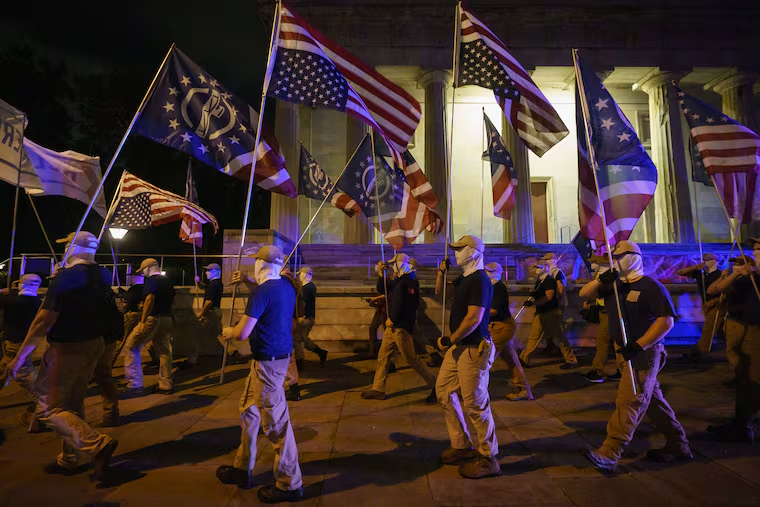
The Patriot Front demonstration on July 4, 2026, attracted national attention because of both its timing and location. Occurring during the United States’ semiquincentennial celebration, the march juxtaposed a nationally commemorated civic holiday with the public display of an extremist organization’s political message.
According to verified reporting, approximately 400 masked Patriot Front members marched through Washington, D.C., wearing standardized clothing consisting of khaki pants, navy shirts, white face coverings, and baseball caps. Participants carried Patriot Front banners and American flags while chanting slogans as they moved through the city under police observation. Law enforcement monitored the event, managed traffic, and reported no major violence or arrests. The demonstration concluded without significant confrontation.
Photographs from Reuters, Getty Images, and other professional news organizations documented Thomas Rousseau participating in the march. These images became significant because they directly linked the organization’s publicly identified founder with the event, reducing uncertainty regarding organizational responsibility. Visual documentation by multiple independent journalists also strengthened confidence in the factual record surrounding the demonstration.
One widely circulated image depicted Patriot Front members standing in a Washington Metro railcar surrounding a lone Black passenger. The photograph generated extensive public discussion because viewers interpreted it through different historical and social lenses. Some viewed the image primarily as evidence of racial intimidation, while others emphasized the broader symbolism of extremist organizations occupying shared public spaces during a national celebration. Regardless of interpretation, the image illustrates how photographs often become powerful political symbols extending beyond the events they capture.
Political communication scholars have long observed that visual media frequently shapes public understanding more powerfully than written descriptions. Images compress complex events into memorable narratives, often influencing emotional reactions before audiences examine accompanying factual reporting (Hariman & Lucaites, 2007). Consequently, photographs can simultaneously inform public understanding while contributing to intensified political polarization.
It is equally important to distinguish between constitutional protections and public approval. Under longstanding First Amendment jurisprudence, peaceful political demonstrations generally receive constitutional protection even when the underlying viewpoints are widely rejected by society. Courts have consistently maintained that constitutional protections apply based upon the nature of speech rather than its popularity. This principle remains one of the defining characteristics of constitutional democracy.
Public disagreement with an organization’s message, therefore, should not be confused with legal authority to prohibit peaceful expression. Democratic societies protect offensive speech while allowing equally vigorous public criticism through peaceful civic engagement.
False Flag Claims, Political Misinformation, and the Role of Evidence
Almost immediately following the July 4 demonstration, social media platforms became saturated with competing explanations regarding the identity of the marchers. Some users asserted that Patriot Front had organized the demonstration. Others alleged that participants were undercover federal agents, political opponents, or members of unrelated organizations conducting a coordinated “false flag” operation.
As of this writing, no credible publicly available evidence supports claims that the July 4 demonstration was organized by Antifa, the FBI, the Southern Poverty Law Center, or other groups frequently mentioned in online speculation. Multiple independent news organizations documented the event as a Patriot Front march, and photographs showed Thomas Rousseau participating alongside other members.

The rapid emergence of competing narratives reflects broader patterns identified within misinformation research. Lewandowsky et al. (2020) found that individuals frequently accept information that confirms preexisting beliefs while discounting contradictory evidence. This tendency, known as confirmation bias, influences people across the political spectrum rather than affecting only one ideological group (Nickerson, 1998).
Social media platforms further intensify this process through algorithmic amplification. Content that generates strong emotional responses—including anger, outrage, fear, and moral condemnation—is more likely to receive engagement, increasing its visibility regardless of factual accuracy (Vosoughi, Roy, & Aral, 2018). As a result, emotionally compelling misinformation may spread more rapidly than carefully verified reporting.
Political scientists describe false flag narratives as a recurring feature of highly polarized political environments. Throughout history, competing factions have frequently alleged hidden conspiracies following controversial events, particularly when accepting responsibility would create political or psychological discomfort. Such narratives are not unique to any single ideology; they have appeared across numerous countries and political contexts.
Researchers recommend several evidence-based practices for evaluating controversial claims:
- Examine whether multiple independent news organizations report the same facts.
- Distinguish documented evidence from speculation or anonymous social media posts.
- Evaluate whether photographs, videos, and official statements corroborate one another.
- Be willing to revise conclusions as new verified evidence becomes available.
These practices reflect the core principles of information literacy and scientific reasoning. They do not require agreement on political ideology; rather, they require a shared commitment to evaluating evidence consistently.
The July 4 march illustrates how democratic societies face two simultaneous challenges: confronting organized extremism while resisting the spread of misinformation about that extremism. Addressing only one challenge while neglecting the other risks weakening public trust in democratic institutions.
Domestic Extremism: What the Evidence Shows

Domestic extremism has become an increasing focus of researchers, law enforcement agencies, and policymakers during the past two decades. Although extremist violence has taken many ideological forms—including racially motivated, anti-government, religiously motivated, and anarchist violence—scholars consistently emphasize that each movement should be evaluated according to its own ideology, organizational structure, and demonstrated behavior rather than broad political labels (Federal Bureau of Investigation [FBI], 2024; National Institute of Justice [NIJ], 2022).
The FBI defines domestic terrorism as criminal acts dangerous to human life that are intended to intimidate or coerce a civilian population or influence government policy, when those acts occur primarily within the United States (FBI, 2024). Importantly, holding extremist beliefs alone is not a crime. Criminal liability generally arises from illegal conduct rather than ideology. This distinction reflects a fundamental constitutional principle: the United States protects even highly offensive beliefs unless they are connected to unlawful acts or fall within recognized exceptions to First Amendment protections.
Researchers at the National Consortium for the Study of Terrorism and Responses to Terrorism (START) have documented substantial variation in domestic extremist activity over time. Rather than following a steady trajectory, extremist movements tend to expand and contract in response to political events, economic uncertainty, social conflict, and technological change (START, 2024). Public demonstrations, online recruitment, and propaganda campaigns often increase during periods of heightened political polarization.
Academic research also demonstrates that visibility should not be confused with size. Organizations capable of staging coordinated demonstrations often receive media coverage that far exceeds their actual membership. Media attention, however, can unintentionally amplify extremist messaging by increasing public awareness of the organization. For this reason, many scholars recommend reporting that focuses on factual documentation while avoiding sensationalism (Miller-Idriss, 2020).
The July 4, 2026 Patriot Front march illustrates this tension. Approximately 400 members reportedly participated, according to the organization and journalists on the scene. While the demonstration received national attention because of its symbolism and timing, researchers caution against interpreting one public event as evidence of widespread public support. Instead, it is more accurate to view such demonstrations as examples of strategic public communication intended to maximize visibility.
Another important finding from empirical research is that extremist organizations frequently seek legitimacy through disciplined public presentation. Patriot Front’s coordinated clothing, standardized banners, synchronized marching, and carefully managed public image are consistent with broader research showing that extremist groups often attempt to project organizational competence and unity as part of recruitment efforts (Blee, 2018).
The Psychology of Extremist Recruitment and Radicalization
Understanding why individuals join extremist organizations remains one of the central questions in political psychology and criminology. Contrary to common stereotypes, research does not support the conclusion that all members of extremist groups share a single psychological profile. Instead, radicalization typically results from the interaction of personal, social, political, and environmental factors (McCauley & Moskalenko, 2017).
One influential framework proposes that radicalization develops through a combination of perceived grievance, identity, and social belonging. Individuals experiencing personal uncertainty, social isolation, or perceived injustice may become more receptive to groups that provide clear explanations for complex societal problems. Extremist organizations often offer members a sense of purpose, identity, and community while framing political issues in simple moral terms.
Social identity theory provides additional insight into this process. According to Tajfel and Turner (1979), people naturally categorize themselves into social groups. Under certain conditions, strong identification with an “in-group” may be accompanied by increased hostility toward perceived “out-groups.” Extremist organizations frequently exploit this psychological tendency by portraying outsiders as threats to the group’s identity or survival.

Digital communication has transformed recruitment strategies. Rather than relying exclusively on face-to-face meetings, organizations increasingly use encrypted messaging platforms, social media, professionally produced videos, and graphic design to reach potential recruits. Researchers describe this environment as one in which repeated exposure to ideological content can normalize increasingly extreme viewpoints over time (Conway et al., 2019).
Importantly, radicalization is neither inevitable nor irreversible. Studies indicate that protective factors—including strong family relationships, community engagement, educational opportunities, and exposure to diverse viewpoints—can reduce susceptibility to extremist messaging (NIJ, 2022). Programs emphasizing critical thinking, media literacy, and civic participation have shown promise in strengthening resilience against misinformation and ideological manipulation.
Researchers also emphasize that preventing radicalization requires avoiding simplistic explanations. Economic hardship alone does not explain extremism, nor does mental illness. Most individuals facing financial stress or psychological challenges never become involved in extremist organizations. Instead, recruitment generally reflects a complex interaction of individual experiences, social networks, ideological messaging, and broader political contexts (McCauley & Moskalenko, 2017).
Patriotism, Nationalism, and Democratic Identity
One of the most significant themes surrounding the July 4, 2026 march concerns the distinction between patriotism and nationalism. Although the terms are often used interchangeably in everyday conversation, political scientists generally regard them as related but distinct concepts.
Patriotism refers to affection for one’s country, its institutions, and its civic ideals. Democratic patriotism emphasizes constitutional government, equal citizenship, and commitment to democratic processes regardless of race, religion, or ancestry (Kohn, 1944). This understanding allows individuals from diverse backgrounds to share a common national identity while maintaining different cultural traditions.
Nationalism, by contrast, encompasses a broad range of political beliefs concerning national identity and sovereignty. Civic nationalism defines membership through shared political values and citizenship, whereas ethnic nationalism emphasizes ancestry, ethnicity, or cultural heritage as the basis for national belonging (Smith, 1991). Most democratic societies contain elements of both traditions, though constitutional democracies generally emphasize civic rather than ethnic conceptions of nationhood.
Researchers studying extremist organizations note that groups such as Patriot Front seek to redefine national identity using ethnonationalist frameworks. Their public messaging often incorporates familiar patriotic symbols—including American flags, references to the nation’s founders, and Revolutionary imagery—while advancing an exclusionary understanding of who belongs within the national community. Scholars describe this communication strategy as an effort to increase perceived legitimacy by associating ideological objectives with widely respected national symbols (Snow et al., 1986).
The First Amendment protects the use of political symbols, even when many citizens strongly disagree with the message being conveyed. At the same time, democratic societies depend upon the public’s ability to debate competing interpretations of national identity through peaceful civic participation rather than intimidation or violence.
The July 4 march therefore raises broader questions extending beyond one organization. How should democratic societies respond when extremist groups adopt national symbols? How can constitutional freedoms be preserved while resisting efforts to normalize exclusionary ideologies? These questions have confronted democratic governments throughout history and remain subjects of ongoing scholarly debate.
Rather than offering simple answers, political science research encourages careful distinction between constitutional rights, political rhetoric, organizational behavior, and public accountability. Maintaining these distinctions helps reduce polarization while promoting evidence-based civic discussion.
The First Amendment, Extremist Speech, and Democratic Society

One of the enduring tensions within American constitutional democracy is the balance between protecting freedom of expression and responding to speech that many citizens view as hateful, exclusionary, or threatening. The July 4, 2026 Patriot Front demonstration illustrates this tension. Although the organization’s ideology has been widely criticized by scholars, civil rights organizations, and public officials, the demonstration itself was monitored as a protected public assembly because there were no reported acts that removed it from constitutional protection during the event.
The legal foundation for protecting controversial speech rests largely on the First Amendment to the U.S. Constitution. Over several decades, the U.S. Supreme Court has established that the government generally may not prohibit speech simply because it is unpopular or offensive. In Brandenburg v. Ohio (1969), the Court held that advocacy of violence or unlawful conduct is protected unless it is directed to inciting imminent lawless action and is likely to produce such action. This standard remains one of the central legal tests governing extremist speech in the United States.
Similarly, National Socialist Party of America v. Village of Skokie (1977) reinforced that constitutional protections extend even to deeply unpopular political organizations. Although the proposed march by a neo-Nazi group generated widespread public outrage, the courts concluded that constitutional rights could not be denied solely because the group’s message was offensive. These decisions reflect a constitutional principle rather than an endorsement of extremist ideology.
Political scientists frequently describe this as one of democracy’s paradoxes: constitutional systems protect freedoms that may be used by groups seeking to undermine democratic values (Levitsky & Ziblatt, 2018). The solution adopted by the American legal system has generally been to preserve broad protections for peaceful expression while enforcing criminal laws against violence, threats, intimidation, conspiracy, and other unlawful conduct.
Importantly, constitutional protection should not be confused with public acceptance. Citizens retain the same constitutional rights to criticize extremist organizations, organize peaceful counter-demonstrations, publish research, and advocate alternative visions of American society. Democratic accountability therefore operates not only through criminal law but also through public debate, civic participation, journalism, education, and peaceful political engagement.
Political Polarization and Democratic Accountability
Political polarization has become one of the defining characteristics of contemporary American politics. Research from the Pew Research Center has documented increasing ideological distance between Americans who identify with different political parties, accompanied by declining trust in political institutions and growing concern about misinformation and political violence (Pew Research Center, 2024).
Polarization itself is not inherently undemocratic. Vigorous disagreement over policy is a normal feature of representative government. Problems arise, however, when political opponents are increasingly viewed as existential enemies rather than fellow citizens with differing views. Scholars describe this process as affective polarization, in which emotional hostility toward opposing groups becomes stronger than disagreement over policy itself (Iyengar et al., 2019).
The rapid spread of competing narratives following the July 4 demonstration illustrates how polarized information environments can shape public understanding. Some individuals immediately accepted verified reporting identifying the demonstration as a Patriot Front event, while others promoted unsupported alternative explanations. From an analytical perspective, the key question is not which political perspective benefits from a particular narrative but whether the available evidence supports it.
Information literacy therefore becomes an essential democratic skill. Researchers recommend evaluating controversial claims by considering multiple independent sources, distinguishing verified reporting from speculation, and remaining willing to revise conclusions as additional evidence becomes available (Lewandowsky et al., 2020).
Democratic accountability also requires consistent standards. If political violence, intimidation, or organized extremism is considered unacceptable when associated with one ideological movement, the same principle should apply regardless of ideological orientation. Consistency strengthens public confidence in democratic institutions by demonstrating that constitutional principles are applied equally rather than selectively.
Lessons from History
History suggests that democratic societies are most resilient when they respond to extremism through a combination of constitutional governance, effective law enforcement, civic education, and public participation rather than panic or political opportunism. Throughout American history, extremist organizations have emerged during periods of rapid social change, economic uncertainty, and political conflict. Most have ultimately declined because of legal accountability, public rejection, internal fragmentation, or changing social conditions (Belew, 2018).
Scholars caution against overstating the strength of extremist organizations while also warning against dismissing them entirely. Exaggeration may unintentionally amplify their public profile, whereas minimization can obscure legitimate public safety concerns. Evidence-based analysis seeks to avoid both extremes by focusing on documented organizational behavior rather than symbolic narratives.
Another historical lesson concerns the importance of democratic institutions. Independent courts, professional journalism, academic research, peaceful elections, and constitutional protections collectively provide mechanisms for resolving political disagreement without resorting to violence. These institutions do not eliminate extremism, but they create lawful avenues for addressing social conflict while protecting fundamental rights.
Finally, history demonstrates that misinformation often accompanies periods of political tension. Rumors, conspiracy theories, and unsupported allegations have appeared throughout American history, from the nineteenth century to the digital age. Although technology has accelerated the speed of information sharing, the underlying challenge remains the same: distinguishing evidence from speculation.
Conclusion: Defending Democracy Through Evidence

The Patriot Front demonstration of July 4, 2026, represents more than a single public march. It highlights broader questions concerning constitutional freedoms, political extremism, democratic accountability, and the quality of public discourse in the United States.
The available evidence supports several conclusions. Verified reporting identified the demonstration as a Patriot Front event led by its established leadership. At the time of writing, no credible publicly available evidence has substantiated claims that the event was a coordinated “false flag” operation by unrelated political organizations or government agencies.
The event also illustrates the distinction between legal rights and civic judgment. Constitutional protections permit peaceful political expression, including expression that many Americans strongly reject. Those same constitutional principles equally protect the rights of citizens to criticize extremist ideologies, engage in peaceful counter-speech, conduct scholarly research, and advocate for democratic values.
From a historical perspective, organizations such as Patriot Front are best understood within the broader evolution of extremist movements rather than as isolated phenomena. Their strategies, symbolism, and communication methods have adapted to contemporary media environments, yet many of the underlying dynamics of recruitment, identity formation, and propaganda remain consistent with earlier patterns documented by historians and social scientists.
Ultimately, democratic resilience depends not upon eliminating political disagreement but upon preserving a shared commitment to constitutional governance, factual accuracy, and the peaceful resolution of conflict. Citizens may disagree profoundly about policy, ideology, and national identity while still affirming common democratic principles. Evidence-based public discourse, supported by reliable journalism and scholarly inquiry, remains one of the strongest safeguards against both extremism and misinformation.
References
- Anti-Defamation League (ADL) Center on Extremism
- Anti-Defamation League. (2025). Patriot Front. https://www.adl.org/
- Belew, K. (2018). Bring the war home: The white power movement and paramilitary America. Harvard University Press.
- Blee, K. M. (2018). Understanding racist activism: Theory, methods, and research. Routledge.
- Conway, M., Scrivens, R., & Macnair, L. (2019). Right-wing extremists’ persistent online presence: History and contemporary trends. International Centre for Counter-Terrorism, 10(2), 1–26.
Federal Bureau of Investigation (FBI)
- Federal Bureau of Investigation. (2024). Domestic terrorism. https://www.fbi.gov/
- Foner, E. (1988). Reconstruction: America’s unfinished revolution, 1863–1877. Harper & Row.
- Hariman, R., & Lucaites, J. L. (2007). No caption needed: Iconic photographs, public culture, and liberal democracy. University of Chicago Press.
- Kohn, H. (1944). The idea of nationalism: A study in its origins and background. Macmillan.
- Levitsky, S., & Ziblatt, D. (2018). How democracies die. Crown.
- Lewandowsky, S., Ecker, U. K. H., Cook, J., Schmid, P., Holford, D. L., Finn, A., & Lombardi, D. (2020). The COVID-19 vaccine communication handbook. Nature Human Behaviour, 5(3), 337–348.
- MacLean, N. (1994). Behind the mask of chivalry: The making of the second Ku Klux Klan. Oxford University Press.
- McCauley, C., & Moskalenko, S. (2017). Understanding political radicalization: The two-pyramids model. American Psychologist, 72(3), 205–216.
- Miller-Idriss, C. (2020). Hate in the homeland: The new global far right. Princeton University Press.
- Mudde, C. (2019). The far right today. Polity Press.
- Nickerson, R. S. (1998). Confirmation bias: A ubiquitous phenomenon in many guises. Review of General Psychology, 2(2), 175–220.
National Consortium for the Study of Terrorism and Responses to Terrorism (START)
- National Consortium for the Study of Terrorism and Responses to Terrorism. (2024). Global Terrorism Database. https://www.start.umd.edu/
- National Institute of Justice (NIJ)
- National Institute of Justice. (2022). Radicalization and violent extremism research. https://nij.ojp.gov/
- Pew Research Center. (2024). Political polarization in the United States. https://www.pewresearch.org/
- Reuters. (2026, July 4). Masked Patriot Front white nationalists stage July Fourth march through Washington.
- Snow, D. A., Rochford, E. B., Worden, S. K., & Benford, R. D. (1986). Frame alignment processes, micromobilization, and movement participation. American Sociological Review, 51(4), 464–481.
- Vosoughi, S., Roy, D., & Aral, S. (2018). The spread of true and false news online. Science, 359(6380), 1146–1151.