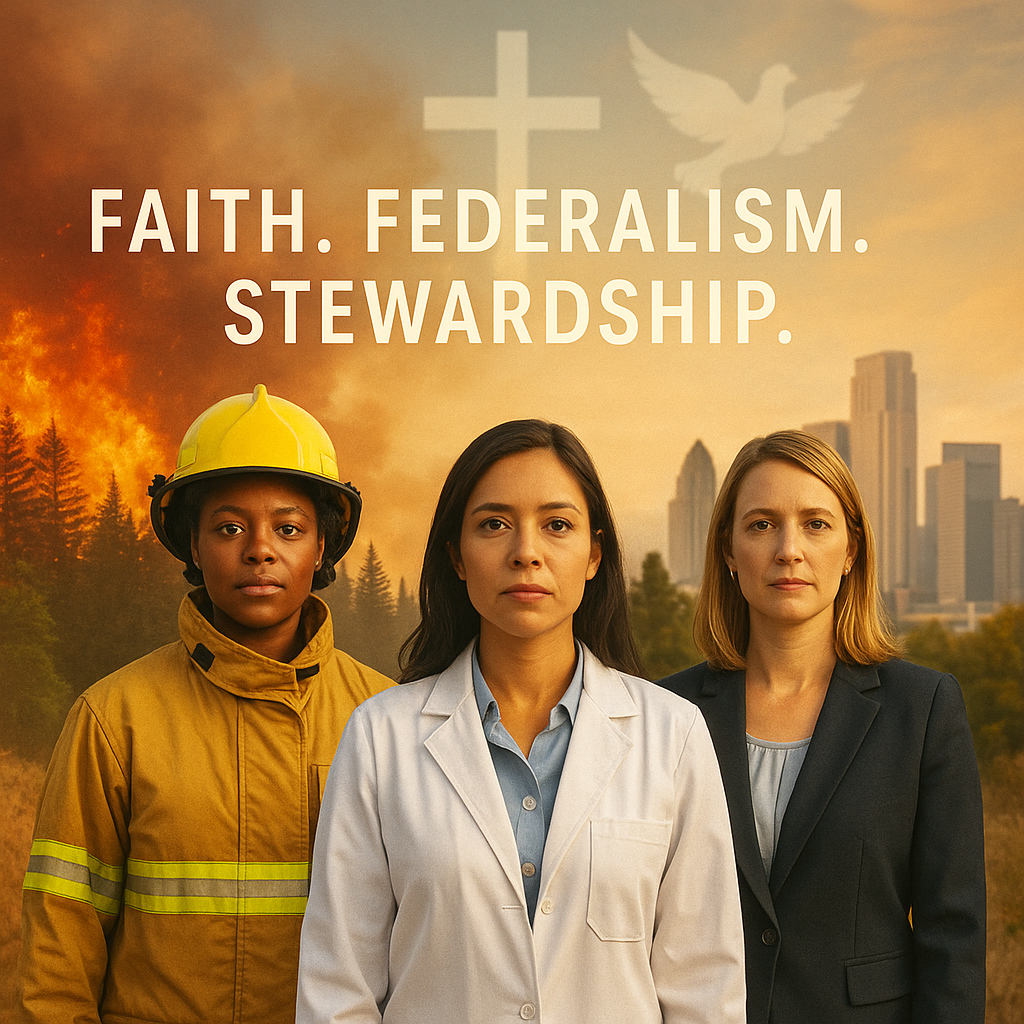
Faith. Federalism. Stewardship
From Forest Fires to Fresh Air: Where Faith Meets Federalism
The landscapes of our country are on fire, as is trust between government agencies. From Western skies shrouded in smoke to urban centers’ industrial air channels, environmental imperatives before us call for more than divided policy or political one-upmanship. These call for collaboration based on honesty, accountability, and moral courage.
This week, we explore two contrasting policy perspectives—on wildfires and clean air—through a biblical lens of stewardship, justice, and cooperative governance. Together, these examples show how the federal government can either contribute to institutional chaos or become a force for healing, depending on how it aligns incentives, shares responsibility, and honors relational leadership.
Case Study 1: When Fire Burns Through the System
The West in Flames by Charles Davis reveals a harsh truth: federal wildfire policy, though well-funded, generally does more harm than good. By encouraging short-term suppression rather than longer-term prevention, agencies compete for funding and never collaborate. Instead of restoring the land, the system implements fragmentation.
From a feminist Christian view, this is more than administrative failure—it’s a spiritual one. It reflects a broken relationship between power and people, between creation and those called to steward it (Genesis 2:15). Women, especially in rural and Native communities, bear the brunt of environmental mismanagement—raising children in unsafe air, losing homes, or being left out of policymaking tables entirely.
Case Study 2: Clean Air, Cleaner Politics?
In contrast, Matthew Potoski’s study of Clean Air Act implementation offers a more hopeful picture. Here, federal policy sets minimum standards while allowing states room to innovate. The result? A collaborative federalism that avoids a “race to the bottom” and allows some states to lead boldly while protecting baseline rights for all.
This is subsidiarity in action—a Christian principle affirming that problems should be solved at the most local level competent to address them, but with higher institutions stepping in to safeguard justice when necessary. When the federal government serves as a platform for equality, not an enforcer of uniformity, everyone breathes easier.
A Faith-Based Insight: Stewardship Through Relational Federalism
These two cases—fire and air—offer a powerful juxtaposition. One demonstrates how top-down misalignment can inflame mistrust; the other how well-structured standards can preserve innovation and protect lives.
The real insight here goes beyond politics—it’s spiritual:
Effective national policy must be more than directive; it must be relational.
Just as Christ called leaders not to lord authority but to serve (Matthew 20:25–28), so must federal power operate through humility and collaboration. This means treating local and state governments as partners, not problems. It means designing policies that support—not smother—local ingenuity. And it means listening to the people most impacted—often women, communities of color, and those on the frontlines of environmental crisis.
Fresh Synthesis: Adaptive Federal Stewardship as Justice
Drawing from both Davis and Potoski, we propose a new insight: Adaptive Federal Stewardship—a vision where federal policy acts not as a one-size-fits-all mandate, but as a broker of trust, capacity, and local empowerment. Key Pillars of Adaptive Stewardship:
- Flexible federal floors that ensure minimum protections while allowing local excellence
- Equitable redistribution of resources based on ecological vulnerability, not political clout
- Relational policy design where trust, transparency, and mutual learning shape cooperation
- Centering community voice—especially those historically excluded from environmental decision-making
This model adheres to the biblically based call to justice (Micah 6:8), stewardship (Genesis 1:28), and covenant responsibility—understanding government as more than a regulator, but as a moral agent responsible before people and before God.
Conclusion: Toward Justice That Breathes
Whether fighting fires or defending clean air, national policies decide how well we care for both creation and each other. We Christian feminists don’t seek a government that governs or a government that disappears—but a government that raises up, protects, and empowers.
Let us construct a future in which federalism doesn’t divide, but forms covenant.
Where stewardship is not an afterthought, but a common moral imperative.
And where justice doesn’t just fill pages of policy, but dwells in lungs, homes, and lives.
“The Spirit of God has made me, and the breath of the Almighty gives me life.” – Job 33:4
Let us make sure that breath is clean, fair, and safeguarded—for every child, woman, and community throughout this nation.