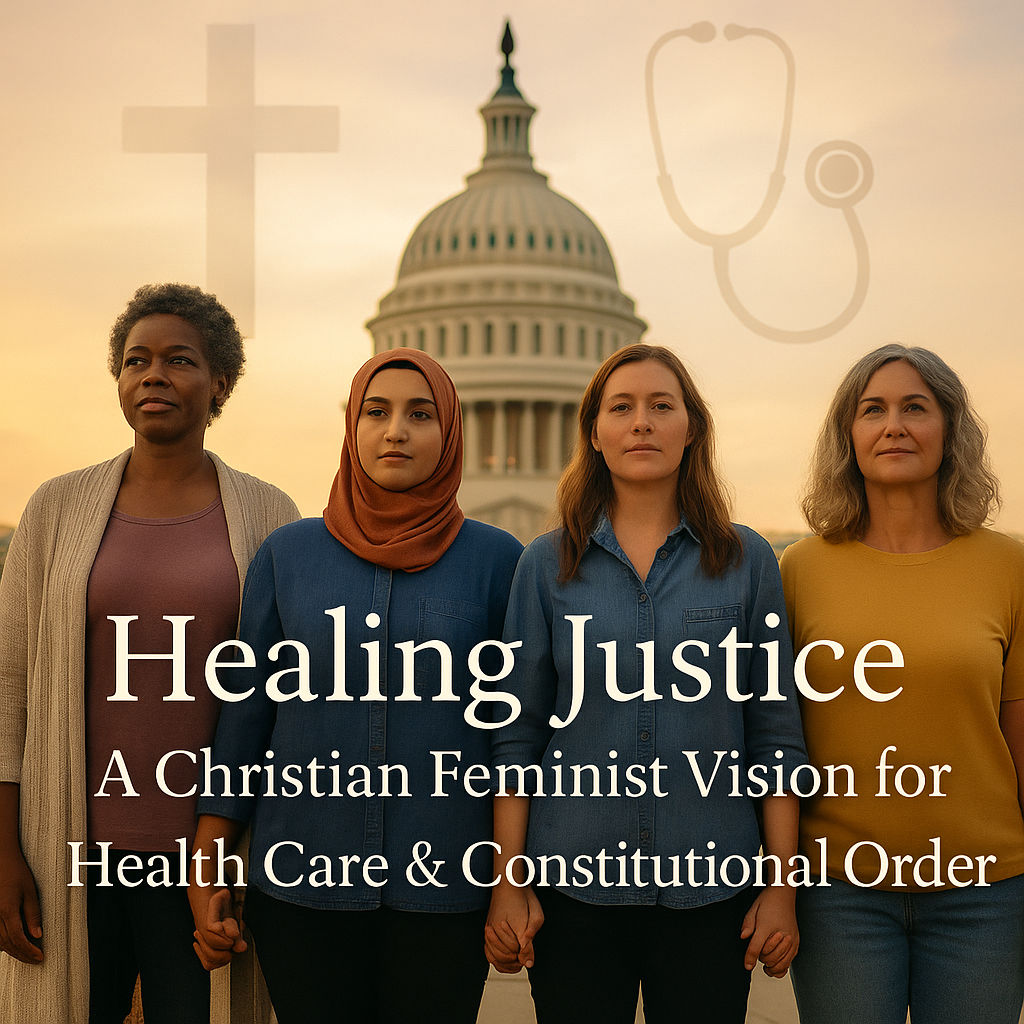
A Nation Built on Healing—But Whose Hands?
Healthcare is not just hospitals, policies, or insurance markets. It’s about bodies—fearfully and wonderfully created in His image—created by God and His holy expectation to look after one another. We women, mothers, caregivers, and laborers understand this deep within us. Somewhere along the way, though, the original silent Constitution on healthcare was stretched to accommodate massive federal healthcare programs—through new definitions by judges, not new amendment or national consensus, but judicial redefinition.
This blog delves into how we arrived here—and how, as Christian women and citizens, we can recover a healthcare vision based on justice, dignity, and constitutional faithfulness.
From Local Compassion to Bureaucratic Control
Health care in early America was personal. It was administered in homes, in church, in local communities. Women—often as nurses, midwives, and caregivers—were at its center in such systems of caring. This was not custom; this was a reflection of Biblical teaching on subsidiarity and stewardship (see 1 Timothy 5:8). But as federal programs grew during times of crisis (Great Depression, wars, pandemics), health care increasingly was removed from local hands and into the hands of distant bureaucracies.
This centralization didn’t just alter policy—it disrupted the moral architecture of care. When families and faith-based institutions are sidelined, real compassion is replaced by regulation. And women, often the silent engine behind caregiving, are left navigating systems that fail to see them.
The Commerce Clause and the Power to Heal (or Control)
The Constitution never granted Congress a direct right to control healthcare. But increasingly, through Supreme Court decisions like Wickard v. Filburn and Gonzales v. Raich, the Commerce Clause was interpreted widely enough to permit regulating even personal health choices.
By the time we reached NFIB v. Sebelius in 2012, the federal government claimed authority not just to regulate healthcare—but to mandate individual participation. While the Court stopped short of upholding the mandate under the Commerce Clause, it rebranded it as a tax, allowing it under the Taxing Clause.
Theologically, we must ask: is coercion in the name of care truly compassionate? Biblical love is freely given. Government should encourage and support—not force—moral responsibility.
A Feminist Christian Concern: Whose Voice Shapes the Policy?
For feminist Christians, the centralization of healthcare power raises critical questions: Who makes decisions for our bodies? Who defines access? Who is heard when policy is made?
Traditionally, women—particularly women of color—have been underrepresented in policy circles and overrepresented in health woes. A responsible feminist view resists government overreach and corporate exploitation. It pursues a third option: a government that respects constitutional limits and places community, conscience, and caring at its center.
NFIB v. Sebelius: A Turning Point
This landmark case tried to define the boundaries of federal healthcare power. The ruling both limited and expanded federal authority. It confirmed Congress couldn’t use the Commerce Clause to compel participation in health markets—but allowed the ACA to stand under the taxing power.
Chiefly, it prevented the federal government from forcing states to expand Medicaid by threatening lost funds. That’s a victory for federalism—but the underlying question persists: what if policy becomes dictated by judicial philosophy, rather than by democratic consensus or moral principle?
Women at the Crossroads of Care
Today, nearly all of healthcare policy impacts women most directly: reproductive care, family health decisions, access to clinicians, and work-life balance. Very few have been designed, though, with women’s spiritual, emotional, and community experience in mind.
Let’s go back to something shared by both the Constitution and the Bible: a feeling of responsibility based on proximity. Care should begin in the church, in the household, in the community—intead of be prescribed out of a federal bureaucracy.
This doesn’t mean getting rid of government altogether—but adjusting its size, narrowing its scope, and empowering local and religious organizations to lead.
Toward a Covenantal Vision of Healthcare
What we need is a Covenantal Healthcare Framework—not a bureaucratic one. This model affirms:
- Care with Dignity – health as a human and spiritual right, not a policy category.
- Judicial Humility – courts interpreting law, not creating it.
- Community First – equipping families, non-profits, and churches to provide care.
- Moral Limits – compassion by conviction, not coercion.
A Controversial Proposal: Sacred Wellness
In a nation as prosperous and fortunate as ours, no woman ought to succumb to treatable disorders because of her income, zip code, or lack of coverage. Christian women summoned to justice, life, and dignity, we have a responsibility to cry out with moral urgency: women’s health is not a luxury—it’s a sacred trust. To connect between moral obligation and constitutional form, we would like to propose a new legislative structure:
The Women’s Integrity and Neighborhood Equity in Life & Liberty Act (W.I.N.E.L.L.)
This policy initiative maintains local control while making sure that all women in America—regardless of income or background—have access to basic health services that promote life, wellness, and human dignity. What W.I.N.E.L.L. Would Guarantee:
1. Universal Access to Core Health Services for Women
Every eligible woman in the United States would have access to:
- Annual wellness exams & OB-GYN visits
- Routine mammograms (age/condition based)
- Basic dental cleanings & emergency dental care
- Mental health screenings and therapeutic access
- Contraceptive counseling (non-coercive, faith-friendly)
- Pregnancy support and postpartum services
2. A Federal Universal Pay Scale (Sliding + Subsidized)
- Tiered pricing: Ranging from free for the lowest-income households to affordable copays for others
- Income-based formulas guided by federal poverty levels
- Faith-based exemptions to protect conscience in care delivery
- Eliminates cost barriers without incentivizing dependency
3. Localized Administration & Community Anchoring
- Services delivered through local clinics, hospitals, faith-based organizations, and nonprofit providers
- States and counties manage implementation with transparency and accountability
- Partnerships encouraged with churches, ministries, and maternal health networks
4. Federally Set Benchmarks & Constitutional Guardrails
- Federal government sets nationwide care standards, privacy protections, and quality benchmarks
- Local programs are evaluated by performance-based outcomes, not just dollars spent
- Oversight modeled after education block grants: freedom with guardrails
5. Moral & Legal Commitment to Life and Equity
- Rejects both full government control and free-market abandonment
- Upholds Christian feminist principles of justice, life, compassion, and stewardship
- Built on the belief that wellness is a woman’s right—and our national responsibility
Why It Matters: Faith Meets Federalism
Women bear the emotional, physical, and economic weight of this nation—often in silence. From caring for children to caregiving for aging parents, women serve. It’s time they are served in return.
W.I.N.E.L.L. offers a framework that doesn’t compromise on constitutional order, doesn’t sacrifice moral clarity, and doesn’t leave women behind.
Since we hold to what Scripture says:
“She is clothed with strength and dignity… and she laughs without fear of the future.” – Proverbs 31:25
And because no woman should die simply because she couldn’t afford to live.
Conclusion: Between Justice and Restraint — A Covenant for Women’s Health
The journey of healthcare policy in the United States reflects both moral urgency and constitutional tension. From the courtroom in NFIB v. Sebelius to the clinic doors in underserved neighborhoods, we see a nation struggling to reconcile two valid concerns: the need to protect the vulnerable and the duty to uphold limited government.
On the one hand, Christian constitutionalists are correct to caution against federal overreach that nullifies state sovereignty, local initiative, and personal freedom. Judicial reinterpretation of the Commerce and Taxing Clauses has pushed constitutional limits, frequently supplanting the family, church, and community—the very pillars Scripture entrusts with caregiving (1 Timothy 5:8, Galatians 6:2).
Christian feminists and public health experts, on the other hand, caution us that women are perishing—not from hypothetical constitutional omissions, but from actual, everyday, structural abandonment. It is hard to speak meaningfully of “life, liberty, and the pursuit of happiness” if a mother cannot afford a mammogram or a survivor cannot secure mental health treatment. Justice, in a biblical sense, is not silent. It acts, shields, and advocates for the least of these (Proverbs 31:8–9, Isaiah 1:17).
Rather than enter a polarizing debate, we propose a path of religious renewal founded on moral clarity and modesty in constitutional construction. It can be found in the Women’s Integrity and Neighborhood Equity in Life & Liberty Act (W.I.N.E.L.L.)—a system of laws that bridges federal leadership and neighborhood responsibility. It guarantees minimum health coverage to all American women—wellness tests, psychiatric care, and the rest—leaving communities and states to supply care as their values and circumstances dictate.
W.I.N.E.L.L. develops a federally mandated sliding scale of pay, thus eliminating costs as a determinant without imposing universal care. It preserves local control and community-based collaboration, with performance measures and moral standards. It neither federalizes everything nor leaves women to market failure. Rather, it integrates federal form, faith-based caring, and feminist accountability—all while observing constitutional architecture.
This is the middle ground we must recover:
- Where government protects, but does not dominate.
- Where rights are preserved, but not divorced from moral responsibility.
- Where women’s lives are valued—not as talking points, but as sacred trusts.
To return to the Founders’ vision is not to idolize the past, but to recover the wisdom of shared governance and the call to local virtue. To live into the Gospel is not to escape politics, but to bring light into it—to advocate for dignity, justice, and healing in systems shaped by brokenness.
Let the Constitution remain our boundary.
Let Scripture be our guide. Let love, and truth, and courage be our stance.
And let us start afresh—this time, not at the fringes, but in the covenantal center of liberty and compassion.
“Let justice roll down like waters, and righteousness like an ever-flowing stream.” – Amos 5:24