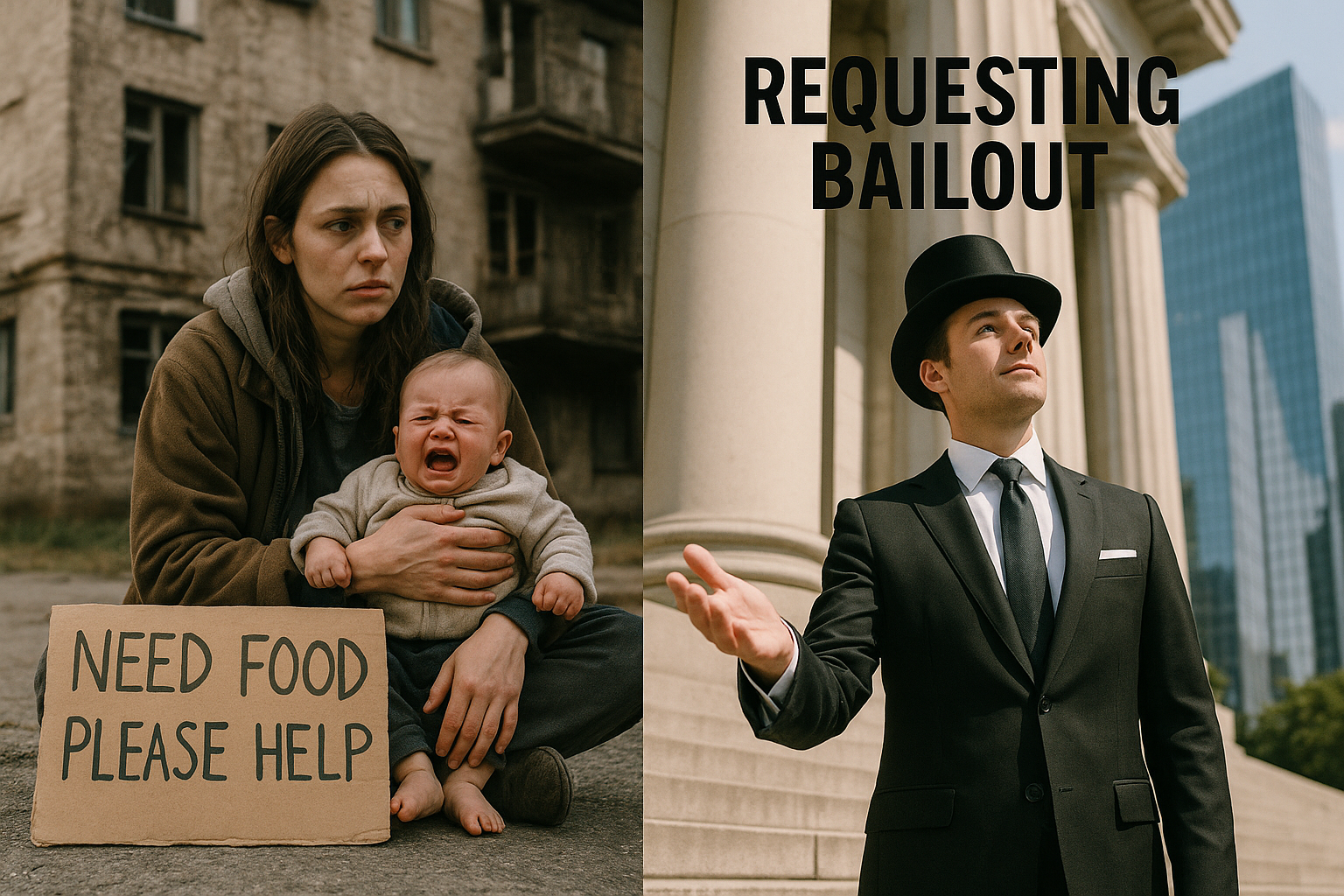
Why America’s Economy Isn’t Broken—It’s Rigged
Telling people to pull themselves up by their bootstraps ignores reality—some bootstraps are made of steel, locked in place by systems designed to keep people down. – Tobi M
The Two Americas: One for the Rich, One for the Rest
In America, the answer is all too predictable: billionaires, megabanks, and giant corporations. They are “too big to fail,” and in days—in some cases, hours—they receive government bailouts, tax breaks, or rescue packages to insure their profits are safeguarded and their CEOs are very well taken care of.
By contrast, the working class is given a very different script. They must tighten their belts, work even harder, accept additional jobs, or “lift themselves up by their bootstraps.” Single parents struggling to pay rent or keep their children fed are expected to tough it out on their own, often supported in no way except by temporary assistance or hollow words from politicians.
But here’s the hard truth: this isn’t a bug in the system—it’s a feature.
The U.S. economy is structured to place the priority on keeping money at the top and passing on risk and sacrifice to the general population. It is no accident that billionaires thrive as crucial workers are experiencing layoffs, foreclosures, and increased debt amidst recession. This is an indication that the system is operating precisely as programmed: prioritizing the protection of capital over people.
To effect change, we must begin by identifying that imbalance for what it is—not a regrettable side effect, but a conscious decision integral to the very nature of contemporary capitalism.
Elon Musk: The $38 Billion Man
Elon Musk is often praised as a visionary entrepreneur. But behind the success of Tesla, SpaceX, and SolarCity lies a massive government safety net. According to a Washington Post investigation, Musk’s businesses have received over $38 billion in government support since 2003. That includes tax credits, subsidies, and federal contracts (Fowler & Shapira, 2025).
Yet the workers at Tesla’s factories report dangerous conditions, suppressed wages, and retaliation for union organizing. The public funds boost corporate profits, but those at the assembly line rarely see the benefits.
Corporate Bailouts vs. Worker Abandonment
Take the 2008 financial crisis as a prime example. When Wall Street’s reckless behavior brought the global economy to the brink of collapse, the U.S. government responded with the $700 billion Troubled Asset Relief Program (TARP). Banks were rescued, financial institutions were stabilized, and corporate executives—many of whom had played a direct role in the meltdown—continued to collect lavish bonuses. Meanwhile, ordinary Americans bore the brunt of the fallout. Millions of families lost their homes to foreclosure. Retirement savings evaporated. Jobs disappeared overnight. The social safety net was threadbare, and those most affected were told to rebuild their lives from scratch, largely without help.
Fast forward to the COVID-19 pandemic, and we see the same playbook reused—this time on an even larger scale. The Paycheck Protection Program (PPP) was sold to the public as a lifeline for small businesses, a way to keep Main Street afloat while the country shut down. But in reality, many of the program’s benefits went to large corporations, wealthy franchises, and politically connected insiders (Autor et al., 2022). Some small businesses did receive help, but countless others—particularly those owned by women, minorities, and local entrepreneurs—were left out of the process or denied aid altogether. The result? Thousands of beloved neighborhood shops, restaurants, and family-run businesses shuttered their doors forever.
At the same time, frontline workers—the backbone of the American economy during the crisis—risked their lives every day for little more than symbolic applause. Nurses, grocery clerks, delivery drivers, sanitation workers, and caregivers powered the nation through lockdowns and supply shortages. They clocked into work while the rest of the country stayed home, often without hazard pay, proper protections, or sufficient health care coverage. Some of them paid the ultimate price, sacrificing their health—or their lives—while corporate profits soared and executive stock buybacks returned in record numbers.
These are not isolated incidents—they are the predictable outcomes of a system designed to protect wealth, not people. Crises may change in form, but the beneficiaries of government intervention remain the same: the powerful, the privileged, and the well-connected. Meanwhile, ordinary citizens are left to pick up the pieces, told once again to be resilient and patient while the economic elite consolidate even more control.
Why Is Helping Billionaires Called “Stimulus” But Helping Workers Called “Socialism”?
Whenever the government rushes to bail out corporations or prop up Wall Street, it’s framed as “stimulus” or “economic recovery.” The media calls it a responsible, necessary intervention to stabilize the market and “save jobs.” Politicians from both sides of the aisle often justify these corporate lifelines by claiming they prevent larger economic collapse. The narrative is clear: when the wealthy need help, it’s called patriotism or pragmatism.
But propose policies that directly benefit ordinary people—universal healthcare, paid family leave, affordable housing, student debt relief, or a living wage—and suddenly the conversation shifts. The same media outlets and political voices cry “socialism!” The public is warned about government overreach, irresponsible spending, or moral hazards that could supposedly discourage hard work and personal responsibility.
This double standard isn’t just hypocrisy—it’s a reflection of who truly holds power in America.
Decades of research, including the landmark study by Gilens and Page (2014) from Princeton University, confirms what many Americans already feel in their daily lives: U.S. public policy overwhelmingly aligns with the interests of the wealthy elite and large corporations, not the majority of citizens. When the rich lobby for tax cuts, deregulation, or financial bailouts, the system responds quickly and decisively. When everyday people advocate for basic rights and dignities, they’re met with obstruction, media fear-mongering, or outright dismissal.
In this rigged landscape, it’s clear: corporate welfare is considered sound economic policy, but human welfare is branded as a dangerous ideological threat.
If we want to build a fairer and more compassionate society, we must start by exposing this imbalance—calling it out not as politics as usual, but as a structural injustice that demands serious change.
The Collapse of Worker Power
For much of the 20th century, labor unions played a critical role in balancing the scales between corporate power and the American workforce. Through collective bargaining, unions gave workers a seat at the table—negotiating for better wages, safer working conditions, retirement benefits, and health care protections that became the backbone of the American middle class. Unions didn’t just improve life for their members; they set standards across entire industries, forcing even non-union employers to raise wages and offer competitive benefits to keep up.
But over the past four decades, that balance has eroded. In 1983, about 20% of U.S. workers were unionized, a reflection of organized labor’s enduring strength in sectors like manufacturing, construction, and public service. Today, union membership has dropped to less than 10% of the workforce—the lowest percentage in nearly a century (BLS, 2024). In the private sector, the numbers are even more stark: only about 6% of private-sector workers belong to a union, down from over 30% in the 1950s.
This decline didn’t happen by accident. It was the result of decades of corporate lobbying, anti-union legislation, court rulings, and aggressive union-busting campaigns. Employers invested in legal teams and consultants whose sole job was to prevent unionization efforts from taking root. At the same time, federal labor laws—originally designed to protect workers’ rights—were weakened or left unenforced, leaving employees vulnerable to retaliation for organizing. As unions shrank, so did workers’ ability to negotiate for fair pay, reasonable hours, job security, and health protections. Without collective bargaining, the power dynamic between employer and employee became dangerously lopsided.
While workers’ bargaining power has diminished, CEO compensation has skyrocketed to historic highs. In 2023, the average CEO of a top U.S. company earned over 300 times more than the average worker (Economic Policy Institute, 2023). To put that into perspective, in the 1960s, CEOs made about 20 times the typical worker’s pay—a gap that, while notable, still allowed for some semblance of shared prosperity. Today’s pay ratios are staggering by comparison, reflecting a system where executive wealth grows exponentially, while workers’ wages stagnate in real terms.
This widening inequality isn’t just about money—it’s about power. When unions are strong, workers can negotiate for a fairer share of the profits they help create. They can push back against exploitative practices, unsafe workplaces, and unfair treatment. When unions are weak or absent, corporations have little incentive to prioritize workers’ well-being. Instead, they focus on shareholder returns, stock buybacks, and inflating executive pay.
The consequences ripple throughout society. Economic inequality widens. Middle-class stability erodes. Workers face rising costs of living without corresponding wage increases. And in times of crisis—whether it’s a financial collapse or a global pandemic—those without bargaining power are often the first to suffer and the last to recover.
If we are serious about restoring balance to the economy, we must confront this reality: rebuilding worker power is not optional—it’s essential. Revitalizing labor rights, protecting union organizing efforts, and holding corporate leadership accountable for pay equity are necessary steps toward an economy that works for everyone, not just the executive class.
Other Countries Do It Differently
Around the world, other nations have made very different choices about how their economies function—and who they are designed to serve. While the U.S. often frames worker protections and social welfare programs as radical or unaffordable, many countries treat these policies as standard components of a just and stable society. Their systems are not perfect, but they reflect a foundational belief: the economy should serve people—not the other way around.
Take Germany, for example. There, workers are not just employees; they are participants in corporate governance. Under a model called co-determination, large German companies are legally required to allocate up to 50% of board seats to worker representatives. This ensures that decisions about layoffs, wages, benefits, and company strategy are made with direct input from those who will be most affected. As a result, Germany has fewer labor strikes, stronger job protections, and a more collaborative relationship between management and labor. Companies still make profits, but profits are not prioritized at the expense of workers’ livelihoods (Stettes, 2021).
In Sweden, work-life balance is not a luxury—it’s a social expectation. New parents receive 480 days of paid parental leave per child, and this benefit is designed to be shared between both mothers and fathers, promoting gender equity in caregiving roles. Parents can also return to work gradually, choosing part-time hours without penalty for the first eight years of their child’s life. This policy isn’t viewed as government overreach; it’s seen as an investment in family stability, child development, and long-term workforce health (OECD, 2023).
Canada takes a different but equally humane approach when it comes to healthcare. There, universal healthcare is publicly funded and not tied to employment status. This means losing a job doesn’t mean losing access to medical care. In the U.S., by contrast, millions of people are locked into jobs they dislike—or stay in abusive or exploitative workplaces—simply because they cannot afford to lose their health insurance. Canada’s model reduces this “job lock,” giving workers more freedom to change careers, start businesses, or retire without the fear of medical bankruptcy (Flood & Thomas, 2021).
Other nations offer similar examples:
- In Norway, education—including college—is largely free, preventing massive student debt burdens that follow graduates for decades in the U.S.
- In Denmark, unemployment benefits are generous and coupled with active labor market policies that help people re-enter the workforce without stigma.
- In France, workers enjoy a 35-hour workweek with protections against forced overtime and a strong culture of vacation time, including a guaranteed five weeks of paid leave per year.
These policies are not fringe experiments or utopian fantasies. They are evidence of different social contracts, where governments and societies choose to prioritize human dignity over unchecked market forces. The goal is not to eliminate business or innovation—it’s to ensure that economic growth does not come at the expense of basic human rights and well-being.
In contrast, the U.S. often treats worker-centered policies as controversial or unaffordable, despite being the wealthiest nation in history. Proposals for universal healthcare, paid family leave, or stronger labor protections are met with cries of “socialism” or “big government.” Yet, in much of the developed world, these rights are simply the baseline of a fair economy.
If America is to build a more just and compassionate society, it will require rethinking the purpose of the economy itself. Is the goal endless profit accumulation for the few, or shared prosperity for the many? The examples are there—not as unreachable ideals, but as proof that a better balance is both possible and sustainable.
What Does the Bible Say About This?
From a Christian ethical perspective, the current structure of the economy isn’t just flawed policy—it’s a moral failure. In Scripture, justice is not confined to courtroom procedures or legal fairness. Biblical justice is holistic. It encompasses how societies care for the vulnerable, distribute resources, and uphold the dignity of every person created in the image of God.
The prophet Amos issued a timeless rebuke to nations that claim religious devotion while ignoring economic injustice. He declared:
“Let justice roll down like waters, and righteousness like an ever-flowing stream.”
(Amos 5:24)
This was not merely a call for personal piety but a demand for systemic fairness. Amos condemned leaders who exploited the poor while living in luxury, warning that empty rituals and national pride mean nothing to God when oppression persists in the marketplace.
The book of Proverbs echoes this warning:
“Whoever oppresses the poor to increase his own wealth, or gives to the rich, will only come to poverty.”
(Proverbs 22:16, ESV)
Yet, in many ways, this is precisely what the current system incentivizes. Policies and practices that widen the gap between rich and poor are not just economically unsustainable—they are spiritually bankrupt. When corporations hoard wealth while workers struggle to afford basic necessities, when billionaires receive tax cuts while schools, hospitals, and social services are underfunded, we are witnessing the normalization of oppression under the guise of free-market efficiency.
Jesus himself spoke directly to these issues. In the Gospel of Luke, Christ warns:
“Woe to you who are rich, for you have already received your comfort.”
(Luke 6:24, NIV)
This is not a condemnation of wealth in itself, but of wealth that blinds people to injustice and hoards resources at the expense of others. Christian ethics demands an economy of care, not exploitation. It calls for structures that prioritize the common good over personal gain, recognizing that every human being—rich or poor, powerful or marginalized—bears the image of God.
Throughout the Bible, from Levitical laws about gleaning and debt forgiveness (Leviticus 19:9-10; Deuteronomy 15:1-11) to Jesus’ teachings on generosity and neighbor love (Luke 10:25-37), there is a consistent thread: the measure of a society is how it treats its most vulnerable members.
But in today’s system, wealth is protected while poverty is punished. Wage stagnation, lack of affordable healthcare, and rising corporate profits built on worker exploitation are not just policy failures—they are violations of biblical justice. We have allowed markets to dictate morality, replacing compassion with competition and dignity with dollar signs.
For Christians, this should raise urgent questions:
- Are we building an economy that reflects the Kingdom of God or one that mirrors the worst excesses of empire?
- Do our policies embody neighbor love or do they prioritize profit at any cost?
- Are we aligning with the God who “raises the poor from the dust and lifts the needy from the ash heap” (Psalm 113:7), or with systems that keep people trapped there?
If we are to live faithfully, these questions cannot be avoided. Justice is not optional in the Christian life. It is central to discipleship and core to the Gospel’s vision for human flourishing.
Final Thought: It’s Time for a Reckoning
If there’s always money to rescue corporations and bail out Wall Street, then there’s more than enough to invest in affordable housing, quality education, universal healthcare, paid family leave, and worker protections. These aren’t radical ideas—they are basic building blocks of a society that values human dignity over corporate bottom lines.
This isn’t about punishing success. It’s about demanding accountability and restoring balance. No billionaire builds their fortune alone. They rely on public infrastructure, public research, and the labor of everyday people. They drive on public roads, hire workers educated in public schools, and profit from technologies developed with taxpayer-funded research.
The least they can do—the least we can require—is to help build a system that works for everyone, not just the elite few.
So let’s stop accepting excuses. Let’s stop settling for trickle-down promises that never materialize. It’s time to raise our voices, organize, vote, and advocate for policies that reflect the simple truth: people come first.
Join the movement. Speak up. Build something better.
Join the Conversation
We want to hear from you:
- Do you think America’s economic system is fair?
- Should billionaires receive public subsidies while workers struggle?
- What policies would you like to see change?
Leave a comment below or send us your thoughts at tobi@centerwoman.blog
References
Autor, D., Cho, D., Crane, L., et al. (2022).
Business formation and employment dynamics in the Paycheck Protection Program. National Bureau of Economic Research.
https://doi.org/10.3386/w29669
Economic Policy Institute. (2023).
State of Working America 2023.
https://www.epi.org/publication/state-of-working-america-2023/
Fowler, G., & Shapira, I. (2025, May 22).
Elon Musk’s empire has received $38 billion in government support. The Washington Post.
https://www.washingtonpost.com/technology/interactive/2025/elon-musk-business-government-contracts-funding/
Gilens, M., & Page, B. I. (2014).
Testing theories of American politics: Elites, interest groups, and average citizens. Perspectives on Politics, 12(3), 564–581.
https://doi.org/10.1017/S1537592714001595
Stiglitz, J. E. (2012).
The price of inequality: How today’s divided society endangers our future. W. W. Norton & Company.