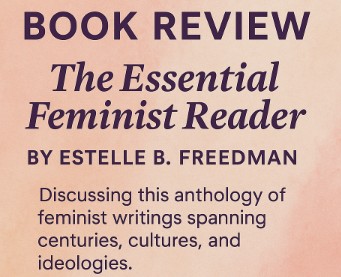
Why Feminist History Still Matters
In a world grappling with gender inequality, intersectional justice, and debates over bodily autonomy, understanding the roots of feminist thought is no longer optional—it’s essential. Estelle B. Freedman’s The Essential Feminist Reader is not just an anthology; it is a historical compass, guiding readers through centuries of ideas, resistance, and transformation in the fight for gender equity.
Published in 2007 by Modern Library, this text is a comprehensive collection of feminist writings from ancient times to the early 21st century. By curating voices across cultures and eras, Freedman presents feminism not as a monolith, but as a dynamic and evolving dialogue that has shaped—and been shaped by—global social change.
Building a Timeline of Feminist Thought: How the Book is Structured
Freedman structures the anthology chronologically, so readers may see the evolution and diversification of feminist thinking over time and location. Each work is prefaced with historical background, writer information, and commentary that places it within larger political and cultural movements.
Early Foundations: Philosophy and Pre-Modern Feminist Thought
- Plato’s Republic (c. 380 BCE) is a surprising starting point. Freedman includes an excerpt where Plato proposes that women, in an ideal society, could perform the same roles as men—including leadership and military service. While far from modern feminism, this text challenges early gender hierarchies.
- Christine de Pizan’s The Book of the City of Ladies (1405) provides a medieval defense of women’s virtue and intellectual capabilities. In a time when misogynistic texts dominated European literature, de Pizan’s work stands as a courageous outlier.
Revolution and Enlightenment: The Rise of Women’s Rights Discourse
- Mary Wollstonecraft’s A Vindication of the Rights of Woman (1792) remains a cornerstone of feminist theory. Wollstonecraft’s argument for female education and rationality laid the groundwork for modern liberal feminism.
- Sojourner Truth’s “Ain’t I a Woman?” (1851) addresses the intersection of race and gender in abolitionist and feminist circles. Truth’s speech critiques white women’s movements for excluding Black women from their calls for equality.
- The Seneca Falls Declaration of Sentiments (1848), drafted by Elizabeth Cady Stanton, is America’s first formal demand for women’s legal and social equality, echoing the Declaration of Independence but reimagined for gender justice.
The 20th Century: Expansion and Diversification
- Simone de Beauvoir’s The Second Sex (1949) introduces existentialist feminism, analyzing how women have been historically constructed as “the Other” in patriarchal societies.
- Betty Friedan’s The Feminine Mystique (1963) exposes the post-WWII myth of domestic bliss for middle-class white women, igniting what became known as second-wave feminism in the United States.
- Angela Davis and Bell Hooks shift the conversation from gender alone to race, class, and capitalism, emphasizing that feminism must address multiple systems of oppression to remain relevant.
Global Feminism and Contemporary Voices
Freedman consciously enlarges the scope of the anthology with pieces from Asia, Africa, Latin America, and the Middle East. These pieces represent transnational feminism, breaking with Western-focused narratives and recognizing that gender conflicts take on different faces within cultural contexts.
Strengths of the Collection: Why This Reader Still Resonates
1. Depth and Breadth: A Multi-Voiced History
With 63 texts from over 40 authors, Freedman presents a rich mosaic of feminist thought. From classical philosophy to modern intersectionality, the book allows readers to see how feminist ideas have branched, evolved, and sometimes conflicted with one another over time.
2. Historical Contextualization: Learning the ‘Why’ Behind the Words
Each text is framed with detailed introductions that explain the social, political, and personal conditions under which the authors wrote. Freedman excels at showing how feminist writing is often a response to specific historical injustices—not just abstract theory.
3. Intersectionality at the Forefront
Freedman doesn’t shy away from the complicated intersections of race, class, colonialism, and gender. By including activists and scholars like Sojourner Truth, Angela Davis, and Bell Hooks, she acknowledges that feminism cannot be understood in isolation from other forms of oppression.
4. Educational Utility: A Classroom Staple
The anthology’s structure makes it a perfect textbook for courses in gender studies, history, political science, or philosophy. Its approachable tone and clear commentary invite both newcomers and advanced students to engage with feminist theory without intimidation.
Limitations: Where the Book Falls Short
1. The Challenge of Excerpts: Depth vs. Breadth
Because the collection covers such a vast range of material, many works are excerpted rather than presented in full. This is both a strength and a weakness—while the reader gets a panoramic view, some key arguments lose their complexity when shortened.
2. Western Bias Persists
Despite Freedman’s conscious inclusion of global voices, the majority of the collection still leans heavily toward Western feminist texts. For readers interested in indigenous feminisms, queer and decolonial feminism, or activism outside of Europe and the United States, the collection may feel incomplete.
3. Digital Age Omissions
Since the book was published in 2007, it does not include the digital revolution of feminist activism—such as #MeToo, feminist blogging, online gender justice movements, or social media discourse. These have reshaped feminist engagement in the 21st century but are absent from the collection.
Why This Anthology Still Matters: Relevance in Today’s World
At a time when feminism is both celebrated and contested, The Essential Feminist Reader provides critical historical grounding. The book helps us understand where today’s debates come from, including discussions on:
- Workplace equity and the gender pay gap
- Reproductive rights and bodily autonomy
- Transnational activism and decolonial feminist thought
- Intersectionality in modern movements
In an era of polarized politics and social media soundbites, Freedman’s anthology reminds us that feminism is a long conversation, not a quick reaction. It invites readers to engage thoughtfully with the roots of gender justice rather than rely on simplified slogans.
Final Reflections: Who Should Read This Book?
Whether you are a student, professor, activist, or simply a curious reader, The Essential Feminist Reader offers a comprehensive introduction to feminist history and theory. It balances academic rigor with accessibility, making it suitable for anyone seeking to understand how ideas about gender have evolved—and why they continue to matter.
This anthology is not just for feminists; it’s for anyone who wants to understand how social change happens, who drives it, and what barriers persist. While no single book can capture the full spectrum of feminist voices, Freedman’s collection comes close, making it an essential resource for serious inquiry into gender and justice.
Reference
Freedman, E. B. (Ed.). (2007). The Essential Feminist Reader. Modern Library.
Additional Reading for Deeper Exploration
If you’re interested in continuing your feminist education beyond this anthology, consider these key texts:
- Mohanty, C. T. (2003). Feminism Without Borders: Decolonizing Theory, Practicing Solidarity. Duke University Press.
Focuses on postcolonial feminist theory and solidarity across global divides. - Hooks, B. (2000). Feminism Is for Everybody: Passionate Politics. South End Press.
A concise, accessible introduction to feminist thinking from one of the movement’s most beloved scholars. - Ahmed, S. (2017). Living a Feminist Life. Duke University Press.
Explores how feminism is lived day-to-day, especially in academic and activist spaces.
Join the Dialogue
- What feminist text has had the most impact on your life?
- Do you believe any voices were left out of Freedman’s anthology?
Share your thoughts in the comments or join the discussion on social media with #CenterlineWomanReads.