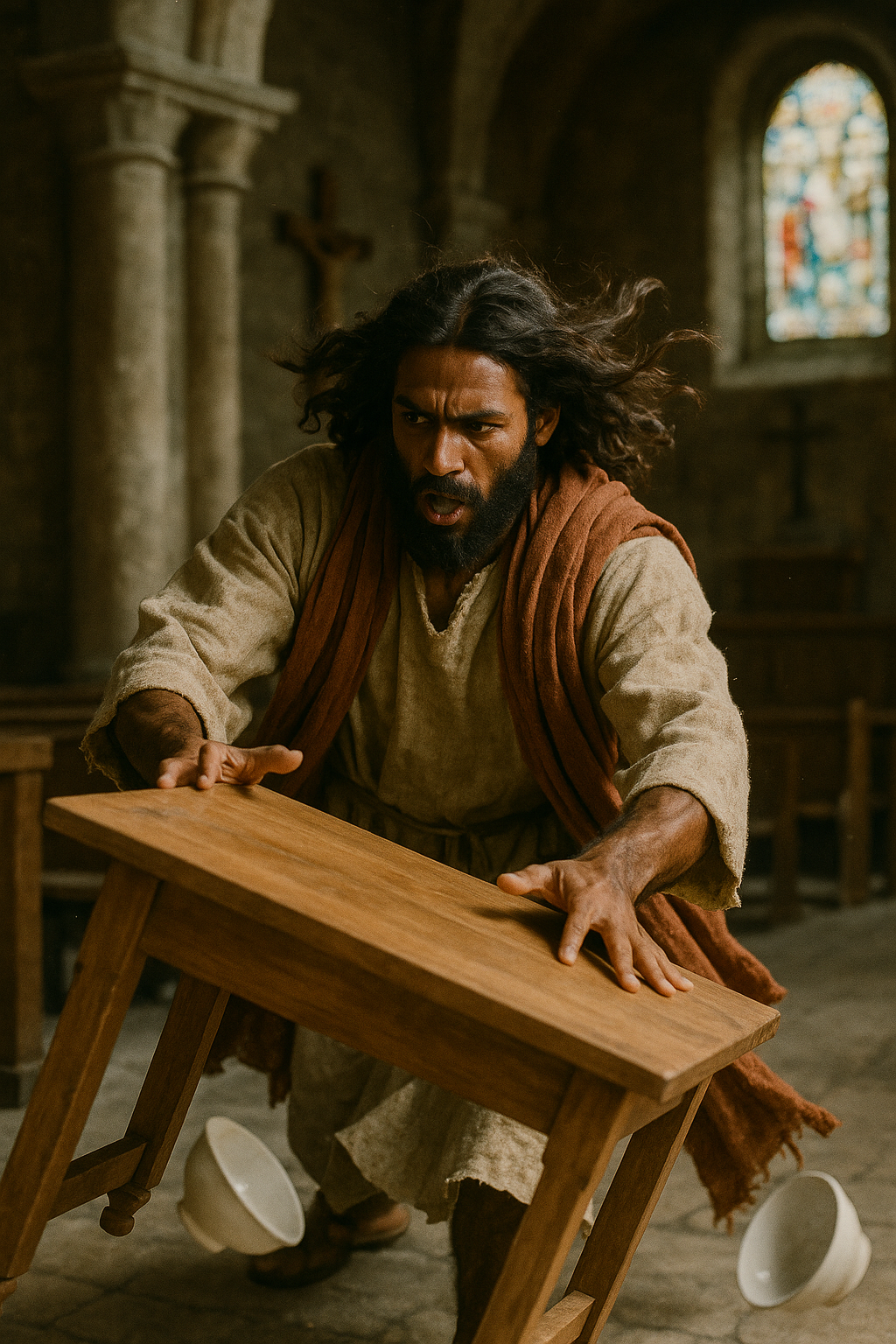
Would Jesus stay home and pray?
Faith Beyond Politics: The Gospel’s Call to Justice
In these contentious days, we might be tempted to reduce Christianity merely to a political label—“conservative,” “progressive,” “left,” or “right,” but real Christianity goes beyond political labels. As theologian Miroslav Volf (2011) helps us remember, “Christian faith is not a tool of partisan agendas but a mandate to bear testimony to the Kingdom of God—a kingdom of peace, mercy, and justice.”
Therefore, we pose a more elemental query: What would Jesus actually do in response to systemic injustice today?
Would he dismiss poverty, inequality, and environmental destruction as “political issues”? Or would he address the systems which oppress the poor and profit from exploitation? The life and ministry of Christ point to the latter.
Jesus and Economic Inequality: Confronting Exploitation
The Temple Tax and the Tables of Injustice
When Christ overturned tables in the temple (Matthew 21:12–13), he was not simply objecting to individual greed. He was condemning the general practice of oppressing the poor through spiritual and monetary exploitation. Temple taxation forced ordinary citizens to purchase sacrificial money from the temple vendors at usurious interest, a practice which impoverished the poor and filled the treasuries of the elite (Wright, 2012).
In today’s world, Jesus would likely challenge:
- A tax system that benefits the wealthy while burdening the poor
- Policies that prioritize corporate bailouts over affordable housing, healthcare, or education
As Luke 12:15 warns: “Beware of greed; life does not consist in the abundance of possessions.”
Healthcare as Compassion: Healing Without Profit
Jesus as the Healer of All
The ministry of Jesus was that of healing. He ministered to the lepers, the blind, and the chronically sick—without fee, without questions regarding insurance, without regard to social status before care (Matthew 4:23-24). His mission of healing was predicated on mercy rather than money (Gorman, 2003).
Contrast that with a contemporary healthcare system where families are forced to start GoFundMe pages to be able to afford surgeries, medical debt is the leading reason for bankruptcy (Himmelstein et al., 2019), and Jesus could not accept that as a fait accompli—he would insist on a system more mindful of the dignity of humans than of revenue margins.
Education Equity: Let the Children Come
The Gospel and Equal Access to Opportunity
Jesus said, “Bring little children to me, and do not hinder them, for the kingdom of heaven belongs to such as these” (Mark 10:14). Yet today in America, a child’s education is often tied to the property taxes of his or her zip code—in other words, leaving poor children behind with under-equipped schools and bleak futures.
Education historian Jonathan Kozol (2005) describes this “savage inequality,” where systemic structures continue poverty from generation to generation. If Jesus was concerned for children and the least of these, would he not be for school structures that value every child equally, regardless of ZIP code?
Mass Incarceration: A Crisis of Justice
Freedom for the Prisoners
Jesus proclaimed at the beginning of his ministry: “The Spirit of the Lord is upon me… to proclaim good news to the poor… and freedom for prisoners” (Luke 4:18-19). Punishment and imprisonment under the ancient Roman Empire weighed heaviest on the powerless. Sound familiar?
Today, the U.S. imprisons more citizens than any other nation on the planet, with entrenched racial and economic disparities (Alexander, 2010). Jesus would certainly reject a punishment-for-profit corrections system that prioritizes retribution over restoration.
Creation Care: Stewardship, Not Exploitation
The Earth Is the Lord’s
As we read from Genesis 2:15, humans were delegated to the garden “to work it and to care for it,” not exploit it. Jesus echoed this ethic, reminding his students of God’s interest in all of creation (Matthew 6:26-30).
However, we now face climate change, environmental destruction, and corporate greed that prioritizes short-term profit over long-term sustainability (Pope Francis, 2015). Creation care is not a Republican or Democratic issue for Christians; it is a spiritual imperative.
Faith in Action: Prayer and Prophetic Disruption
Not Either/Or—Both/And
Jesus prayed, naturally. He prayed alone in deserted places (Luke 5:16). Yet his praying never hindered him from confronting injustice publicly. He rebuked religious and political leaders, spoke up for the oppressed, and called for radical social change.
Christian discipleship means combining prayer with action—compassion with courage.
As James 2:17 puts it:
“Faith without works is dead.”
Final Thought: The Gospel is Bigger Than Politics
Christianity is not about fitting Jesus into our political boxes. It’s about living out the radical, justice-centered ethics of the Kingdom of God. That means:
- Speaking out against systems that oppress the poor
- Caring for the sick without profiting from their suffering
- Ensuring every child has access to quality education
- Reforming a justice system that prioritizes punishment over healing
- Protecting the planet for future generations
Jesus wouldn’t stay silent. Neither should we.
This isn’t about partisanship—it’s about discipleship.
Reflection Questions:
- Where do you see systemic injustice in your community?
- How can you, as a follower of Christ, advocate for change without becoming trapped in partisan labels?
- What spiritual practices can help you sustain the work of justice with humility and courage?
References & Further Readings
- Alexander, M. (2010). The New Jim Crow: Mass incarceration in the age of colorblindness. The New Press.
- Gorman, M. J. (2003). The politics of healing: Jesus and the medical establishment of his day. In Elements of Biblical Exegesis (pp. 191-205). Baker Academic.
- Himmelstein, D. U., Lawless, R. M., Thorne, D., Foohey, P., & Woolhandler, S. (2019). Medical bankruptcy: Still common despite the Affordable Care Act. American Journal of Public Health, 109(3), 431–433. https://doi.org/10.2105/AJPH.2018.304901
- Kozol, J. (2005). The shame of the nation: The restoration of apartheid schooling in America. Crown Publishing.
- Pope Francis. (2015). Laudato si’: On care for our common home. Vatican Press.
- Volf, M. (2011). A public faith: How followers of Christ should serve the common good. Brazos Press.
- Wright, N. T. (2012). How God became king: The forgotten story of the Gospels. HarperOne.
About Centerline Woman Blog
We are a nonpartisan Christian feminist platform committed to exploring faith, justice, and civic engagement. Our mission is to center women’s voices, advocate for human dignity, and reflect the radical love of Christ in public life.