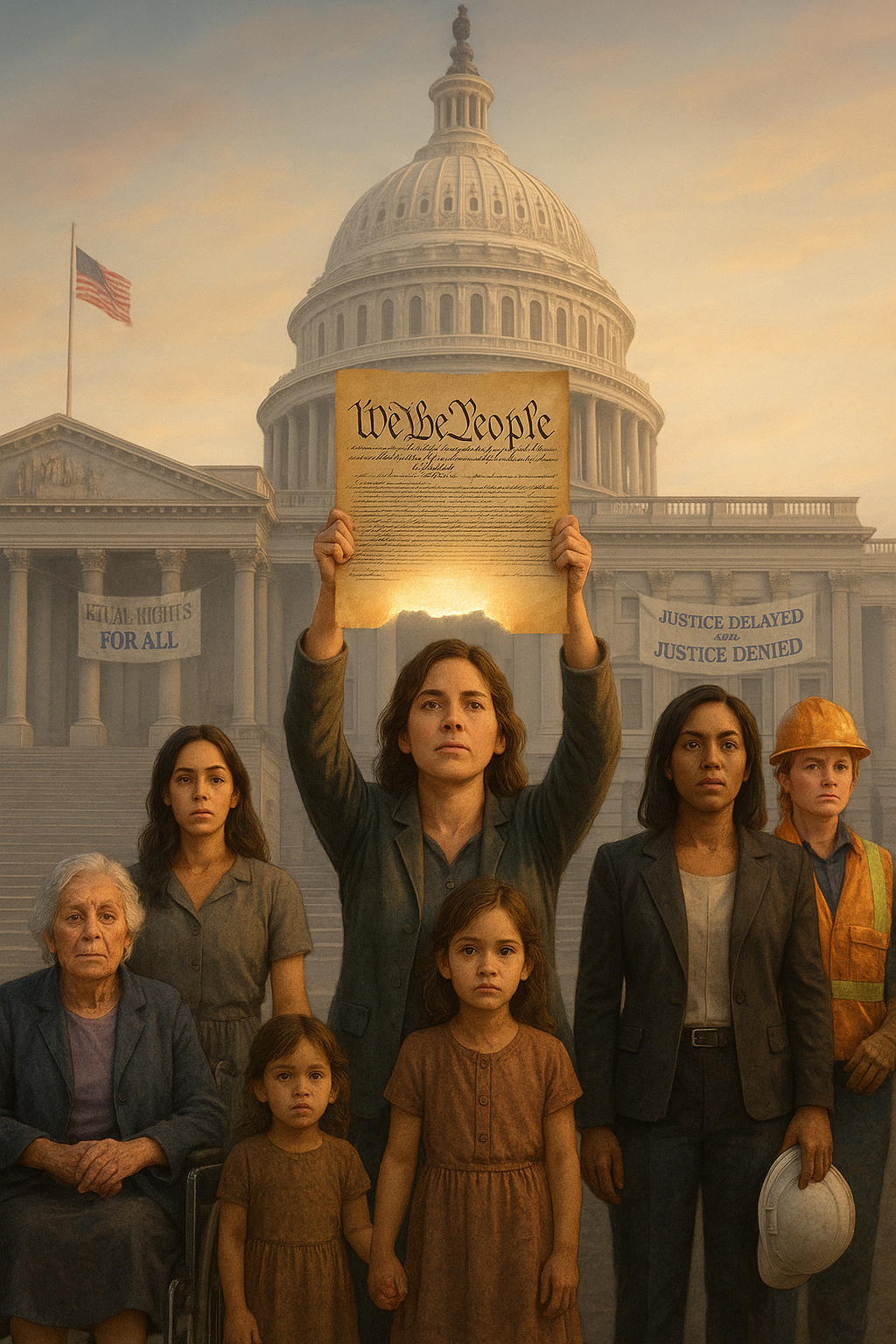
Preventing Regression of Rights
The Silent Gap in America’s Constitution
For centuries, women in America have struggled for recognition, dignity, and equality before the law. Despite enormous gains—such as acquiring the right to vote with the passage of the 19th Amendment—the U.S. Constitution does not yet explicitly enshrine gender equality (MacKinnon, 2016). That lack exposes women to changing winds of politics as well as interpretation of law that can grow or dissipate their right.
In Christian feminist thought, this is not simply a matter of law but of rightness. Scripture cautions that men and women alike bear the image of God (Genesis 1:27, NIV), and thus systems of government ought to mirror this innate equality. In Christ, according to Galatians 3:28, there is no “male nor female”—all stand as one in God’s justice and mercy. There is unfinished business in explicitly amending the Constitution in order to safeguard women’s rights; it is a challenge issue for anyone believing in justice across party lines.
Why Constitutional Protections Matter
The Fragility of Statutory Protections
Today, the rights of women in America are safeguarded mainly under federal statutes such as Title IX, the Equal Pay Act, and employment discrimination legislation. These, however, can change. Legislation can be revoked, defunded, or diluted through shifts in political leadership or court rulings (Deva & Dey, 2020). Without a constitutional foundation, such rights exist at risk. As illustrated in issues of reproductive freedom, employment parity, and gender-based violence protection in the past few years, statutory protections can prove tenuous when not founded in constitutional text (Ginsburg, 2014).
Historical Precedents for Constitutional Change
When civil rights movements have won in the past, it is because those of their achievements had been enshrined in constitutional amendments. The 13th outlawed slavery, the 14th ensured equal protection under the law, and the 15th provided voting rights no matter one’s race. These modifications set in place lasting legal underpinnings that outlasted fleeting political environments (Amar, 2005). Women are entitled to similar constitutional protections.
A Christian Perspective on Justice and Equality
Equality Rooted in Scripture
The Christian tradition provides a strong ethical mandate for gender equality. The Bible’s creation story affirms the equal worth of men and women, stating that both are made in God’s image (Genesis 1:27, NIV). Justice is not a partisan issue; it is a spiritual calling. Micah 6:8 commands believers to “do justice, love mercy, and walk humbly with God.” A society that leaves half its population legally vulnerable falls short of this biblical standard.
The Role of Christian Feminism
Christian feminism acknowledges that the fight for women’s rights is not a rebellion against faith but a faithful response to it. Proverbs 31:8-9 urges us to “speak up for those who cannot speak for themselves… and defend the rights of the poor and needy.” This includes advocating for women whose equality is not yet fully recognized in the highest legal documents of the nation.
The Political Responsibility to Amend the Constitution
Why Politicians Must Act
A Constitutional amendment is a rare but necessary piece of legislation when the moral compass of society shifts. Omitting the passing of the Equal Rights Amendment (ERA), initially presented in 1923 and Congress passing it in 1972 but not being fully ratified, is a glaring deficiency in America’s legal canon (Schultz, 2021). There is an obligation in this direction on the part of politicians across party affiliations. As representatives of the people, they have a responsibility of maintaining justice for every citizen of this nation rather than only those most politically expedient of groups.
The Dangers of Leaving Rights Undefined
Leaving women’s rights in the hands of legislatures and courts allows fundamental protections to vary with every election season. As recent Supreme Court rulings have demonstrated, rights long believed permanent can be undone when they have not been encoded in the Constitution (Ginsburg, 2014). Amendments to the Constitution have a degree of finality that legislation does not.
Barriers to Change: Why Hasn’t This Happened?
Historical and Cultural Resistance
Opposition to gender equality in the constitution is based on patriarchal customs and fears of social destabilization. Certain detractors maintain nothing is flawed with current legislation, but history proves otherwise. Without specific provision in a constitution, the rights of females will be susceptible to erosion (MacKinnon, 2016).
Political Polarization
In today’s divided political climate, meaningful bipartisan cooperation is rare. However, protecting human dignity should not be a partisan issue. Advocating for constitutional equality is about aligning the nation’s laws with its professed values of liberty and justice for all (Schultz, 2021).
Misinterpretations of Faith
There have been religious objections against gender equality, wrongly equating biblical teaching on roles in marriage with legislative oppression. However, Christian scripture is not in favour of systematic inequality. In reality, the early church in its time was radical in the inclusion of women as leadership and as disciples (Romans 16:1-7). Religion, as correctly interpreted, demands legislative structures recognizing the equal worth of human beings.
Barriers to Change: Why Hasn’t This Happened?
The absence of constitutional guarantees for women’s rights sends a dangerous message to future generations. It tells young women that their equality is negotiable, dependent on temporary laws rather than foundational principles. Justice delayed is justice denied—not just for today but for tomorrow.
Christians are called to be active participants in the work of justice, not passive observers. This means advocating for policies and constitutional amendments that protect the vulnerable and promote equity. Doing so honors both faith and feminist commitments.
Final Thought: Constitutional Equality Is a Moral Imperative, Not a Political Option
The failure of the United States Constitution to include protections of women’s rights is not only a legal omission, but a moral failure of epic proportion. Despite a long half-century of activism, advocacy, and achievement, women in America cannot be seen in the Constitution as automatically enjoying guaranteed equality before the law. That places essential issues—pay equity, reproductive freedom, workplace security, and freedom from violence based on gender—open to partisan change and revision at the hands of courts (MacKinnon, 2016). As long as women’s rights appear as legislative privileges and not as constitutional entitlements, equality will be partial at best.
From a Christian feminist perspective, this is no mere issue of a void in law but of a spiritual injustice. The Bible’s call to justice is not abstract but is a call to action. It instructs in Proverbs 31:8-9 that we “speak up for those who cannot speak for themselves” and “defend the rights of the poor and needy.” Women, especially those in oppressed groups, still bear the brunt most under structural inequality in healthcare, work, school, and under the law. Christian ethics compel us to frame this scenario as no issue of policy hassle but as a moral emergency.
Constitutionalizing express protections of women is not a matter of affording new rights—it is a matter of affirming and protecting the rights women have had all along. Amendments to a Constitution set a nation’s moral tone. They instruct future generations of citizens as to what a society stands for at its foundation. By not including gender equality in the Constitution, the United States communicates it is possible to bargain away the dignity of women, rather than treating it as non-negotiable foundations. This is inconsistent with both democratic principles as well as with Christian doctrine in emphasizing as it does the inherent equal worth of every human being (Genesis 1:27; Galatians 3:28). The work is long overdue. Equality cannot be entrusted to fleeting legislation or partisan argument. It needs to be encoded in the nation’s most revered document of law so that justice, as in Amos 5:24, can roll down with ease—unchecked by prejudice, politics, or patriarchal structures. Christians, feminists, and citizens of conscience of every sort need to stand together to insist that women’s rights be not merely safeguarded by policy but forever sustained as a matter of constitutional law.
Join the Dialogue: Questions for Reflection
- What actions can you take to encourage your local representatives to support constitutional protections for women?
- Why do you think the U.S. has never fully amended the Constitution to protect women’s rights explicitly?
- How can people of faith, regardless of political affiliation, advocate for gender equality in law and policy?
References
- Amar, A. R. (2005). America’s Constitution: A biography. Random House.
- Deva, S., & Dey, I. (2020). Gender justice and constitutional guarantees: A global perspective. Human Rights Review, 21(3), 285–302. https://doi.org/10.1007/s12142-020-00594-5
- Ginsburg, R. B. (2014). My own words. Simon & Schuster.
- MacKinnon, C. A. (2016). Butterfly politics. Belknap Press.
- Schultz, V. (2021). The ERA revival and constitutional gender equality. Yale Law Journal Forum, 130, 118–142. https://www.yalelawjournal.org/forum/the-era-revival-and-constitutional-gender-equality
- The Holy Bible, New International Version. (2011). Zondervan.