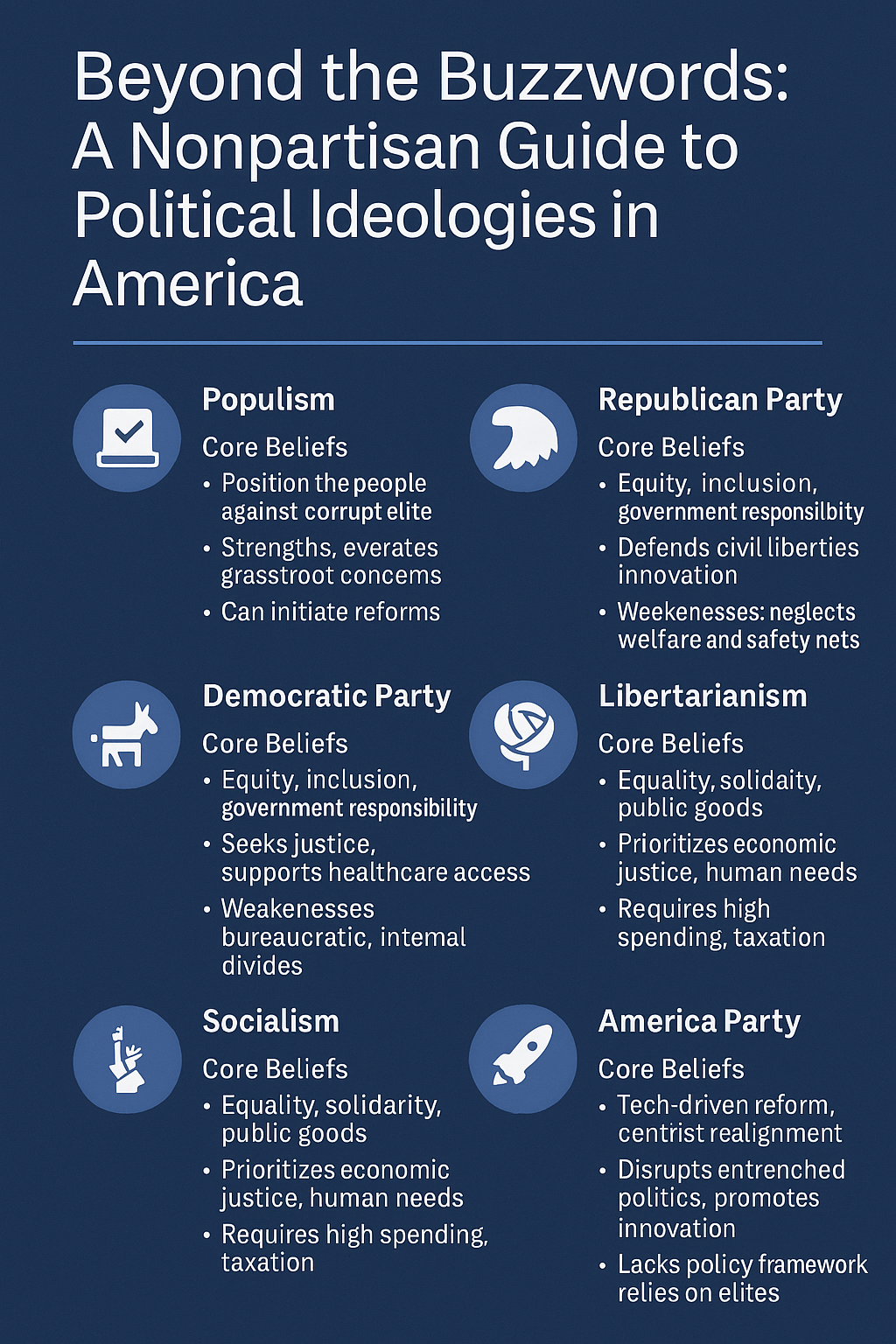
Understanding Populism, Republicanism, Democracy, Libertarianism, and Socialism—Their Principles, Strengths, and Limitations
Understanding the Ideologies that Shape American Politics: A Nonpartisan Exploration
In an era of intensifying polarization and ideological branding, discerning the line between political philosophy and party allegiance has become increasingly complex. The American political landscape is not a static binary but a dynamic ecosystem of ideas shaped by historical precedent, socioeconomic change, cultural values, and technological innovation. As legacy parties like the Republicans and Democrats recalibrate their platforms in response to shifting voter priorities, emerging movements such as Elon Musk’s “America Party” reflect broader disillusionment with the traditional partisan paradigm.
This article offers a nonpartisan and academically grounded exploration of six key ideological currents currently influencing U.S. political discourse: populism, republicanism, the Democratic Party’s interpretation of democracy, libertarianism, socialism, and the America Party. Rather than promoting any particular stance, this analysis seeks to elucidate the foundational principles, practical implications, and internal tensions within each framework. By doing so, it aims to equip readers with a deeper understanding of how these ideologies inform public policy, civic identity, and institutional governance in the modern United States.
As ideological boundaries become increasingly blurred, critical engagement with these perspectives is essential—not only to navigate electoral decisions but also to foster a more informed and constructive democratic dialogue. Understanding where ideas originate, how they have evolved, and what challenges they pose offers a path toward a more nuanced and participatory political culture.
Populism: Voice of the People or Power Play?
Core Beliefs:
Populism is more a style of political engagement than a structured ideology. It positions “the people” against a perceived corrupt elite and often appears on both the left and right of the spectrum (Mudde & Rovira Kaltwasser, 2017).
Strengths:
- Elevates grassroots concerns and exposes elite disconnect.
- Energizes political participation among marginalized voters.
- Can initiate needed institutional reforms.
Weaknesses:
- Prone to oversimplifying complex issues.
- Can encourage demagoguery and authoritarian tendencies.
- Often lacks long-term policy coherence.
Republican Party: Tradition, Free Markets, and Federalism
Core Beliefs:
Rooted in classical liberalism and conservatism, the Republican Party emphasizes limited government, free-market capitalism, traditional values, and constitutional originalism (GOP Platform, 2016).
Strengths:
- Promotes individual rights and economic growth through deregulation.
- Supports law and order, military strength, and religious freedom.
- Advocates for federalism and local governance.
Weaknesses:
- May downplay systemic inequalities or climate concerns.
- Critics argue it favors corporate interests over social welfare.
- Resistance to social reforms may alienate younger generations.
Democratic Party: Equity, Inclusion, and Government Responsibility
Core Beliefs:
The Democratic Party advocates for a more active government role in reducing inequality, protecting civil rights, addressing climate change, and expanding healthcare and education access (Democratic Platform, 2020).
Strengths:
- Seeks social justice through redistributive and regulatory policies.
- Champions environmental protection, labor rights, and healthcare access.
- Embraces multiculturalism and diversity.
Weaknesses:
- Critics cite bureaucratic inefficiency and overregulation.
- Internal ideological divides can lead to inconsistent messaging.
- Risk of alienating centrists through progressive overreach.
Libertarianism: Individual Liberty, Minimal Government
Core Beliefs:
Libertarianism centers on maximizing personal freedom in both economic and social spheres, advocating minimal government intervention (Boaz, 2015).
Strengths:
- Defends civil liberties, including free speech and privacy.
- Encourages entrepreneurial innovation and personal accountability.
- Emphasizes non-interventionist foreign policy.
Weaknesses:
- Critics argue it neglects public welfare and social safety nets.
- Can minimize systemic issues like racism, poverty, or healthcare inequity.
- Risks privatizing essential services without oversight.
Socialism: Equality, Solidarity, and Public Goods
Core Beliefs:
Socialism emphasizes economic equality, collective ownership of key industries, and robust public services. In the U.S., most socialists favor democratic socialism, combining market mechanisms with universal healthcare, housing, and education (Ghodsee, 2018).
Strengths:
- Prioritizes economic justice and human dignity.
- Ensures access to basic needs regardless of income.
- Addresses wealth disparities through taxation and redistribution.
Weaknesses:
- Requires high public spending and taxation.
- Risk of bureaucratic inefficiency or reduced innovation.
- Critics cite historical examples of authoritarian socialism as cautionary tales.
The America Party: Tech-Driven Reform and Centrist Realignment
Core Beliefs:
Recently introduced by Elon Musk, the America Party positions itself as a pragmatic, centrist alternative aimed at restoring functionality to American politics. Musk has emphasized innovation, free expression, meritocracy, and common-sense governance as guiding principles. While the party is still forming, its platform appears to blend libertarian values with a populist critique of the establishment.
Emerging Strengths:
- Seeks to disrupt entrenched party politics and special interests.
- Appeals to voters disillusioned by polarization.
- Prioritizes technology, innovation, and transparency.
Emerging Weaknesses:
- Lacks an established policy framework or voter base.
- Critics warn of over-reliance on technocratic and elite-driven solutions.
- Risk of becoming a personality-driven movement without institutional checks.
Note: As of 2025, the America Party is still in its organizational phase and may evolve as more official platforms are released.
Questions for Reflection:
- Do existing political parties adequately represent your values—or do you feel politically homeless?
- Is a new party like the America Party a needed solution—or another temporary political brand?
- Can any one ideology effectively balance freedom, fairness, innovation, and compassion in a diverse society?
Final Thoughts: Democracy Requires Discernment
The presence of ideological diversity is foundational to the health of a pluralistic democracy. Competing perspectives, when grounded in coherent principles and civil discourse, can enhance institutional resilience and ensure that policymaking reflects a wide range of lived experiences and societal needs. However, when partisanship supplants principle—when allegiance to political identity overrides critical evaluation of policy substance—the democratic process can erode into factionalism and zero-sum thinking.
In such an environment, the vitality of democracy depends less on the endurance of any single party and more on the integrity of its participants. Political movements—whether long-established or newly formed—should be assessed not merely by their rhetorical appeal or branding strategies, but by the tangible values they embody and the structural outcomes they promote. It is insufficient to measure political legitimacy by popularity or opposition alone; rather, one must ask whether a given vision genuinely advances the public interest and aligns with democratic norms.
This shift in perspective requires a reframing of civic engagement. Instead of defaulting to binary loyalties—asking “which side am I on?”—citizens and policymakers alike might more productively ask, “which framework best promotes equity, justice, and the common good?” Civic responsibility, therefore, should not be reduced to episodic participation at the ballot box. It demands continuous intellectual engagement, critical reflection, and a willingness to contribute constructively to public discourse, even when doing so requires challenging one’s own assumptions or ideological affiliations.
References
Bartels, L. M. (2008). Unequal Democracy: The Political Economy of the New Gilded Age. Princeton University Press.
Boaz, D. (2015). The Libertarian Mind: A Manifesto for Freedom. Simon & Schuster.
Democratic National Committee. (2020). Democratic Party Platform. https://democrats.org
Frank, T. (2004). What’s the Matter with Kansas? Metropolitan Books.
Ghodsee, K. (2018). Why Women Have Better Sex Under Socialism. Bold Type Books.
GOP. (2016). Republican Party Platform. https://www.gop.com
Hayek, F. A. (1944). The Road to Serfdom. University of Chicago Press.
Mudde, C., & Rovira Kaltwasser, C. (2017). Populism: A Very Short Introduction. Oxford University Press.
Norris, P., & Inglehart, R. (2019). Cultural Backlash: Trump, Brexit, and Authoritarian Populism. Cambridge University Press.
Teles, S. (2009). The Rise of the Conservative Legal Movement. Princeton University Press.
Musk, E. (2025). Public statements on X (formerly Twitter). https://twitter.com/elonmusk
We Want to Hear from You!!!
Have you found yourself questioning party loyalty? Are new political movements like the America Party a breath of fresh air—or a distraction from reforming what we have? Drop your thoughts in the comments or share this article with your own insights.