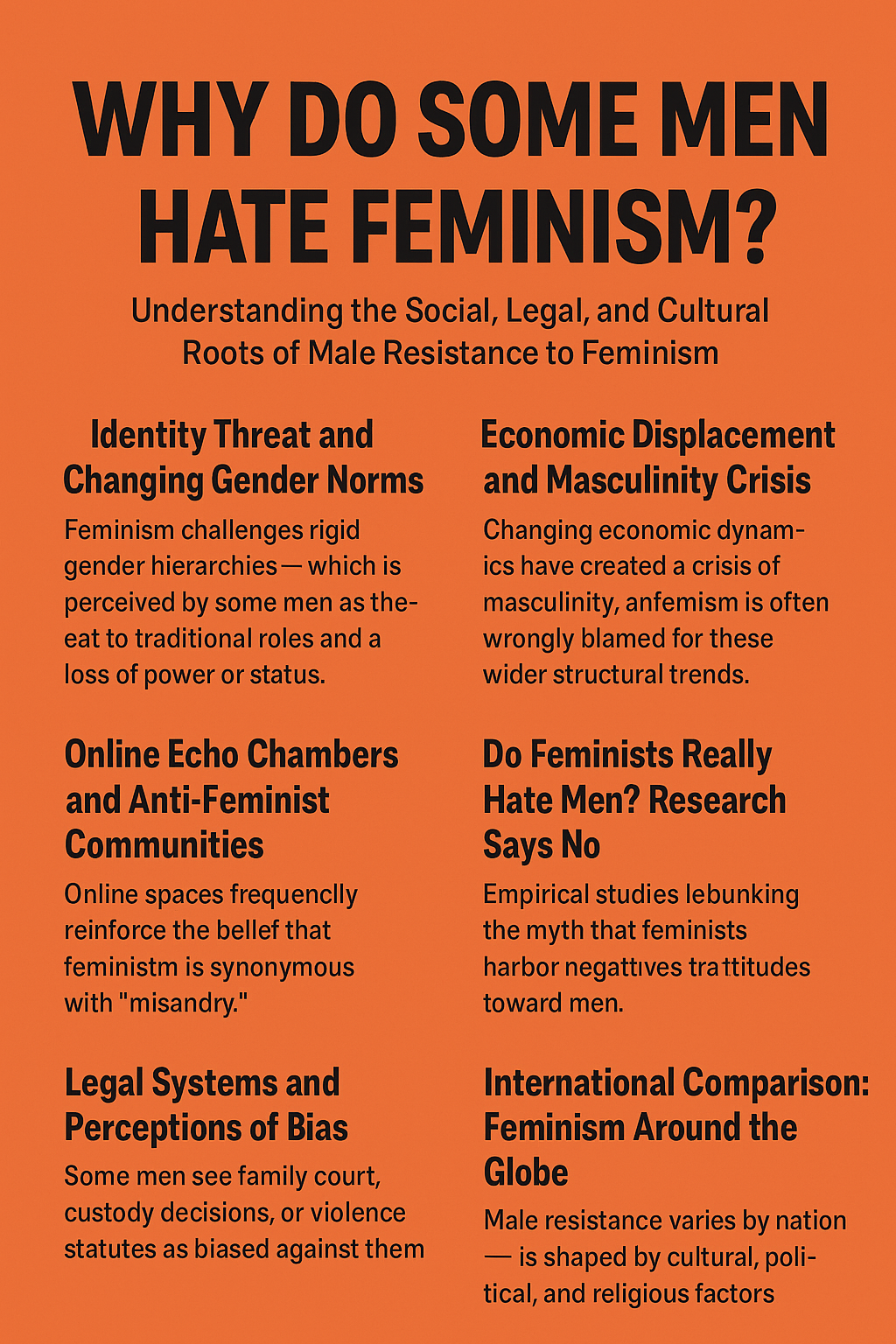
Understanding the Social, Legal, and Cultural Roots of Male Resistance to Feminism
Feminism, fundamentally understood as a movement for gender equity, has made significant sociopolitical advances over the past several decades. However, resistance to feminist ideals persists—particularly among segments of the male population. Understanding this resistance requires more than attributing it to individual prejudice or ideological opposition. Rather, it reflects a multifaceted convergence of generational dynamics, legal and institutional developments, economic restructuring, and cultural narratives. This analysis examines the underlying factors contributing to male hostility toward feminism, drawing upon contemporary research to provide a balanced and educational perspective that avoids partisan framing.

Identity Threat and Changing Gender Norms
One major reason men resist feminism is what researchers call identity threat—the perception that one’s traditional role is under attack. Feminism challenges rigid gender hierarchies, which some men interpret as a loss of power or status rather than a push toward equality (Ging & Siapera, 2023).
This perceived threat is magnified when masculinity is defined narrowly—as dominance, control, or economic provision. As feminist ideals gain ground, men steeped in traditional masculinity may feel alienated or defensive. The emergence of groups like “Men Going Their Own Way” (MGTOW) and the “Men’s Rights Movement” (MRM) reflects a broader cultural backlash fueled by the fear that men are being displaced in society (Hopkins, 2024).
Economic Displacement and Masculinity Crisis
The erosion of industrial jobs, automation, and rising economic precarity have disproportionately affected working-class men. These shifts contribute to what sociologists call a crisis of masculinity—a situation in which traditional male roles (e.g., breadwinner, provider) are no longer economically feasible (Reeves, 2022).
Feminism is often wrongfully blamed for these structural changes. As women gain access to education, employment, and leadership, some men interpret this as a zero-sum game—believing that gains for women mean losses for them. These fears are amplified by media narratives and political rhetoric that frame feminism as a force for male disempowerment rather than a movement for collective liberation.
Online Echo Chambers and Anti-Feminist Communities
Digital platforms like Reddit, YouTube, and TikTok have given rise to the manosphere—a loosely connected web of online communities that often promote anti-feminist, misogynistic, or regressive ideologies. These spaces function as echo chambers, reinforcing the belief that feminism is a form of “misandry” (Barber & Munsch, 2024).
Influential figures in these communities—such as Andrew Tate or Jordan Peterson—frame feminism as emasculating and portray male dominance as natural or desirable. Younger men, in particular, are susceptible to these narratives. According to the Pew Research Center (2023), nearly half of Gen Z men believe feminism has “gone too far.”
Do Feminists Really Hate Men? Research Says No
A common myth perpetuated by anti-feminist groups is that feminists hate men. But empirical research consistently debunks this claim. A 2024 study published in Psychology of Women Quarterly found no significant difference in men’s attitudes among feminists and non-feminists; in fact, many feminists held more positive views of men overall (Barber & Munsch, 2024).
Similarly, a University of Surrey study showed that feminist-identifying individuals were no more likely to hold negative stereotypes about men than their non-feminist counterparts (Stanford Gender News, 2024). This evidence challenges the narrative that feminism is rooted in misandry, revealing instead that it often advocates for dismantling toxic masculinity in ways that can benefit men as well as women.
Legal Systems and Perceptions of Bias
Some men perceive family law, child custody rulings, and domestic violence statutes as inherently biased against them. For instance, while courts often award custody to mothers, research shows this is typically based on caregiving history—not legal discrimination. However, the perception of systemic bias fuels resentment that is frequently projected onto feminism (Family Court Review, 2021).
Moreover, feminist-led initiatives like Title IX reforms and #MeToo-era policies have sparked debates over due process, especially in university settings. Critics argue that these reforms sometimes sacrifice procedural fairness in the name of justice, though advocates maintain they are necessary to protect survivors.
This tension highlights a broader issue: many legal systems have not adapted quickly or clearly enough to gender-equal frameworks, creating ambiguity that fuels male frustration.
Generational Shifts: Youth Attitudes and Resistance
Generational trends reveal that younger men are more likely to challenge feminism—not necessarily because they reject equality, but because they are influenced by a digital culture of grievance. Influencers promote narratives suggesting that feminism shames men, devalues fatherhood, or suppresses masculine traits (Ging & Siapera, 2023).
While Gen Z and Millennial men largely support gender equality in theory, they often reject the label “feminist.” A 2023 Pew survey showed that only 22% of young men identified with the term, despite broader agreement with its goals. This suggests a branding issue rather than outright ideological opposition.
International Comparison: Feminism Around the Globe
Attitudes toward feminism vary widely across nations:
- Nordic countries (e.g., Sweden, Norway) see high male support for feminism due to strong welfare states, normalized gender equality, and egalitarian parenting policies. Over 60% of Swedish men support feminist policies (UN Gender Equality Index, 2022).
- Anglophone countries (e.g., U.S., UK, Australia) display more polarized attitudes, shaped by culture wars, political divisions, and media influence. In the UK, only 33% of men identify as feminists (Fawcett Society, 2022).
- Traditional societies (e.g., India, Russia) often frame feminism as foreign or destabilizing. Feminist discourse in these contexts is met with greater resistance, especially when tied to Western values or elite movements.
These comparisons highlight that male resistance to feminism is not universal—it’s contextual. Where feminism is integrated into policy and identity, it thrives. Where it is politicized or misunderstood, it struggles.
Final Thought: Toward Shared Liberation
Understanding the roots of male resistance to feminism necessitates a multidimensional analysis that transcends reductive explanations or ideological labeling. While public discourse often frames this tension in terms of blame or cultural division, a closer examination reveals that such resistance is frequently shaped by a constellation of social, psychological, and structural influences. These include, but are not limited to, economic instability, shifting labor market dynamics, evolving norms of masculinity, and the politicization of gender discourse. In this context, feminism is sometimes mischaracterized or scapegoated—not because of its core tenets, but because it is perceived as emblematic of broader societal transformations that challenge long-standing power structures and identities.
This misperception is compounded by cultural narratives that frame gender equity as a zero-sum competition, in which gains for women are assumed to entail losses for men. Such narratives fail to account for the transformative potential of feminist thought, which—when accurately understood—does not seek to invert hierarchies but to dismantle them altogether. Contemporary feminism includes frameworks that advocate for shared liberation, promote relational justice, and interrogate harmful norms of masculinity that negatively affect men themselves (hooks, 2004; Kimmel, 2017).
Bridging the ideological and emotional divide between men and feminism thus requires more than rhetorical persuasion; it calls for intentional engagement grounded in empathy, critical reflection, and mutual accountability. Constructive dialogue must center shared human dignity, recognize intersecting struggles, and resist the temptation to oversimplify complex realities. In doing so, both men and women can participate in building more equitable social systems—ones that are not rooted in opposition, but in cooperation and shared flourishing.
Questions for Reflection
- What role does media play in shaping young men’s views on feminism?
- Can family law reform reduce tensions between men’s rights groups and gender equity movements?
- How can educators and community leaders bridge the divide between feminist goals and male participation?
References
- Barber, K., & Munsch, C. L. (2024). Do feminists hate men? Empirical evidence from national survey data. Psychology of Women Quarterly. https://journals.sagepub.com/doi/10.1177/03616843231202708
- Ging, D., & Siapera, E. (2023). Digital Misogyny and the Alt-Right: Online Cultures of Gender Backlash. Critical Discourse Studies. https://www.tandfonline.com/doi/full/10.1080/17405904.2023.2257816
- Hopkins, P. (2024). Moral Redemption and the Manosphere: Masculinity and Victimhood in Anti-Feminist Narratives. Men and Masculinities. https://journals.sagepub.com/doi/10.1177/1097184X241238764
- Stanford Gender News. (2024). Good Guys, Bad Guys: Feminist Men, MRAs, and the Quest for Moral Redemption. https://gender.stanford.edu/news/good-guys-bad-guys-feminist-men-mras-and-quest-moral-redemption
- Pew Research Center. (2023). Gender Attitudes Among Gen Z and Millennials
- Reeves, R. (2022). Of Boys and Men: Why the Modern Male is Struggling, Why It Matters, and What to Do About It. Brookings Institution Press
- Family Court Review. (2021). Custody Outcomes and Gender Bias
- UN Gender Equality Index. (2022). Measuring Progress Toward Global Gender Equality
- Fawcett Society. (2022). Attitudes Toward Feminism in the UK