How Two Conservative Policy Agendas Threaten Civil Liberties, Academic Freedom, and Democratic Institutions
The Rise of Strategic Governance by Think Tank
In a time of heightened political polarization and institutional distrust, policy blueprints like Project Esther and Project 2025 offer more than just ideological perspectives—they propose a fundamental restructuring of American governance. Both initiatives, authored by The Heritage Foundation, reflect sweeping ambitions to recenter U.S. political, legal, and cultural norms around a particular brand of conservative nationalism. While supporters frame these projects as restoring order, tradition, and security, critics—including legal scholars, civil liberties organizations, and academic institutions—raise alarms about their broader implications for democracy.
This blog post offers an academic, nonpartisan analysis of the risks these plans pose to core democratic principles, including freedom of speech, separation of powers, and nonpartisan civil service.
Project Esther – National Security or Political Suppression?
Origin and Premise
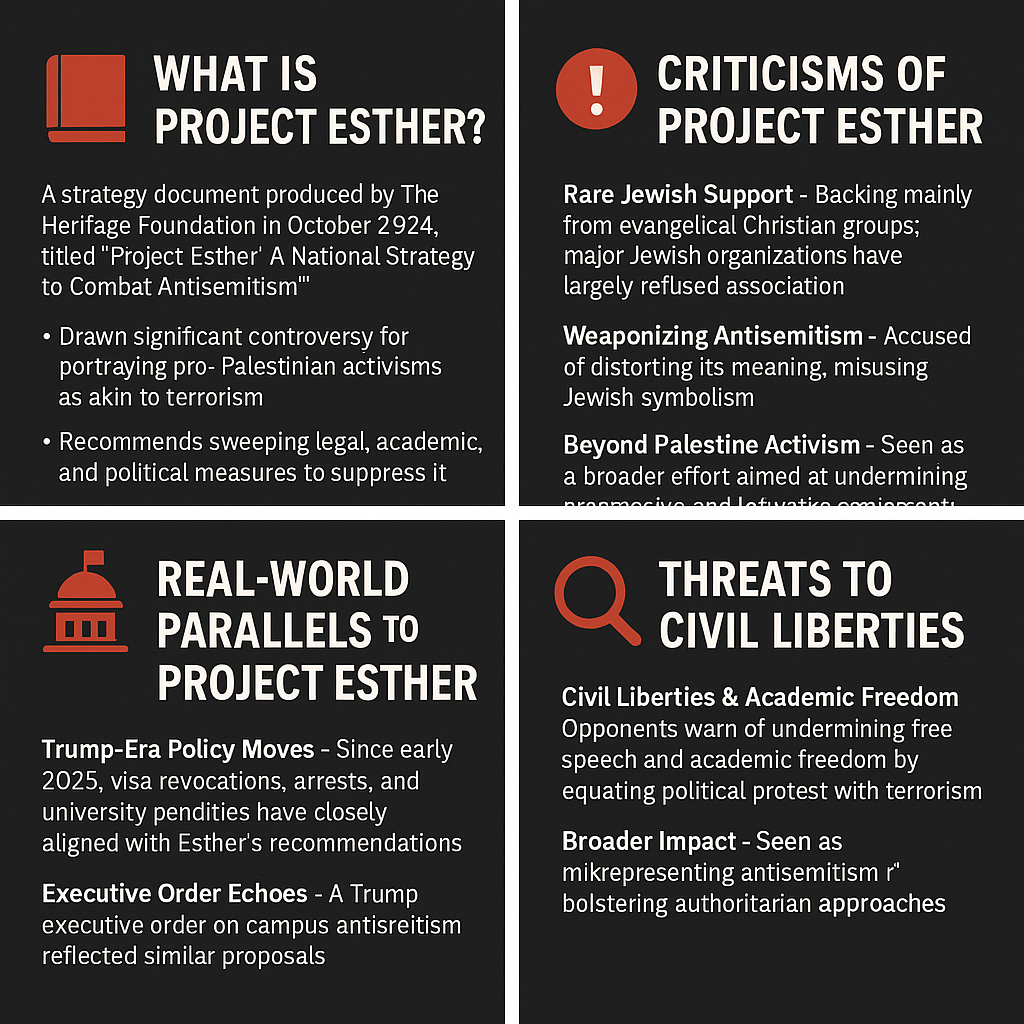
Launched in October 2024, Project Esther presents itself as a “national strategy to combat antisemitism.” But its contents go far beyond safeguarding Jewish communities. Authored by Heritage Foundation figures like Victoria Coates and Robert Greenway, the report redefines pro-Palestinian activism in the U.S. as part of a ‘Hamas Support Network’ (HSN)—a term critics argue dangerously conflates political speech with terrorism.
Proposed Tactics
Project Esther’s action plan includes:
- Revoking visas and deporting international students and activists involved in protests.
- Leveraging RICO laws to criminalize political organizing.
- Pressuring universities to discipline or fire faculty in Middle East Studies.
- Targeting progressive donors and advocacy organizations (e.g., Jewish Voice for Peace).
Dangers to Civil Liberties
While antisemitism must be taken seriously, critics argue Project Esther weaponizes the term to shut down dissent. Legal experts warn that it threatens:
- First Amendment rights by equating criticism of Israeli policy with hate speech or terrorism (Vox, 2025).
- Academic freedom by advocating state-sanctioned retaliation against educators.
- Equal protection by disproportionately targeting Muslims, Arabs, and left-leaning groups (Anadolu Agency, 2025).
Broader Implications
The plan reflects a growing trend toward politicizing national security to delegitimize opposition movements. Importantly, Project Esther has little endorsement from mainstream Jewish organizations and is primarily backed by conservative Christian groups—raising concerns about co-opting Jewish identity for political ends.
Project 2025 – Dismantling the Administrative State
Overview
Project 2025, formally titled the “Presidential Transition Project,” is Heritage’s 900-page roadmap for the next Republican administration. It aims to reshape the federal government by concentrating executive power, dismantling regulatory frameworks, and removing career civil servants in favor of ideological loyalists.
Key Components
- Personnel Overhaul: Reinstating Trump’s Schedule F order to fire tens of thousands of federal employees and replace them with political appointees.
- Executive Power Expansion: Weakening independent agencies and strengthening presidential control over judicial, economic, and environmental policy.
- Policy Agenda: Rolling back LGBTQ+ protections, reproductive rights, climate regulations, and civil rights enforcement.
Constitutional Concerns
The plan challenges the balance of powers enshrined in the U.S. Constitution. By removing traditional checks on the presidency and replacing institutional expertise with partisan loyalty, Project 2025 risks:
- Politicizing the civil service, traditionally a nonpartisan pillar of democratic governance (Brookings, 2024).
- Curtailing agency independence, especially in public health, education, and environmental protection.
- Eroding rule of law, as laws may be interpreted based on political expediency rather than constitutional fidelity.
The Ideological Engine
Although framed as a technocratic transition plan, Project 2025 reflects a deeper ideological mission: to reverse liberal social gains, enshrine Christian nationalist values, and deconstruct federal bureaucracy in favor of centralized executive rule (NPR, 2024).
Shared Risks: Suppression Through Structure
Despite their different targets—Project Esther focusing on protest and academia, Project 2025 on bureaucratic reshaping—both share a tactical blueprint:

National Reach: Why Every American Should Pay Attention
Although Project Esther and Project 2025 may appear targeted—focusing on campus protests, federal employees, or progressive activism—their implications ripple far beyond partisan lines or geographic boundaries. These proposals could reshape the everyday experiences of citizens in all 50 states, regardless of profession, religion, race, or political affiliation.
Community-Level Consequences
- Educators and students face surveillance, censorship, or job insecurity simply for engaging in critical scholarship or protest.
- Healthcare providers may see changes in reproductive care, gender-affirming services, and funding structures.
- Environmental protections could be rolled back, increasing exposure to pollution and public health risks in both rural and urban communities.
- Religious minorities and immigrants may be disproportionately affected by increased deportation, visa restrictions, or ideological screening.
Erosion of Institutional Neutrality
By inserting partisan loyalty into once-independent institutions—like public education, the EPA, or the Department of Justice—these projects could politicize the basic functions of governance, undermining services that millions rely on.
Everyday Democracy at Risk
The transformation of civil service, the criminalization of protest, and the redefinition of civil rights aren’t abstract concerns—they directly affect how laws are enforced, who is protected, and whose voice counts in the democratic process.
In short: You don’t have to be a protester, professor, or public servant to feel the effects. Whether you’re a student, small business owner, parent, or retiree—your rights, your information, and your institutions are at stake.
Academic Takeaways
From a nonpartisan and academic standpoint, these two projects raise serious red flags:
- Democratic Backsliding: The consolidation of power under the executive branch—while legal under certain precedents—represents democratic backsliding when it undermines transparency, pluralism, and institutional independence.
- Civil Rights Reversal: Rolling back hard-won protections (LGBTQ+, reproductive, educational, racial equity) in the name of “traditional values” shifts power away from vulnerable populations and toward dominant cultural hierarchies.
- Crisis of Legitimacy: Using policy frameworks to criminalize dissent not only silences voices—it erodes the public trust in governmental neutrality and fairness.
Questions for Thought
- What safeguards can be put in place to prevent ideological capture of government institutions?
- Should think tanks have the power to shape national security policy and personnel strategy?
- How do we distinguish between protecting national interests and weaponizing patriotism to silence dissent?
References
Heritage Foundation – Project Esther
Vox – Deporting Protesters Blueprint
The Forward – Jewish Critique of Esther
Anadolu Agency – Critique of Project Esther
Heritage Foundation – Project 2025
Brookings Institution – Administrative State
We Want to Hear from You
Do you believe projects like Esther and 2025 represent strategic governance or ideological overreach?
How should citizens respond when legal and political tools are used to suppress dissent?
Let us know in the comments or join the discussion on our Facebook page and Twitter/X!