Understanding the Overlap Between Personal Principles and Party Identity
Two Concepts, One Conversation
In the United States, political affiliation and personal values are often discussed as though they are one and the same. While these concepts are related, they are fundamentally different. Values are deeply held beliefs that shape how individuals view morality, fairness, and the role of society. Political affiliation, by contrast, reflects an individual’s chosen alignment with a political party or movement, which may shift over time as party platforms evolve (Jost et al., 2009).
Despite this distinction, values and political affiliation are frequently intertwined because individuals tend to choose political parties whose policy positions reflect their core principles (Feldman, 2013). This intersection has been reinforced by partisan messaging, social identity theory, and increasing political polarization (Iyengar & Krupenkin, 2018).
Defining Values and Political Affiliation
Values
Values are personal guiding principles that influence how individuals make judgments and prioritize decisions. They often stem from cultural, religious, familial, and life experiences and can include ideals such as liberty, equality, compassion, and personal responsibility (Schwartz, 2012).
Political Affiliation
Political affiliation is a formal or informal association with a political party or ideology. While political parties often use value-based rhetoric to attract supporters, affiliation itself is about collective political identity and strategic alignment with a group’s platform (Dalton, 2016).
Why They Appear Intertwined
Values Shape Political Preferences
Research suggests that citizens often use their personal values as a framework to evaluate political candidates and policies (Schwartz et al., 2014). For example, individuals who prioritize individual liberty may gravitate toward parties promoting limited government, while those who value social equity may support parties advocating for redistributive policies.
Parties Market Themselves Through Values
Political parties deliberately frame their platforms in value-driven language—such as “freedom,” “justice,” or “family”—to appeal to specific voter segments (Lakoff, 2002). This marketing can blur the line between universal values and partisan ownership of those values.
Social Identity and Group Belonging
Political affiliation can become a core part of an individual’s identity. Social identity theory posits that people derive self-esteem and a sense of belonging from group membership, which may lead them to adopt party positions even on issues unrelated to their core values (Tajfel & Turner, 1979).
Polarization and Reinforcement Loops
Partisan media and political rhetoric increasingly frame opposing parties as holding “anti-values,” deepening the association between certain principles and specific political affiliations (Pew Research Center, 2022). This reinforces the perception that values and party identity are inseparable.
A Visual Representation of Overlap
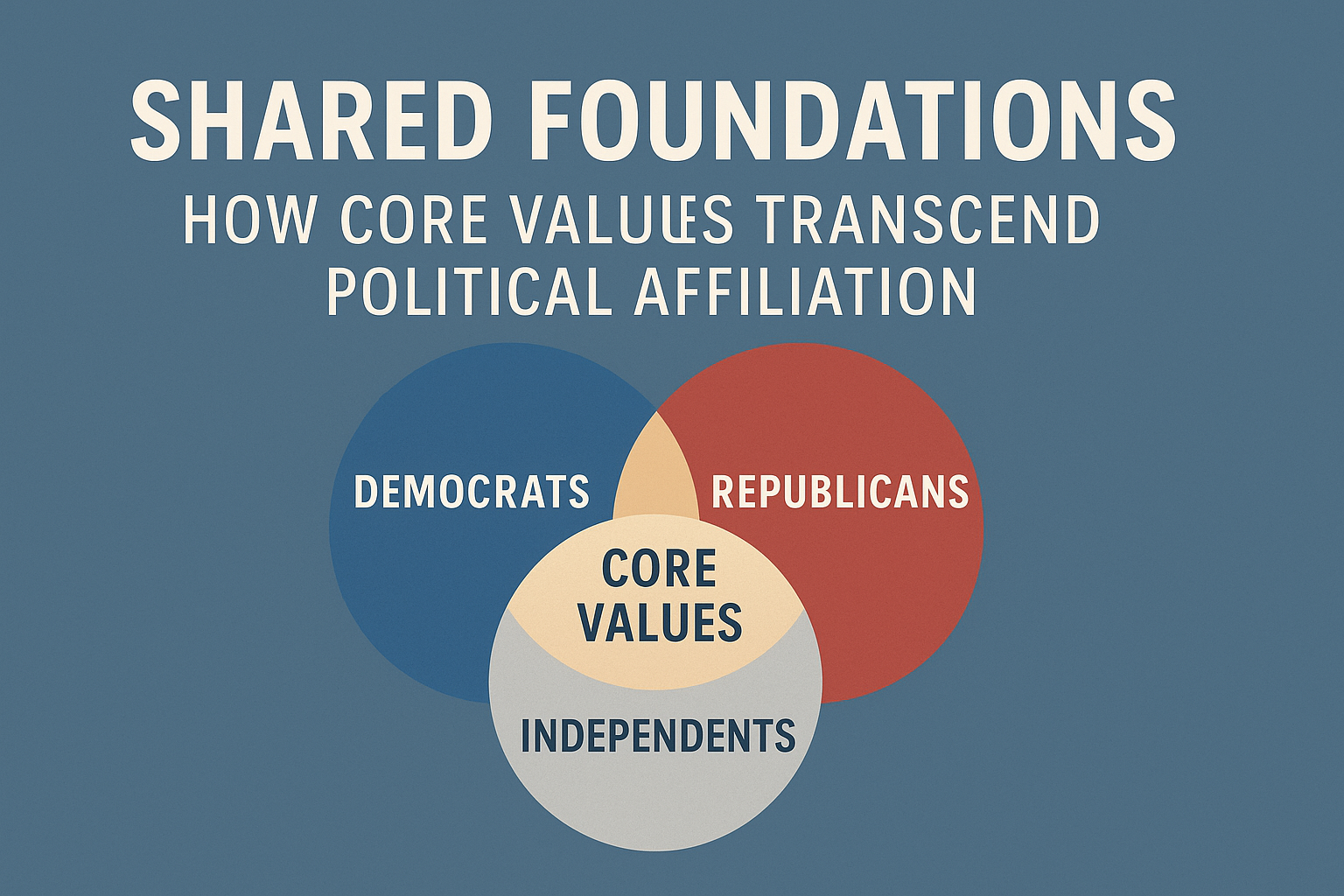
A comparative analysis of value emphasis across Democrats, Republicans, and Independents demonstrates significant overlap. While emphasis levels differ—e.g., Republicans may rate “tradition” more highly, Democrats may prioritize “equality”—all groups express concern for freedom, safety, and responsibility. This suggests shared moral foundations exist, even amid political polarization.

Why the Distinction Matters
Separating values from political affiliation is critical for fostering bipartisan collaboration. Shared values such as justice, safety, and opportunity can serve as starting points for dialogue, even when policy approaches differ (Gutmann & Thompson, 2012). By focusing on overlapping principles, policymakers and citizens alike can work toward solutions that transcend partisan divisions.
Call to Action
As political polarization intensifies, it is essential to remember that many Americans—regardless of party—share common values. Recognizing this overlap allows for more constructive political dialogue, better policy-making, and healthier civic engagement. Citizens, community leaders, and policymakers should actively seek common ground rooted in shared principles rather than solely in partisan identity.
We Want to Hear from You
This conversation about the relationship between values and political affiliation is one that benefits from many perspectives. We invite you to reflect on your own experiences and share your insights:
- Which of your personal values have shaped your political decisions the most?
- Have you ever found common ground with someone from a different political affiliation because of shared values?
- How do you think communities can create more spaces for value-based discussions without partisan labels?
Your voice matters. Whether you are a student, policymaker, community leader, or engaged citizen, your perspective helps broaden understanding and bridge divides.
Join the conversation:
- Leave a comment below.
- Share this article with friends, colleagues, and community groups.
- Reach out to us with your own story about how values have shaped your civic engagement.
By focusing on the values we hold in common, we can take meaningful steps toward dialogue that builds connection rather than division.
Questions for Further Discussion
- Which of your personal values influence your political decisions the most?
- Have you ever changed your political affiliation because your values no longer aligned with a party’s platform?
- How can communities create spaces for value-based discussions that are not immediately politicized?
References
Dalton, R. J. (2016). The apartisan American: Dealignment and changing electoral politics. CQ Press.
Feldman, S. (2013). Values, ideology, and the structure of political attitudes. In L. Huddy, D. O. Sears, & J. S. Levy (Eds.), The Oxford handbook of political psychology (2nd ed., pp. 591–626). Oxford University Press.
Gutmann, A., & Thompson, D. (2012). The spirit of compromise: Why governing demands it and campaigning undermines it. Princeton University Press.
Iyengar, S., & Krupenkin, M. (2018). The strengthening of partisan affect. Political Psychology, 39(S1), 201–218. https://doi.org/10.1111/pops.12487
Jost, J. T., Federico, C. M., & Napier, J. L. (2009). Political ideology: Its structure, functions, and elective affinities. Annual Review of Psychology, 60, 307–337. https://doi.org/10.1146/annurev.psych.60.110707.163600
Lakoff, G. (2002). Moral politics: How liberals and conservatives think. University of Chicago Press.
Pew Research Center. (2022). Partisan polarization and the changing American public. https://www.pewresearch.org
Schwartz, S. H. (2012). An overview of the Schwartz theory of basic values. Online Readings in Psychology and Culture, 2(1), 11. https://doi.org/10.9707/2307-0919.1116
Schwartz, S. H., Caprara, G. V., & Vecchione, M. (2014). Basic personal values and political orientation: The cross-national evidence. Political Psychology, 31(4), 537–561. https://doi.org/10.1111/j.1467-9221.2010.00789.x
Tajfel, H., & Turner, J. C. (1979). An integrative theory of intergroup conflict. In W. G. Austin & S. Worchel (Eds.), The social psychology of intergroup relations (pp. 33–47). Brooks/Cole.