Recent scandals and long-term trends reveal an ongoing accountability crisis.
Politics is meant to be a public trust, but recent events underscore a troubling reality: sexual misconduct allegations continue to surface at every level of government. From federal lawmakers to statehouse representatives, the problem is neither new nor limited to one political party.
The data and cases below show both the immediate headlines—politicians recently facing legal trouble—and the long-term trends pointing to a systemic issue.

Politicians Recently in Trouble (Mid-2025)

RJ May — South Carolina State Representative
- Charges: 10 federal counts of distributing child sexual abuse material (CSAM).
- Status: Arrested in June 2025; resigned August 2025; trial pending.
- Significance: The case prompted public outrage and renewed calls for stricter vetting of political candidates.
Cory Mills — U.S. Congressman, Florida
- Allegations: Accused by ex-girlfriend of threatening to release explicit videos/images (“revenge porn”).
- Status: Denies allegations; under active investigation by state and federal authorities.
- Significance: Highlights how non-criminal accusations can still erode public trust.
Jim Jordan — U.S. Congressman, Ohio
- Allegations: Accused of ignoring sexual abuse reports during his time as a wrestling coach at Ohio State University in the 1990s.
- Status: Jordan denies wrongdoing; allegations resurfaced in 2024 media coverage.
- Significance: Shows how historical claims can continue to impact public perception years later.
Justin Eichorn (Minnesota State Senator, Republican)
- Accusation: Arrested in March 2025 during a sting for allegedly soliciting a minor for sex. He was charged federally with attempted coercion and enticement.
- Status: Resigned from the Senate shortly after his arrest; pleaded not guilty and was released under supervision
Daniel Grossberg (Kentucky State Representative, Democrat)
- Allegations: In mid‑2024, Grossberg was accused by multiple women of sending “weird” and “creepy” late-night messages and inappropriate advances. The Kentucky Legislative Research Commission launched an investigation.
- Status: He was temporarily suspended from his caucus, removed from committee assignments, and faced calls to resign. In mid‑2025, the Kentucky Legislative Ethics Commission found probable cause on three ethics violations (though not specifically labeled sexual harassment). He was offered a settlement (fine and public reprimand), which he declined. A hearing is pending.
Greg Taylor (Indiana State Senate Minority Leader, Democrat)
- Allegations: In late 2024, three women alleged he had physically pinned a legislative assistant, made sexually charged comments, and pursued an intern. A month later, three more women came forward.
- Status: Taylor apologized—saying he “may have blurred the lines”—but denied wrongdoing. Nonetheless, the Senate Democrats removed him from his leadership post.
Matt Schlapp (Conservative Strategist, Republican-Aligned)
- Allegations: New claims emerged in February 2025 that Schlapp groped a man at a Virginia bar, involving unwanted touching and aggressive behavior. Previous claims included alleged sexual assault of male staffers in 2022.
- Status: No criminal charges have been filed to date. Schlapp denies the allegations, and earlier lawsuits related to similar claims were settled—with the accuser receiving nearly $480,000 while formally dismissing the case.
Nancy Mace (U.S. Congresswoman, Republican)
- Allegations/Legal issue: Mace claimed on the House floor that a businessman and others were involved in sexual abuse and non-consensual filming. The businessman, Brian Musgrave, denied the claims and sued her for defamation.
- Status: While Mace is shielded by legislative speech privileges, the lawsuit questions the boundaries of such protections.
State-Level Sexual Harassment Patterns
While high-profile federal cases grab headlines, state legislatures have faced hundreds of misconduct claims over the past decade.
- 400 allegations against 145 sitting lawmakers since 2013.
- Allegations range from verbal harassment to sexual assault.
- Outcomes include resignations, censures, settlements, and legislative reforms.
This pattern shows that misconduct is not isolated to “a few bad actors”—it’s part of a broader cultural problem in politics.
Recent New Allegations (2024)
In 2024 alone:
- 11 new public allegations across 10 states.
- Common themes:
- Inappropriate comments toward staff or lobbyists.
- Sexual advances during official events.
- Misuse of office for sexual favors.
- States involved include California, Arizona, New York, Minnesota, Texas, and others.
These allegations reflect not just individual behavior but also workplace cultures that sometimes allow misconduct to go unchecked.
Why This Matters
When lawmakers face credible allegations—or worse, convictions—public trust suffers. The damage extends beyond individual careers:
- Victims may be less willing to come forward.
- Legislative agendas can be derailed.
- Public cynicism toward government grows.
Misconduct in politics is not a partisan issue—it’s a governance issue. Without robust accountability systems, these cycles will continue.
The diversity of these cases—spanning criminal charges, public allegations, and historical accusations—across different political contexts and countries, underscores that sexual misconduct in politics is not limited to one party or ideology. It reflects systemic issues around power, accountability, and institutional response mechanisms.
By presenting these examples with consistent framing and verified factual details, we ensure the discussion remains fair and centered on abuse of power, rather than partisan critique.
The Double Standard: What Message Does This Send?

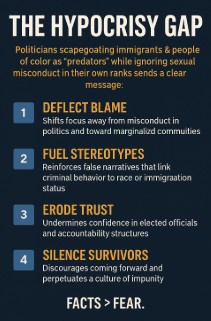
When political leaders make sweeping statements portraying immigrants or people of color as inherently more likely to be rapists or sexual predators, yet scandals involving sexual misconduct persist among elected officials themselves, the result is a dangerous double standard.
This kind of rhetoric sends several troubling messages:
Silencing of Survivors – Survivors, especially those from marginalized backgrounds, may hesitate to come forward if public narratives portray their communities as the perpetrators instead of recognizing them as victims.
Deflection of Accountability – It shifts public attention away from misconduct within political institutions and onto marginalized groups, regardless of evidence.
Reinforcement of Harmful Stereotypes – Associating criminal behavior primarily with race, ethnicity, or immigration status perpetuates false narratives that fuel prejudice and justify discriminatory policies.
Erosion of Public Trust – When leaders accused or convicted of sexual misconduct continue to hold office while targeting vulnerable groups, it undermines the credibility of government and the justice system.
The Evidence Doesn’t Match the Rhetoric
Decades of research consistently show that immigrants—both documented and undocumented—commit sexual offenses at lower rates than native-born citizens.
- Texas Department of Public Safety (2019–2022): Undocumented immigrants were up to 50% less likely to be arrested for sexual assault than U.S.-born citizens (Nowrasteh, 2022, Cato Institute).
- National Academy of Sciences (2015): Found no evidence linking immigration with higher crime rates, including sexual violence.
- American Immigration Council (2020): Communities with higher immigrant populations often reported lower crime rates overall, including sexual offenses.
- Bureau of Justice Statistics (BJS): Most sexual violence is committed by someone known to the victim—often in positions of trust or authority—regardless of race or immigration status.
The data makes one thing clear: sexual violence is rooted in abuse of power, not in nationality or ethnicity.
When leaders ignore misconduct in their own ranks but use fear-based narratives to target marginalized groups, they not only distort the truth but also undermine efforts to address the systemic causes of sexual abuse—such as weak oversight, inadequate whistleblower protections, and a political culture that too often prioritizes loyalty over accountability.
The conversation on sexual misconduct in politics must be grounded in facts, not fear.
What Can Be Done
Strengthen Ethics Rules: Require mandatory reporting, independent investigations, and public disclosure of substantiated cases.
Support Whistleblowers: Protect staff and interns who report misconduct from retaliation.
Cultural Change: Encourage zero-tolerance policies that are enforced consistently, regardless of political affiliation.
We Want to Hear From You
What do you think is the most effective way to hold elected officials accountable for misconduct?
Share your thoughts in the comments below or on our social channels.
References
ABC News. (2025, August 8). Australian lawmaker convicted of rape quits moments before vote to expel him. https://abcnews.go.com/International/wireStory/australian-lawmaker-convicted-rape-quits-moments-vote-expel-124473513
Australian Broadcasting Corporation. (2025, August 7). Gareth Ward lawyer argues against expulsion over sex offences. https://www.abc.net.au/news/2025-08-07/gareth-ward-lawyer-argues-against-expulsion-over-sex-offences/105623194
Justice.gov. (2025, June 11). West Columbia man indicted for distributing child sexual abuse material. https://www.justice.gov/usao-sc/pr/west-columbia-man-indicted-distributing-child-sexual-abuse-material
NDTV. (2025, August 2). Ex-MP Prajwal Revanna gets life term for sexually assaulting house help. https://www.ndtv.com/india-news/ex-mp-prajwal-revanna-gets-life-term-for-sexually-assaulting-house-help-9006187
News.com.au. (2025, July 25). Kiama MP Gareth Ward found guilty of sexual assault. https://www.news.com.au/national/nsw-act/courts-law/kiama-mp-gareth-ward-found-guilty-of-sexual-assault/news-story/05d5bc2151dbd441cace2736172604bc
People. (2025, August 8). Cory Mills accused of threatening to release revenge porn. https://people.com/cory-mills-lindsey-langston-revenge-porn-11787850
The 19th. (2025, March 12). State legislatures have faced 400 sexual misconduct allegations over the last decade. https://19thnews.org/2025/03/state-legislatures-sexual-misconduct
The Washington Post. (2025, August 8). Rep. Cory Mills is accused of threatening revenge porn in latest controversy. https://www.washingtonpost.com/politics/2025/08/08/rep-cory-mills-is-accused-threatening-revenge-porn-latest-controversy
WIS-TV. (2025, August 11). SC Rep. RJ May resigns amid federal child sex abuse material case. https://www.wistv.com/2025/08/11/sc-rep-rj-may-resigns-amid-federal-child-sex-abuse-material-case