The shifting legal landscape, from nationwide bans to lingering loopholes
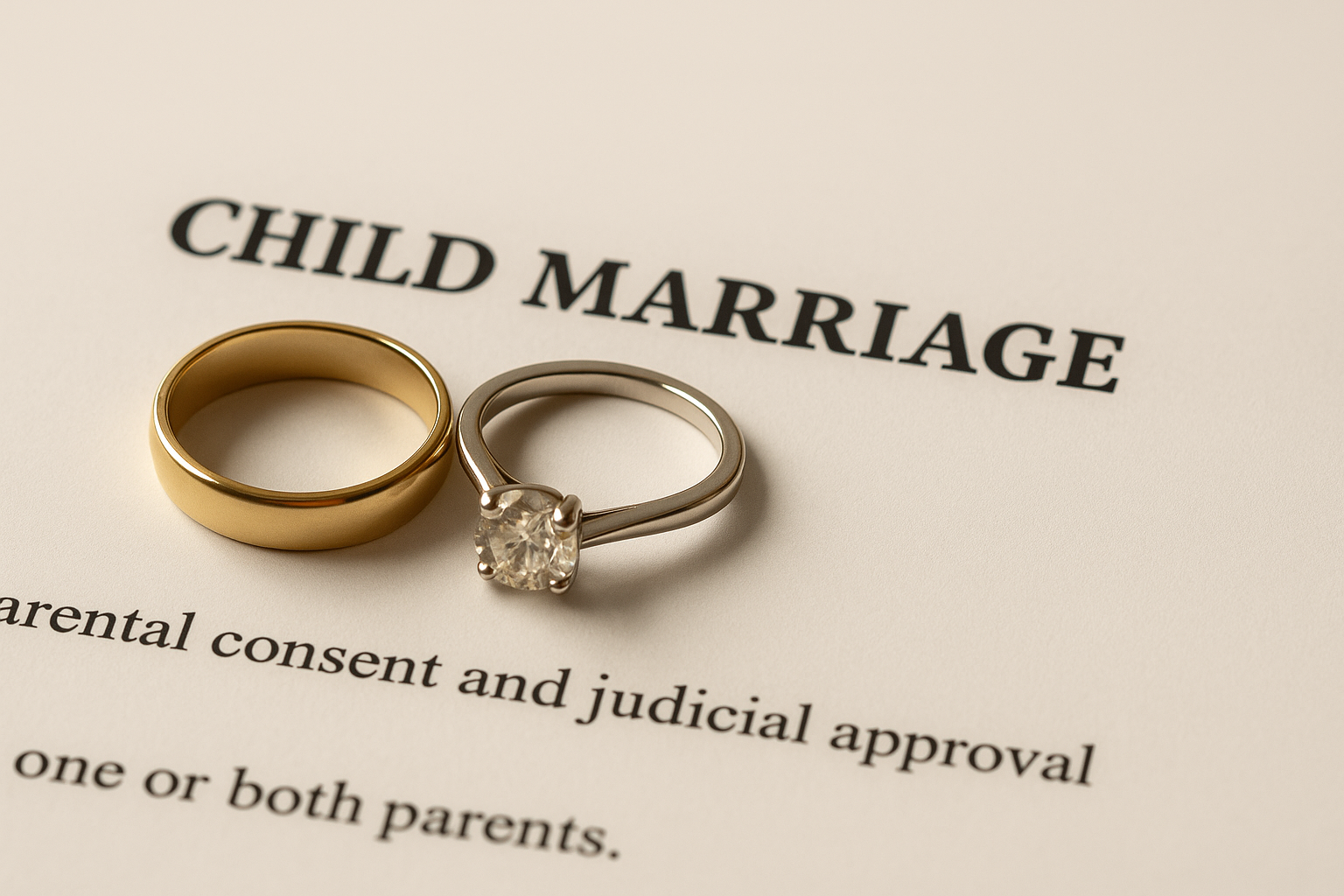
In 2025, the United States is still grappling with a practice many assume is long gone: child marriage. While 16 states and Washington, D.C., have banned marriage under age 18 with no exceptions, the majority—34 states—still allow minors to marry under certain circumstances. These allowances often involve parental consent, judicial approval, or both, and in a handful of states, there is no statutory minimum age.
This patchwork of laws means that whether a minor can marry—and under what conditions—depends entirely on state borders.
Where Child Marriage Is Completely Banned

Since 2018, momentum has been building toward a full prohibition. States that have enacted total bans include:
- Delaware (2018) and New Jersey (2018) — the first to outlaw all child marriage.
- Pennsylvania and Minnesota (2020).
- Rhode Island and New York (2021).
- Massachusetts (2022).
- Vermont and Connecticut (2023).
- Michigan, Washington, and Virginia (2023–2024).
- New Hampshire, Maine, Oregon, and Missouri (2024–2025).
In these jurisdictions, marriage before 18 is prohibited, regardless of parental or judicial consent.
States With No Minimum Age
Four states—California, Mississippi, New Mexico, and Oklahoma—do not set a legal minimum marriage age in statute. In practice, these states still require parental consent and judicial approval, but the absence of a hard age floor leaves room for interpretation.
Advocates argue that this legal gap creates risk for abuse and coerced marriages, especially when combined with cultural or familial pressure.
States Allowing Marriage at 16 or 17
Most of the remaining 30 states permit marriage at 16 or 17 with:
- Parental consent alone (in about 15 states, including Alabama, Nebraska, and Wisconsin).
- Parental consent + judicial approval (in states like Colorado, Utah, and Wyoming).
Some add further safeguards, such as limiting the age gap between the minor and their intended spouse or requiring counseling.
The 14- and 15-Year-Old Question
No state currently allows a 14-year-old to marry with only parental consent.
However, in rare cases, a 14- or 15-year-old may marry if both parents consent and a judge approves—most often in states with no statutory minimum age, or where laws explicitly list this younger range as eligible under strict judicial oversight.
Recent Legislative Shifts
The past three years have been a turning point:
- 2023 — Michigan banned child marriage; Wyoming and West Virginia raised minimum ages to 16.
- 2024 — Washington and Virginia enacted full bans.
- 2025 — Maine, Oregon, and Missouri eliminated child marriage entirely.
Even in states where marriage under 18 remains legal, lawmakers are increasingly proposing bills to either set higher age minimums or close loopholes.
Federal Efforts
The Child Marriage Prevention Act of 2024 was introduced in Congress to create federal safeguards, particularly in immigration cases where underage marriage laws can conflict with state statutes. While it would not override state marriage laws entirely, it aims to harmonize protections and encourage uniform bans.
Why This Matters
Research shows that marrying before 18 is linked to higher rates of:
- School dropout
- Poverty and financial instability
- Domestic violence
- Poor physical and mental health outcomes
For many advocates, ending child marriage is not simply a legal reform—it’s a human rights issue.
Why It’s Even More Dangerous When Women Lack Constitutional Protection
The United States still does not have an explicit constitutional guarantee of gender equality. The Equal Rights Amendment (ERA)—first proposed in 1923 and passed by Congress in 1972—has never been fully ratified and enshrined into the Constitution. This means that when women’s rights are challenged, protections often rely on patchwork state laws or judicial interpretation rather than a clear, enforceable federal standard.
1. Legal Vulnerability in Times of Policy Retrenchment
Without constitutional protection, women’s rights can be narrowed or redefined by shifts in political leadership. When a federal administration—such as the Trump administration—supports policies that limit access to reproductive healthcare, roll back Title IX protections, or narrow definitions of sex discrimination, there is no constitutional safeguard ensuring those rights remain intact.
2. Weak Recourse Against Abuse and Exploitation
In the absence of an ERA, legal remedies for gender-based violence and discrimination depend heavily on existing statutes, which can be underfunded, inconsistently enforced, or repealed entirely. For young girls, this means that even when abuse is reported, systemic gaps can allow perpetrators—especially powerful ones—to evade accountability.
3. A Perfect Storm for Abuse of Power
When elected officials are implicated in sexual abuse, and the legal system lacks a constitutional mandate to treat gender equality as a fundamental right, the result is a dangerous imbalance. Survivors face an uphill battle in pursuing justice, while political leaders accused of misconduct can continue shaping laws that impact women’s bodies, safety, and futures.
4. Intersection with Women’s Health Autonomy
In an environment where women’s reproductive autonomy is already under siege, the lack of constitutional protection magnifies the danger. Restrictions on abortion, contraception, and maternal healthcare do not exist in isolation—they intersect with the broader reality that women’s equality is not constitutionally guaranteed, leaving them more exposed to harmful policies and systemic neglect.
We Want to Hear from You
Do you think all states should ban marriage under 18 with no exceptions?
Should there be federal legislation setting a national minimum age, or should states retain their current flexibility?
Share your thoughts in the comments, and let’s keep this conversation going.
References
Equality Now. (2024). Child Marriage in the United States.
Human Rights Watch. (2017). US: End Child Marriage.
National Conference of State Legislatures. (2025). Marriage Age Requirements.
The Guardian. (2024). The survivors fighting to end child marriage in the U.S.
Wikipedia. (2025). Marriage age in the United States.