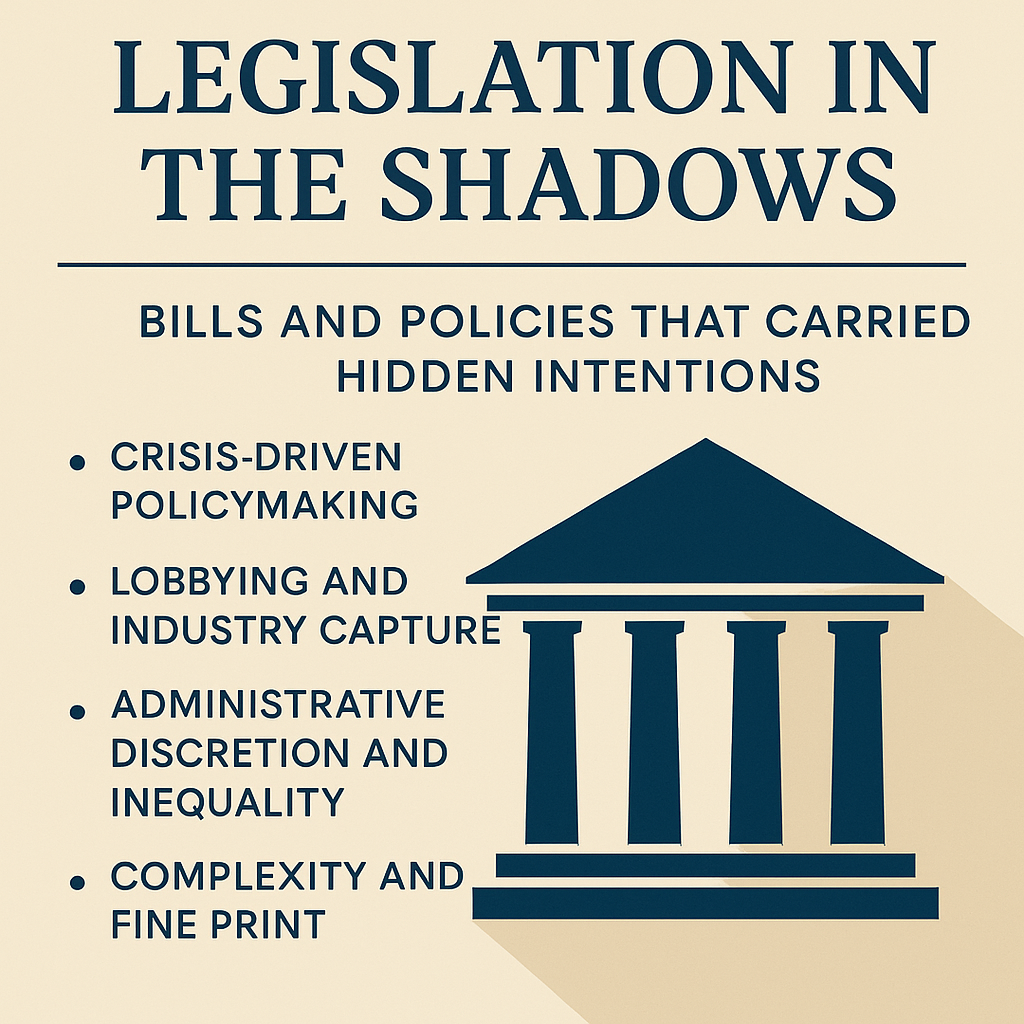
The Promise vs. Reality of Law
Democracy rests on the premise that legislation reflects transparent debate, public interest, and fair compromise. Citizens assume that when Congress passes a bill, its primary purpose is to address a pressing social or economic issue. Yet history reveals that legislation often carries shadow dimensions: provisions, omissions, or administrative designs that produce outcomes far removed from the stated intent. Sometimes these shadows are unintended consequences of rushed policymaking, while in other cases they reflect deliberate attempts to obscure who benefits and who bears the costs (Hacker & Pierson, 2010; Stiglitz, 2015).
This post examines key examples of American laws and policies where stated goals diverged from hidden realities. By analyzing these cases, we uncover recurring patterns of shadow legislation and reflect on their implications for democracy and civic literacy.
Mechanisms of Shadow Legislation

Scholars of public policy highlight several mechanisms through which hidden agendas take root:
- Crisis-driven policymaking: Urgency during national emergencies can override deliberation and transparency.
- Lobbying and industry capture: Wealthy industries often shape bills through influence, campaign financing, and drafting.
- Administrative discretion: Local or institutional implementation can skew access and reinforce inequality.
- Complexity and fine print: Technical language or lengthy provisions conceal long-term impacts (Mettler, 2011).
These mechanisms recur across historical and modern cases of shadow legislation.
Case Studies in Legislation’s Shadows
The USA PATRIOT Act (2001): Security vs. Privacy
Intent: Passed in the aftermath of 9/11, the Patriot Act was presented as a necessary tool to prevent terrorism.
Hidden Reality: The law dramatically expanded government surveillance, allowing warrantless searches, expanded wiretapping, and mass data collection. While marketed as a temporary measure, many provisions became permanent, reshaping the balance between liberty and security (Hudson, 2005; Etzioni, 2015).
Lesson: Crises create conditions for expanding state power in ways that persist long after the emergency subsides.
Section 230 of the Communications Decency Act (1996): Free Speech vs. Corporate Immunity
Intent: Designed to promote free expression online by shielding platforms from liability for user-generated content.
Hidden Reality: Section 230 became a cornerstone for the rise of tech giants like Facebook and Google, giving them near-total immunity while they profit from content moderation practices that shape public discourse. Critics argue the law fostered monopolistic dominance and unchecked harms (Kosseff, 2019).
Lesson: Laws written for a nascent internet created unintended protections for corporate power in the digital age.
The G.I. Bill (1944): Rewarding Veterans, Excluding Black Americans
Intent: The Servicemen’s Readjustment Act offered educational and housing benefits to returning veterans of World War II.
Hidden Reality: Local control over benefit distribution allowed discriminatory practices. Many Black veterans were denied access to home loans and educational programs, deepening racial wealth inequality (Katznelson, 2005).
Lesson: Neutral language can mask systemic inequities when local implementation intersects with racial discrimination.
Agricultural Subsidies: Protecting Farmers or Enriching Agribusiness?
Intent: Federal subsidies were designed to stabilize food supply, protect farmers, and ensure affordability.
Hidden Reality: Large agribusinesses capture the majority of subsidies, while small family farmers often struggle to compete. Subsidy structures reinforce market consolidation rather than equitable distribution (Orden et al., 2011).
Lesson: Policy design often favors concentrated wealth over broad-based benefit.
The 1994 Crime Bill: Public Safety vs. Mass Incarceration
Intent: Officially titled the Violent Crime Control and Law Enforcement Act, the bill was framed as a response to rising crime rates.
Hidden Reality: By incentivizing states to build prisons and imposing mandatory minimums, the law accelerated mass incarceration, disproportionately impacting Black and Latino communities. Its long-term effects have been widely critiqued for worsening systemic inequities (Mauer, 2006).
Lesson: “Tough on crime” rhetoric can mask racialized outcomes of punitive policy.
Medicare Part D (2003): Prescription Coverage with a Price
Intent: Expanded prescription drug access for seniors under Medicare.
Hidden Reality: A provision prohibited the federal government from negotiating drug prices, locking in high costs for consumers while guaranteeing profits for pharmaceutical companies (Blumenthal, 2006).
Lesson: Legislative riders can fundamentally alter the cost-benefit balance of otherwise popular programs.
Highway Funding and Urban Renewal (1950s–1960s): Progress vs. Displacement
Intent: Federal highway bills promised modernization, mobility, and economic growth.
Hidden Reality: Construction routes disproportionately cut through Black and minority neighborhoods, destroying homes and businesses, and erasing generational wealth (Mohl, 2002).
Lesson: Infrastructure policy can function as a tool of displacement under the banner of progress.
Patterns in the Shadows
Across these examples, several patterns emerge:
- Fear and urgency enabled rapid passage of laws with lasting consequences.
- Corporate lobbying embedded provisions favorable to concentrated wealth.
- Structural inequality persisted when implementation intersected with racial bias.
- Technical complexity obscured impacts from the public eye.
These patterns suggest that shadow legislation is not an anomaly but a recurring feature of democratic governance, shaped by institutional incentives and political power.
Implications for Democracy
Shadow legislation erodes public trust when citizens discover that laws do not function as promised. As Pierson (1993) observes, policies create “feedback effects” that reshape political dynamics, often entrenching the very inequities they were meant to address. Public disengagement grows when rhetoric and reality diverge (Putnam, 2000).
Civic Literacy as the Antidote
Civic literacy—the ability to read, analyze, and question policy—offers the strongest safeguard against legislation in the shadows. Citizens who understand government structures and follow the influence of lobbying are better positioned to demand accountability. As Levine (2013) argues, civic renewal depends on informed and engaged publics capable of scrutinizing both the letter and the spirit of the law.
Conclusion
Legislation in the United States has often promised one set of outcomes while delivering another. From the Patriot Act to the G.I. Bill, from agricultural subsidies to Medicare Part D, shadow provisions have shaped American society in profound ways. By studying these cases, we are reminded that laws are not merely words on paper—they are instruments of power.
The challenge for citizens is not only to understand what bills say, but also to discern what they do. Civic literacy transforms democracy from a passive system into an active practice, ensuring that the shadows of legislation are illuminated by public scrutiny rather than hidden in plain sight.
References
Blumenthal, D. (2006). Controlling health care costs—The role of government regulation. New England Journal of Medicine, 354(11), 1137–1139. https://doi.org/10.1056/NEJMhpr054793
Etzioni, A. (2015). Balancing security and liberty in a post-9/11 era. Journal of Political Philosophy, 23(1), 1–20. https://doi.org/10.1111/jopp.12042
Hacker, J. S., & Pierson, P. (2010). Winner-take-all politics: How Washington made the rich richer—and turned its back on the middle class. Simon & Schuster.
Hudson, D. L. (2005). The USA PATRIOT Act: A civil liberties debate. Freedom Forum First Amendment Center.
Katznelson, I. (2005). When affirmative action was White: An untold history of racial inequality in twentieth-century America. W.W. Norton & Company.
Kosseff, J. (2019). The twenty-six words that created the internet. Cornell University Press.
Levine, P. (2013). We are the ones we have been waiting for: The promise of civic renewal in America. Oxford University Press.
Mauer, M. (2006). Race to incarcerate. New Press.
Mettler, S. (2011). The submerged state: How invisible government policies undermine American democracy. University of Chicago Press.
Mohl, R. A. (2002). The interstates and the cities: Highways, housing, and the freeway revolt. Poverty & Race, 11(3), 1–5.
Orden, D., Paarlberg, R., & Roe, T. (2011). Policy reform in American agriculture: Analysis and prognosis. University of Chicago Press.
Pierson, P. (1993). When effect becomes cause: Policy feedback and political change. World Politics, 45(4), 595–628. https://doi.org/10.2307/2950710
Putnam, R. D. (2000). Bowling alone: The collapse and revival of American community. Simon & Schuster.
Stiglitz, J. E. (2015). The great divide: Unequal societies and what we can do about them. W.W. Norton & Company.