When Evidence Disappears
In September 2025, the U.S. Department of Justice (DOJ) quietly removed a major research report from its official website. The document in question—What NIJ Research Tells Us About Domestic Terrorism (2024)—provided extensive evidence that far-right extremism has been the dominant source of ideologically motivated violence in the United States for decades.
The timing of the removal was striking: it came just days after the high-profile assassination of conservative media figure Charlie Kirk, fueling speculation that the federal government may be sidelining politically inconvenient data. This policy brief explores the content of the suppressed report, the significance of its deletion, the broader implications for public trust and counterterrorism policy, and concrete policy recommendations.
The Deleted Study: What the DOJ Research Revealed
A. Key Findings from the 2024 NIJ Report
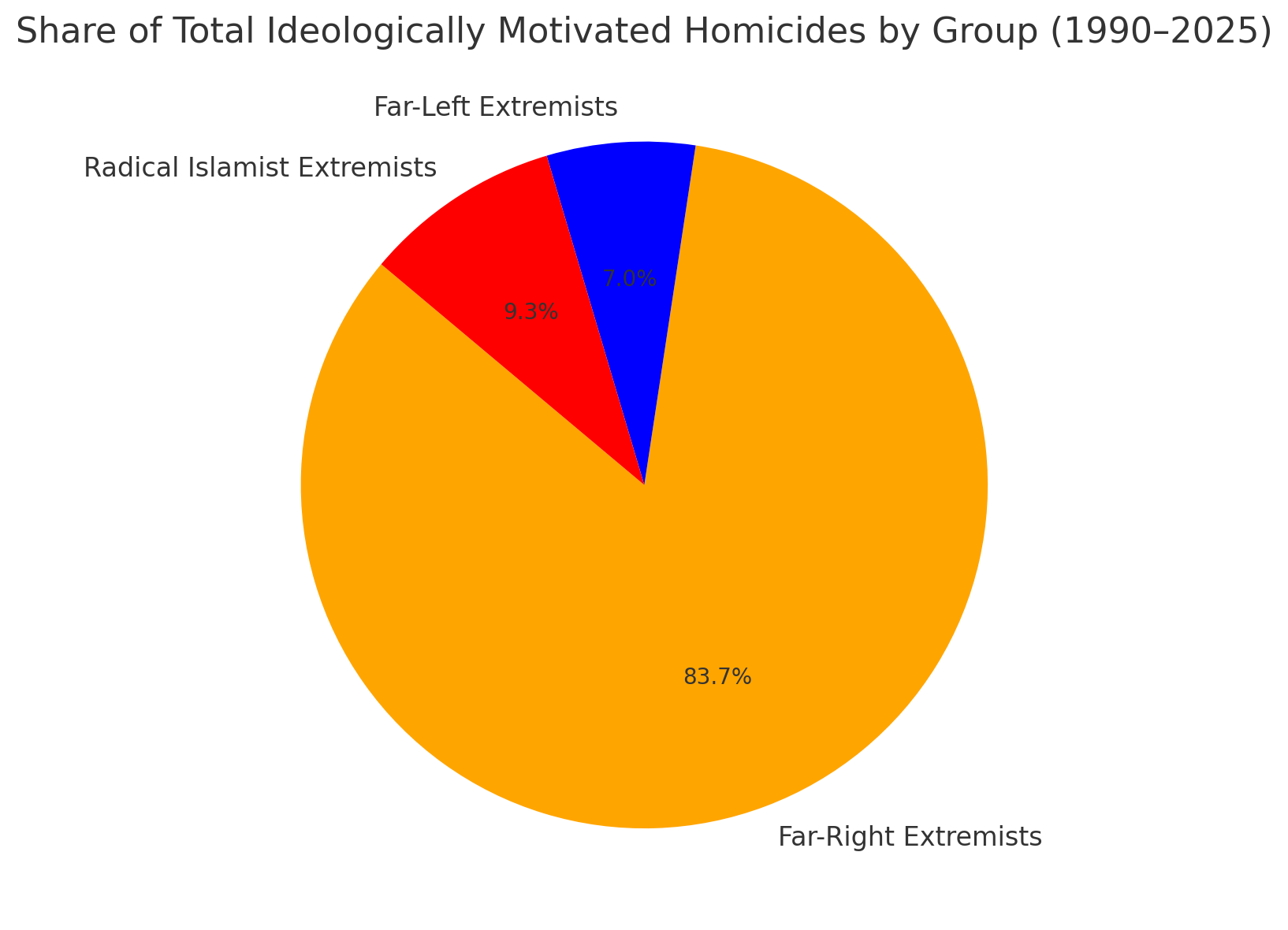
The now-deleted DOJ report provided a detailed empirical analysis of domestic terrorism in the U.S. since the 1990s. Key takeaways include:
- Far-Right Dominance in Political Violence: The study concluded that far-right extremists—including white supremacists, sovereign citizens, militia groups, and accelerationists—were responsible for “far more ideologically motivated homicides than far-left or radical Islamist extremists.”
- Sustained Trendline: Unlike periodic waves of jihadist or left-wing violence, right-wing extremism has remained a consistent and lethal threat over time.
- Implications for Law Enforcement: The report argued that traditional counterterrorism approaches have struggled to adapt to decentralized, homegrown domestic threats rooted in far-right ideology.
B. Public Access and Accountability
Before its removal, the study served as a critical reference point for academics, journalists, and policymakers, shaping understanding of domestic terrorism trends. Its disappearance raises significant transparency concerns.
Why the Removal Matters: Beyond Bureaucratic Housekeeping
A. Undermining Public Trust
The DOJ offered no formal explanation for the deletion. This lack of transparency erodes the public’s ability to trust that government research is driven by evidence, not politics.
B. Politicization of Threat Narratives
At the time of deletion, senior administration officials, including President Trump, were framing domestic terrorism as primarily a left-wing phenomenon. The erased findings starkly contradicted this narrative, prompting fears that research was being censored to align with political messaging.
C. Disrupting Evidence-Based Policy
If the foundation of domestic counterterrorism policy is reshaped to fit partisan optics, the result may be a misallocation of resources, underestimation of actual threats, and greater long-term insecurity.
Possible Explanations for the Deletion
Though speculation abounds, several explanations have been floated—none confirmed by the DOJ:
A. Routine Administrative Action
The study may have been temporarily removed for site reorganization or formatting updates, although the lack of an accompanying statement makes this less plausible.
B. Data Integrity or Legal Concerns
There could be methodological issues—such as definitional disputes over what qualifies as terrorism or outdated data—which might have prompted a quiet takedown.
C. Political Influence and Suppression
The most serious accusation is that the removal was politically motivated, especially in light of mounting pressure to align with certain ideological narratives following Charlie Kirk’s assassination.
Without an official explanation, the vacuum invites distrust and speculation, rather than clarity.
Elected Officials and Extremist Associations: A State-Level Snapshot

While much of the focus around extremism centers on public safety and federal response, the issue also cuts closer to home—literally. Across several U.S. states, a handful of elected officials and candidates have faced credible allegations or documentation of affiliations, sympathies, or behavior consistent with white supremacist or extremist ideologies.
A recent review of news investigations, watchdog reports, and legislative records reveals the following:
Documented Cases with Moderate to High Credibility
- Matthew Heilman (North Dakota House, District 7) – Allegedly engaged with white nationalist content on social media and is associated with far-right groups. Currently serving.
- Dallas Heard (Oregon State Senator) – Participated in protests and issued rhetoric aligned with anti-government and extremist views. Currently serving.
- Josh Schriver (Michigan State Representative) – Shared the “great replacement” conspiracy theory online, a common white supremacist narrative. Lost committee assignments. Currently serving.
- Wendy Rogers (Arizona State Senator) – Known for inflammatory statements endorsing white nationalist tropes and affiliations with militia-linked groups such as the Oath Keepers. Currently serving.
- Matt Shea (Washington, former State Rep.) – A state investigation accused him of participating in domestic terrorism planning and supporting armed standoffs. No longer in office.
- Judd Blevins (Enid, Oklahoma City Council) – Affiliated with Identity Evropa and participated in the 2017 Charlottesville rally. Removed from office via recall.
- Darrell Leon McClanahan (Missouri gubernatorial candidate) – Publicly associated with the Ku Klux Klan and describes himself as “pro-white.” Running for office, but not elected.
What This Tells Us
While the number of confirmed or strongly alleged cases remains relatively small, their presence in state houses, local councils, and active campaigns signals a deeper challenge: extremist ideologies are not just on the fringe—they have entered the chambers of public governance.
This trend raises urgent questions:
- What safeguards exist to vet candidates’ affiliations with hate groups?
- Should public officials be held to transparency standards regarding past or present extremist involvement?
- How can state legislatures ensure accountability without stifling free speech?
“Democratic institutions depend on trust. That trust erodes when elected leaders express or endorse ideologies rooted in racial supremacy, antisemitism, or authoritarian extremism.” – Tobi M
Public scrutiny, transparency laws, and rigorous reporting are essential tools in ensuring that the halls of governance remain grounded in democratic values—not extremist ideologies.
Contextualizing the Controversy: The Domestic Terrorism Landscape
A. Federal Trends in Domestic Terrorism
Independent and government sources alike have repeatedly shown that far-right actors pose a disproportionate threat. High-profile incidents—from Charlottesville to the Buffalo supermarket shooting—underscore this point.
Yet, political violence is not exclusive to any ideology. A balanced counterterrorism strategy must acknowledge:
- The persistence of far-right threats
- The emergence of far-left and anarchist violence
- The enduring, though diminished, presence of Islamist extremism
B. Impact on National Security Policy
The deletion of the study suggests a disconnect between intelligence findings and public-facing policy. This compromises the effectiveness of:
- Threat prioritization
- Community resilience programs
- Strategic law enforcement partnerships

Policy Recommendations: Safeguarding Transparency and Objectivity
To restore public confidence and strengthen domestic counterterrorism efforts, policymakers should consider the following reforms:
1. Codified Transparency Requirements
- Mandate public notification and written justification whenever federal research is revised, archived, or removed.
- Implement version tracking and public archives for all DOJ-published reports.
2. Independent Repositories for Sensitive Data
- Transfer archival responsibility for domestic extremism data to nonpartisan entities such as the Government Accountability Office (GAO) or national research universities.
3. Annual Congressional Reporting
- Require DOJ and DHS to produce annual reports on domestic terrorism, publicly reviewed by Congress and developed in consultation with independent researchers.
4. Proportional Resource Allocation
- Ensure federal funding and investigative attention align with evidence-based assessments of threat levels, not partisan influence.
Larger Implications for America’s Safety and Security
The quiet removal of a research report may seem like a bureaucratic act, but in the context of national security, it signals something far more dangerous: the erosion of evidence-based governance at a time of intensifying domestic threats.
A. Strategic Blind Spots in Threat Detection
Suppressing data on far-right extremism undermines the government’s own ability to track, prevent, and respond to threats. When entire categories of risk are politically inconvenient and therefore ignored, the result is predictable: missed warning signs, under-resourced countermeasures, and preventable violence.
By obscuring decades of trend data on right-wing violence, policymakers risk creating blind spots in federal threat assessments, law enforcement training, and interagency coordination.
B. Undermining Public Preparedness and Resilience
Public understanding of domestic extremism is a vital component of national security. When facts are hidden, the public is less informed, less vigilant, and more vulnerable.
If Americans are led to believe that certain threats don’t exist—or are exaggerated by partisan voices—they may dismiss credible warnings, ignore radicalization in their communities, or fail to recognize signs of ideological violence before it’s too late.
C. Eroding Institutional Credibility
The perceived politicization of national security research threatens the legitimacy of the DOJ, FBI, DHS, and related agencies. Once public trust is compromised, even genuine counterterrorism efforts may be met with skepticism or resistance, reducing their effectiveness.
Over time, this distrust can weaken cooperation between federal agencies and:
- Local law enforcement
- Civil society organizations
- Academic researchers
- At-risk communities
D. Encouraging Extremist Narratives
Finally, the disappearance of this report may embolden extremist movements. When governments appear to downplay or deny their existence, far-right groups can frame it as validation. This provides rhetorical ammunition for recruitment, propaganda, and justification of future violence.
In short, silencing facts doesn’t silence threats—it amplifies them.
“The suppression of truth is not a neutral act. In matters of national security, it actively reshapes the landscape of risk, response, and resilience—often to the detriment of those the government is sworn to protect.” – Tobi M
Call to Action: Defending Truth in National Security
The suppression of public data—especially data with profound implications for public safety—should alarm every citizen committed to democracy, transparency, and justice. The erasure of the DOJ’s terrorism study is not an isolated incident; it is a symptom of a deeper vulnerability in our institutions: the politicization of evidence.
We must act now to defend the integrity of our national security policies and protect the right of the public to know the truth about threats facing our communities.
To Policymakers:
- Enact legislative safeguards to ensure government research cannot be quietly altered or removed without accountability.
- Fund independent oversight bodies tasked with preserving, publishing, and analyzing domestic terrorism data beyond the reach of political cycles.
- Champion bipartisan counterterrorism policies that reflect empirical evidence—not partisan narratives.
To Journalists and Civil Society:
- Investigate and report on government actions that obscure or distort security-related information.
- Amplify suppressed research through public forums, op-eds, and community events.
- Pressure agencies to explain content removals and reestablish transparency standards.
To Academics and Researchers:
- Republish and preserve endangered data through academic repositories.
- Collaborate with watchdogs to track government transparency.
- Train the next generation of public policy professionals to value truth over partisanship.
To the Public:
- Demand transparency from elected officials and government agencies.
- Support legislation that promotes open access to security data.
- Stay informed and engaged—because the ability to confront real threats depends on your access to real information.
“Truth in governance is not a partisan luxury. It is a democratic necessity. Let this moment be a catalyst—not just for outrage, but for reform.” – Tobi M.
Conclusion: A Test of Institutional Integrity
The quiet deletion of a DOJ study documenting far-right violence is more than a bureaucratic misstep—it is a test of democratic transparency and the integrity of public safety policy. Whether the result of internal review or political interference, this act threatens to obscure the realities of domestic terrorism at a time when clarity is urgently needed.
As ideological tensions deepen and public trust wanes, government agencies must reaffirm their commitment to evidence-based practice, transparent communication, and the nonpartisan pursuit of national security. Anything less risks weakening the nation’s ability to confront the growing threat of homegrown extremism—regardless of its political origin.
We Want to Hear From You
This moment isn’t just about a deleted report—it’s about who gets to shape the national conversation on public safety, truth, and justice. Your voice matters.
Whether you’re a researcher, policymaker, journalist, law enforcement official, advocate, or engaged citizen, we invite you to share your insights, concerns, and calls for accountability.
Have You Experienced or Witnessed:
- Suppression or distortion of government data?
- Political interference in public safety research?
- Gaps in community protection against extremist threats?
What Ideas Do You Have For:
- Safeguarding transparency in federal agencies?
- Ensuring balanced, evidence-based counterterrorism policy?
- Strengthening public trust in national security institutions?
Ways to Engage:
- Share your story or analysis via op-eds, academic platforms, or public forums.
- Contact your elected officials to support policies for transparency and evidence-based governance.
- Collaborate with watchdogs, journalists, and researchers working to preserve access to vital information.
- Start conversations in your community, classroom, or organization about the real threats we face—and how we face them together.
“Democracy is stronger when it listens. National security is smarter when it sees clearly.” – Tobi M
👉 Let us know what you think, what you’ve seen, and what you demand. The public deserves answers—and a voice.
References
- News Articles:
The Daily Beast. (2025, September 16). DOJ quietly scrubs study on far-right attacks after Kirk shooting. https://www.thedailybeast.com/doj-quietly-scrubs-study-on-far-right-attacks-after-kirk-shooting
People Magazine. (2025, September 16). DOJ deletes study after Charlie Kirk’s death that shows right-wing extremists engage in far more violence. https://people.com/department-of-justice-quietly-deletes-study-after-charlie-kirk-s-death-that-says-right-wing-extremists-engage-in-far-more-political-violence-11811580 - Government and Institutional Sources:
Federal Bureau of Investigation. (Annual). Domestic terrorism reports & statistics. https://www.fbi.gov
National Institute of Justice. (2024). What NIJ research tells us about domestic terrorism. [Withdrawn from DOJ website in September 2025].
U.S. Government Accountability Office. (2021). Countering domestic terrorism: Actions needed to better track and report hate crimes and ideologically motivated violence (GAO-21-236). https://www.gao.gov/products/gao-21-236 - Research Reports and Academic Sources:
Anti-Defamation League. (Annual). Murder and extremism in the United States. https://www.adl.org
Jones, S. G., Doxsee, C., & Hwang, G. (2020). The war comes home: The evolution of domestic terrorism in the United States. Center for Strategic and International Studies. https://www.csis.org/analysis/war-comes-home-evolution-domestic-terrorism-united-states