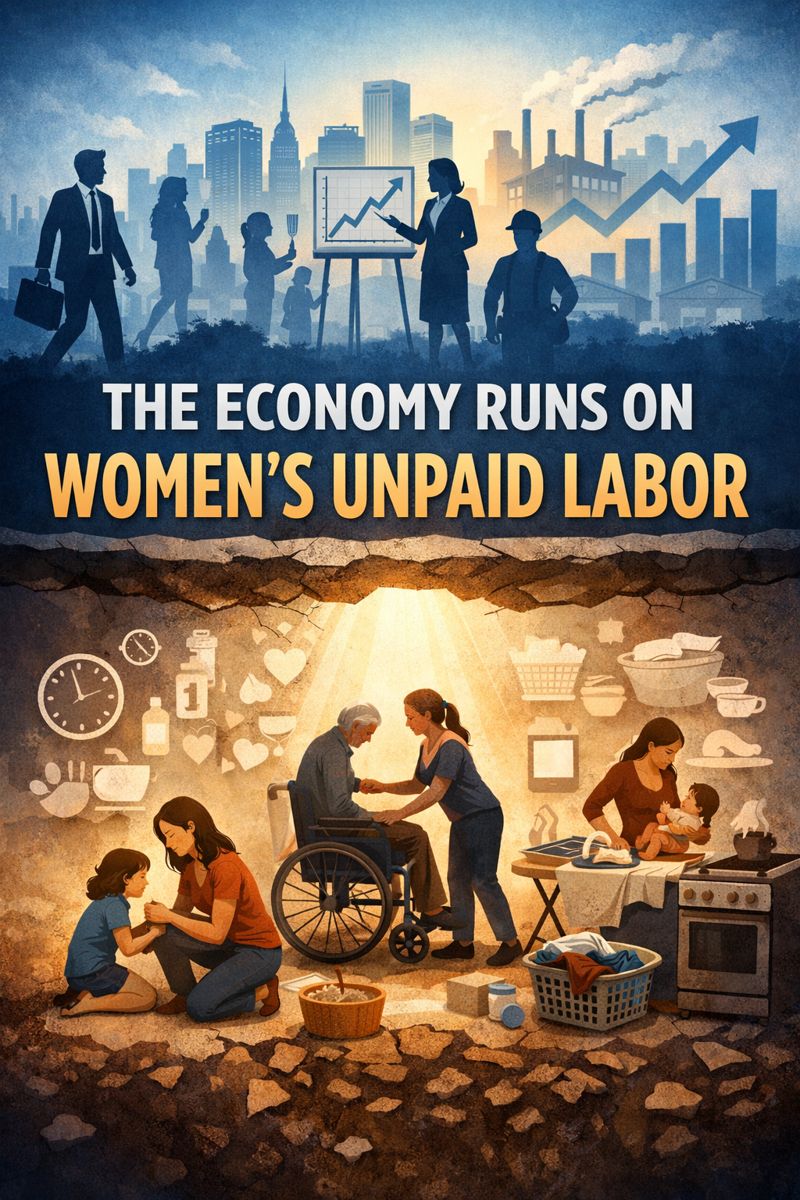
Labor, Power, and Economic Control in Modern Capitalism
The Work That “Doesn’t Count”
Every morning, before markets open and productivity metrics begin to tick upward, millions of hours of labor have already been performed. Children are fed and dressed. Elderly parents are assisted. Homes are cleaned. Emotional support is offered. Schedules are coordinated. Appointments are remembered. Crises are anticipated before they happen.
This labor is essential.
It is also unpaid, largely invisible, and overwhelmingly performed by women.
Modern economies present themselves as neutral systems driven by efficiency, merit, and market forces. Yet beneath formal employment and GDP growth lies a vast foundation of unpaid care work—labor that sustains the workforce, reproduces human capital, and absorbs social risk without compensation. This foundation is not accidental. It is structural.
This essay argues that capitalism depends on women’s unpaid labor, that economic policy systematically ignores this dependence, and that gendered economic outcomes are not side effects but predictable results of how labor is defined, valued, and controlled.
This is not a moral argument. It is an economic one.
Defining Unpaid Labor: What the Economy Leaves Out
Unpaid labor refers to work that produces value but is not compensated through wages. It includes:
- Childcare and parenting
- Elder care
- Domestic labor (cleaning, cooking, household management)
- Emotional labor and relational maintenance
- Community care and informal support networks
According to global estimates, unpaid care work would account for between 10–39% of GDP if formally valued. In nearly every country, women perform two to five times more unpaid care work than men.
Yet national accounting systems like GDP explicitly exclude unpaid labor. This exclusion is not because the work lacks value—but because it lacks a market transaction.
This distinction is foundational to capitalist economics: only labor exchanged for wages is recognized as “productive.”
The result is a paradox:
The economy cannot function without unpaid labor, yet it is treated as economically irrelevant.
Capitalism’s Hidden Subsidy
From an economic perspective, unpaid care work functions as a massive hidden subsidy to markets, employers, and governments.
Consider childcare. If families did not provide unpaid childcare, the cost would need to be absorbed by:
- Employers (through higher wages or benefits)
- Governments (through public childcare systems)
- Markets (through private childcare at significantly higher costs)
Instead, the burden is privatized within households—most often onto women.
This pattern repeats across domains:
- Elder care substitutes for underfunded healthcare systems
- Domestic labor compensates for long work hours and inflexible jobs
- Emotional labor stabilizes families under economic stress
In effect, unpaid labor absorbs the social costs that capitalism externalizes.
This is not inefficiency. It is design.
Gendered Division of Labor: Not Natural, but Institutional
The unequal distribution of unpaid labor is often framed as cultural or personal preference. However, economic evidence suggests otherwise.
Women’s disproportionate care burden is reinforced by:
- Wage gaps that make women the “logical” caregiver
- Workplace norms that penalize caregiving interruptions
- Policy frameworks that assume a full-time caregiver at home
- Social expectations that frame care as moral obligation rather than labor
Once women reduce paid work to perform unpaid labor, the economic consequences compound:
- Lower lifetime earnings
- Reduced retirement savings
- Weaker labor market attachment
- Increased vulnerability to poverty
These outcomes are not the result of individual choices alone. They are structurally induced trade-offs.
Power and Control: Who Benefits from Invisible Labor?
Economic systems are also systems of power.
By rendering care work invisible, capitalism:
- Maintains labor discipline
Workers supported by unpaid care can accept longer hours and lower wages. - Reduces public responsibility
Governments avoid investing in care infrastructure. - Depoliticizes inequality
Gendered outcomes appear natural rather than policy-driven. - Limits bargaining power
Caregivers—especially women—have less flexibility to demand better conditions.
Unpaid labor is not just undervalued. It is strategically excluded from formal economic consideration because its inclusion would require redistribution of power and resources.
The Policy Failure at the Core
Modern economic policy treats care as a private issue rather than a public good.
This failure appears across policy domains:
Labor Policy
- Full-time work models assume a worker unencumbered by care duties.
- Part-time and flexible work are penalized with lower wages and benefits.
Social Policy
- Caregiving credits are limited or nonexistent.
- Social safety nets assume informal family support.
Tax Policy
- Joint taxation and dependent-based systems reinforce single-earner households.
- Unpaid labor generates no tax credits or income recognition.
Economic Measurement
- GDP growth ignores care depletion.
- Productivity metrics reward extraction, not sustainability.
The result is an economy that consumes care labor without replenishing it.
Crisis Reveals the Structure
Economic crises make invisible labor visible.
During recessions, pandemics, or austerity periods:
- Care demands increase
- Public services retract
- Women’s unpaid labor expands to fill the gap
The COVID-19 pandemic was a clear example. As schools closed and healthcare systems strained, women absorbed the shock—reducing paid work or leaving the labor force entirely at disproportionate rates.
This was not coincidence. It was the system functioning as designed under stress.
Beyond Wages: Why “Just Paying Women” Isn’t Enough
Some policy proposals focus on monetizing unpaid labor directly. While valuable, this approach alone is insufficient.
Why?
Because the issue is not only compensation—it is power, recognition, and structural integration.
Without systemic change:
- Paid care work remains underpaid
- Women remain concentrated in low-power sectors
- Care remains feminized and devalued
True reform requires restructuring how economies define value.
Reimagining Economic Value
A care-centered economic framework would:
- Treat care infrastructure as essential, like transportation or energy
- Integrate unpaid labor into economic measurement
- Design labor markets around human sustainability
- Distribute care responsibility across genders, markets, and the state
This is not anti-market. It is economically rational.
Economies that fail to invest in care undermine their own labor supply, productivity, and long-term growth.
Why This Is Not a “Women’s Issue”
Framing unpaid labor as a women’s issue obscures its broader economic implications.
When care collapses:
- Labor force participation declines
- Birth rates fall
- Health outcomes worsen
- Inequality increases
These are macroeconomic problems.
Sustainable economies require sustainable labor reproduction. Ignoring unpaid labor is not neutral—it is economically reckless.
Further Implications: What Happens If Care Remains Invisible
The continued exclusion of unpaid care work from economic frameworks has consequences that extend far beyond individual households or gender inequality. It shapes the long-term stability, resilience, and legitimacy of economic systems themselves.
1. Labor Market Distortion and Workforce Fragility
When care labor is treated as infinite and costless, labor markets are built on unrealistic assumptions. Workers are expected to be perpetually available, mobile, and flexible—conditions that are only possible if someone else is absorbing the costs of care.
As care demands increase due to aging populations, declining birth rates, and weakened public services, this assumption becomes untenable. Labor shortages, burnout, and declining participation rates are not anomalies; they are signals of structural imbalance.
Ignoring care work ultimately undermines the labor supply capitalism depends on.
2. Demographic and Economic Sustainability Risks
Many advanced economies now face declining fertility rates and aging populations. These trends are often framed as cultural or personal choices, but they are deeply economic.
When caregiving is incompatible with economic security:
- Fewer people choose to have children
- Care responsibilities are delayed or avoided
- Informal care networks collapse under strain
The result is a demographic feedback loop that threatens long-term growth, tax bases, and social insurance systems. An economy that does not support care cannot reproduce itself.
3. Rising Inequality and Intergenerational Transfer of Risk
Unpaid labor functions as a private safety net. When families are unable to provide it—due to income constraints, health limitations, or single-parent structures—risk shifts downward.
This deepens inequality:
- Higher-income households can purchase care
- Lower-income households absorb care through unpaid labor or go without
- Children, elders, and caregivers experience uneven outcomes
Because unpaid labor is invisible in policy design, these disparities compound across generations, reinforcing economic stratification.
4. Democratic Legitimacy and Social Trust
Economic systems derive legitimacy not only from growth, but from perceived fairness.
When large segments of the population perform essential labor that is neither recognized nor protected, trust erodes. People experience the economy not as a neutral system, but as one that systematically benefits some forms of work while ignoring others.
This disconnect fuels disengagement, resentment, and instability—outcomes that are often misattributed to cultural polarization rather than economic design.
5. Misguided Policy Solutions
Perhaps most critically, failing to account for unpaid labor leads to policy errors.
Economic reforms aimed solely at increasing labor supply—without addressing care infrastructure—often backfire. Incentives to work more hours, delay retirement, or increase productivity collapse when care demands remain unmet.
Policies built on incomplete economic models produce incomplete—and often counterproductive—results.
Call to Action: Making Care Economically Visible
Recognizing unpaid labor does not require abandoning markets or adopting a singular ideological framework. It requires better economic accounting, better policy design, and clearer institutional responsibility.
The following actions represent practical, non-partisan steps toward aligning economic systems with economic reality.
1. Measure What Sustains the Economy
Economic indicators should reflect the full scope of productive activity.
This includes:
- Integrating unpaid labor into national accounts through satellite measures
- Expanding time-use data collection
- Evaluating economic growth alongside care capacity and social reproduction
What is measured shapes what is valued—and what is governed.
2. Treat Care Infrastructure as Core Economic Infrastructure
Care systems should be approached with the same seriousness as transportation, energy, or telecommunications.
This means:
- Investing in childcare, elder care, and disability support
- Stabilizing care labor through fair wages and standards
- Reducing reliance on unpaid household substitution
Care infrastructure is not a social luxury. It is an economic prerequisite.
3. Redesign Labor Markets Around Human Sustainability
Labor policies should reflect the reality that workers are also caregivers.
This includes:
- Normalizing flexible work without penalty
- Ensuring part-time and non-linear work paths do not erode long-term security
- Designing benefits around people, not job status
An economy optimized for extraction rather than sustainability eventually exhausts its labor force.
4. Redistribute Care Responsibility
Care should not default to women or families by omission.
Responsibility must be shared across:
- Households (more equitable gender norms)
- Markets (employer responsibility)
- Governments (public provision and coordination)
When care is treated as a collective concern, economic participation becomes more equitable and more stable.
5. Reframe Care as Economic Work, Not Moral Obligation
Finally, care must be recognized as labor—not altruism, instinct, or personal sacrifice.
This reframing:
- Makes policy trade-offs explicit
- Clarifies who bears economic risk
- Enables accountability
Invisible labor is not neutral. Visibility is the first step toward functional economic design.
An economy that fails to account for the labor that sustains it is not efficient—it is incomplete.
Making unpaid care work visible is not about assigning blame or advancing ideology. It is about aligning economic systems with how societies actually function.
Until care is treated as economic infrastructure rather than private obligation, policy failures will persist—and inequality will continue to be built into the system itself.
Conclusion: Accounting for the Labor That Sustains the Economy
Modern economies are often evaluated through growth rates, productivity gains, and labor participation statistics. Yet these indicators rest on a critical omission: the unpaid labor that makes all formal economic activity possible. Care work—disproportionately performed by women—sustains the workforce, stabilizes households, and absorbs systemic shocks, while remaining excluded from economic valuation and policy design.
This exclusion is not a technical oversight. It is a structural feature of how labor, value, and responsibility are defined under contemporary capitalism. By treating care as a private obligation rather than a public good, economic systems shift risk downward—onto households, caregivers, and ultimately onto women—while preserving the appearance of market efficiency.
The consequences of this arrangement are now visible at the macro level. Labor shortages, demographic decline, rising inequality, and weakened social trust are not disconnected crises. They are symptoms of an economic model that consumes care labor without recognizing or replenishing it. Policies built on incomplete models of work continue to misfire because they fail to account for the conditions that make labor participation possible in the first place.
Making unpaid labor visible does not require abandoning markets or adopting ideological positions. It requires more accurate measurement, more realistic labor assumptions, and clearer institutional responsibility for care infrastructure. Economies that ignore the reproduction of labor undermine their own sustainability.
Care is not ancillary to economic performance—it is foundational. Until economic systems account for the labor that sustains them, growth will remain fragile, inequality will remain embedded, and policy solutions will continue to address symptoms rather than causes.
Recognizing unpaid care work is not about redefining morality. It is about redefining economic reality.
References
- Folbre, N. (1994). Who Pays for the Kids? Gender and the Structures of Constraint. Routledge.
- Folbre, N. (2001). The Invisible Heart: Economics and Family Values. New Press.
- Fraser, N. (2016). Contradictions of capital and care. New Left Review, 100, 99–117.
- Waring, M. (1988). If Women Counted: A New Feminist Economics. Harper & Row.
- Elson, D. (1998). The economic, the political and the domestic: Businesses, states and households in the organisation of production. New Political Economy, 3(2), 189–208.
- International Labour Organization (ILO). (2018). Care Work and Care Jobs for the Future of Decent Work.
- OECD. (2020). Unpaid Care Work: The Missing Link in the Analysis of Gender Gaps in Labour Outcomes.
- United Nations Development Programme (UNDP). (2015). Human Development Report: Work for Human Development.
- Ferrant, G., Pesando, L. M., & Nowacka, K. (2014). Unpaid Care Work: The Missing Link in the Analysis of Gender Gaps in Labour Outcomes. OECD Development Centre.
- Kuznets, S. (1934). National income, 1929–1932. U.S. Senate Document No. 124.
- Stiglitz, J. E., Sen, A., & Fitoussi, J.-P. (2009). Report by the Commission on the Measurement of Economic Performance and Social Progress.
- Eisner, R. (1988). Extended accounts for national income and product. Journal of Economic Literature, 26(4), 1611–1684.
- Ironmonger, D. (1996). Counting outputs, capital inputs and caring labor. Feminist Economics, 2(3), 37–64.
- Blau, F. D., & Kahn, L. M. (2017). The gender wage gap: Extent, trends, and explanations. Journal of Economic Literature, 55(3), 789–865.
- England, P. (2005). Emerging theories of care work. Annual Review of Sociology, 31, 381–399.
- Goldin, C. (2014). A grand gender convergence: Its last chapter. American Economic Review, 104(4), 1091–1119.
- Budig, M. J., & England, P. (2001). The wage penalty for motherhood. American Sociological Review, 66(2), 204–225.
- Esping-Andersen, G. (1990). The Three Worlds of Welfare Capitalism. Princeton University Press.
- Daly, M., & Lewis, J. (2000). The concept of social care and the analysis of contemporary welfare states. British Journal of Sociology, 51(2), 281–298.
- Gornick, J. C., & Meyers, M. K. (2003). Families That Work: Policies for Reconciling Parenthood and Employment. Russell Sage Foundation.
- Polanyi, K. (1944). The Great Transformation. Beacon Press.
- Piketty, T. (2014). Capital in the Twenty-First Century. Harvard University Press.
- Harvey, D. (2005). A Brief History of Neoliberalism. Oxford University Press.
- Standing, G. (2011). The Precariat: The New Dangerous Class. Bloomsbury.
- Kabeer, N. (2012). Women’s economic empowerment and inclusive growth. International Development Research Centre.
- Razavi, S. (2007). The Political and Social Economy of Care in a Development Context. UNRISD.
- Power, M. (2020). The COVID-19 pandemic has increased the care burden of women and families. Sustainability: Science, Practice and Policy, 16(1), 67–73.
- World Bank. (2023). Women, Business and the Law.
- McKinsey Global Institute. (2015). The Power of Parity: How Advancing Women’s Equality Can Add $12 Trillion to Global Growth.
- UN Women. (2019). Progress of the World’s Women: Families in a Changing World.