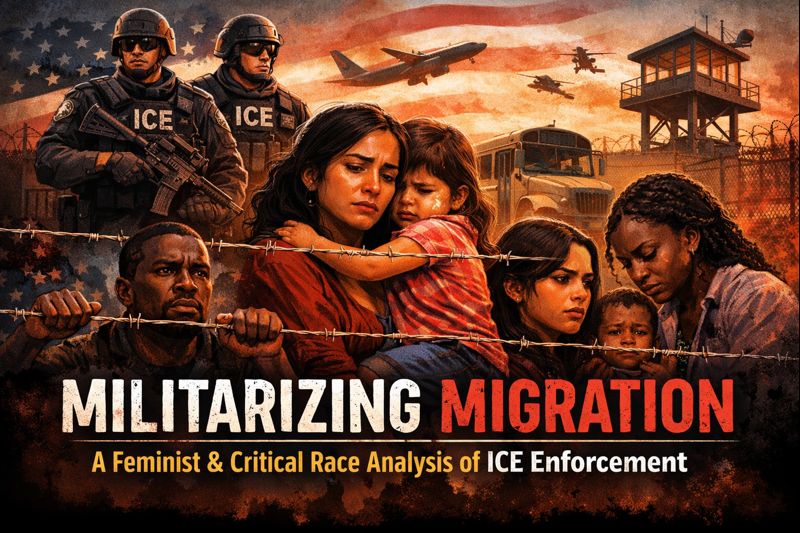
In 2025–26, the United States stands at a critical juncture in its approach to immigration enforcement.
In the contemporary United States, immigration enforcement has undergone a profound transformation. Immigration and Customs Enforcement (ICE), originally framed as an administrative agency tasked with enforcing civil immigration law, has expanded into a highly funded, quasi-militarized institution whose reach extends deeply into labor markets, family systems, and racialized communities. This expansion is not merely a policy choice; it is a structural shift with far-reaching consequences for economic justice, human rights, and democratic governance.
Drawing on feminist political economy and Critical Race Theory (CRT), this essay argues that large-scale ICE operations represent a form of state violence that disproportionately targets Black and Brown communities, entrenches gendered and racialized inequalities, and reallocates public resources away from social reproduction and toward coercive control.
The Budgetary Transformation: From Enforcement to Militarization
PerRecent federal appropriations have dramatically increased ICE’s financial and operational capacity. Under current legislation, immigration enforcement funding is projected to reach approximately $27–30 billion annually, with tens of billions allocated specifically for detention infrastructure, personnel expansion, and removal operations (Brennan Center for Justice, 2024). This places ICE’s budget above the military expenditures of many sovereign nations and rivals the combined budgets of multiple federal law enforcement agencies.
From a feminist political economy perspective, budgets are moral documents: they reflect whose lives are protected and whose are controlled (Elson, 1994). The rapid expansion of ICE funding has occurred alongside chronic underinvestment in childcare, housing assistance, public health, and education — sectors that disproportionately support women, caregivers, and marginalized communities. The result is a redistribution of state power away from social reproduction and toward punishment, reinforcing gendered and racialized hierarchies.
Economic Impacts: Enforcement as Market Disruption
Large-scale ICE operations produce measurable economic harm at both local and national levels. Empirical studies demonstrate that intensified immigration enforcement leads to labor shortages, reduced productivity, and higher consumer prices, particularly in agriculture, construction, and service industries.
A 2025 econometric analysis of enforcement actions in California’s Central Coast found that ICE raids resulted in a 20–40% reduction in the agricultural labor force, producing an estimated $3–$7 billion in crop losses and significant price increases passed on to consumers (García & Flores, 2025). These outcomes contradict enforcement narratives that frame deportation as economically neutral or beneficial.
Feminist political economy emphasizes that labor markets are not abstract systems but social relations embedded in care, migration, and survival strategies. Immigration enforcement destabilizes these systems by criminalizing workers while leaving exploitative labor structures intact — benefiting employers who rely on precarity while externalizing costs onto families and communities.
Gendered State Violence: The Harms and Dangers of ICE Enforcement for Women and Children
Large-scale ICE operations inflict distinct and disproportionate harms on women and children, harms that are often rendered invisible in enforcement-centered policy debates. While immigration enforcement is frequently framed as gender-neutral, empirical evidence demonstrates that its impacts are deeply gendered, exposing women to heightened violence and placing children at risk of long-term developmental harm.
Women in Detention: Reproductive Injustice and Gender-Based Violence
Women detained by ICE face elevated risks of medical neglect, reproductive rights violations, and gender-based violence. Investigations and civil rights litigation have documented failures to provide adequate prenatal care, denial of medically necessary abortions, coercive gynecological procedures, and delayed emergency treatment for pregnant detainees (American Civil Liberties Union [ACLU], 2023; American Progress, 2022).
Detention environments also heighten vulnerability to sexual harassment and assault, particularly for women of color and transgender women. Power asymmetries, fear of retaliation, limited oversight, and language barriers suppress reporting and accountability. From a feminist political economy perspective, detention commodifies women’s bodies within a carceral system that prioritizes cost efficiency over safety and care.
Caregiving Disruption and the Feminization of Survival Labor
Women, particularly immigrant women, are disproportionately positioned as primary caregivers. When women are detained or deported, children lose stability, households collapse, and informal care networks fracture. When male partners are detained, women absorb the shock through increased unpaid labor — balancing wage work, childcare, elder care, and legal navigation with little institutional support.
This transfer of burden exemplifies a core feminist political economy insight: the state externalizes enforcement costs onto women’s unpaid labor, reproducing gender inequality while maintaining punitive policy regimes.
Children as Collateral: Developmental and Psychological Harm
Children — including U.S. citizen children — experience some of the most enduring harms of ICE operations. Research consistently links parental detention or deportation to:
- Toxic stress, anxiety, depression, and trauma symptoms
- Declines in school attendance and academic performance
- Increased risk of food insecurity, housing instability, and foster care placement
(KFF, 2024; Zayas, 2015)
From a feminist framework, these harms represent a failure of social reproduction, as the state actively destabilizes the caregiving conditions necessary for healthy child development.
Family Separation as Structural Violence
Family separation is not an unintended consequence; it is a predictable outcome of enforcement design. Feminist and CRT scholars conceptualize this as structural violence — harm produced by institutional arrangements that systematically disadvantage marginalized populations (Galtung, 1969). For women and children of color, family separation compounds existing inequalities rooted in racism, poverty, and gendered labor expectations.
Humanitarian and Global Impacts
ICE detention and deportation policies generate profound humanitarian harm, particularly through the disruption of family and caregiving systems. Research consistently links immigration enforcement to increased rates of anxiety, depression, food insecurity, housing instability, and educational disruption among affected families (Kaiser Family Foundation, 2024).
From a feminist standpoint, these outcomes represent a crisis of social reproduction — the unpaid and underpaid labor required to sustain human life. When caregivers are detained or deported, women and children absorb the shock through increased unpaid labor, emotional strain, and economic precarity. Enforcement thus functions as a mechanism that extracts value from marginalized households while denying them state support.
Racialized Enforcement: ICE, Critical Race Theory, and the Policing of Belonging
Critical Race Theory provides a necessary framework for understanding why ICE detention overwhelmingly targets Black and Brown immigrants. Data from the Transactional Records Access Clearinghouse (TRAC) show that nearly 90% of ICE detainees originate from Latin America and the Caribbean, with Black immigrants from Africa and the Caribbean detained at disproportionately high rates relative to their population size (TRAC, 2024).
This racial concentration is not accidental. ICE enforcement relies heavily on local policing, traffic stops, workplace surveillance, and database matching — systems already shaped by racial bias. CRT scholars describe this phenomenon as racialized illegality, wherein immigration status becomes socially coded as non-white (Ngai, 2004).
Black Immigrants and Intersectional Harm
Black immigrants experience compounded vulnerability within ICE custody. Empirical studies show they are:
- More likely to be detained and denied bond
- Held for longer periods
- Subjected to higher rates of use-of-force incidents
For Black immigrant women, these harms intersect with gendered violence. Reports document medical neglect, reproductive health violations, and barriers to reporting sexual abuse in detention settings (ACLU, 2023). CRT and feminist theory together reveal how racialized gender stereotypes — particularly assumptions of criminality and disposability — shape enforcement outcomes.
Wrongful Detention and Citizenship Erasure
Racial bias also manifests in wrongful detention, including cases involving U.S. citizens and lawful permanent residents who are Black or Brown. These incidents expose a troubling reality: racial appearance often supersedes legal status, undermining due process and equal protection principles.
Historical Precedents and the Deportation-Industrial Complex
History demonstrates that mass enforcement strategies generate long-term harm without achieving sustainable policy goals. Past workplace raids and detention surges — such as the 2018 Southeastern Provisions raid — resulted in family separation, economic disruption, and community trauma, with little evidence of improved compliance or labor stability.
The current expansion risks entrenching a deportation-industrial complex: a network of private contractors, detention operators, and political interests that benefit financially from enforcement escalation (Brennan Center for Justice, 2024). Once institutionalized, such systems resist reform, even in the face of empirical failure. and Brown immigrants represents not only a policy failure, but a moral and democratic crisis.
Legal and Civil Rights Concerns
One of the most troubling trends in enforcement actions is the high rate of detention among individuals with no criminal convictions. Recent analyses indicate that over 70 % of ICE detainees have no criminal record, with only a small fraction convicted of violent offenses.
Wrongful Detentions and Due Process Deficits
As ICE extends its reach into schools, hospitals, courthouses, and legal appointments, civil rights groups have documented wrongful detentions and due process violations that undermine constitutional protections. These actions erode trust in public institutions and contribute to racialized legal inequities that feminists and civil liberties advocates alike contest.
Historical Parallels and Future Implications
Historically, mass enforcement has often produced lasting social trauma without resolving underlying issues. Examples like workplace raids in the early 2000s or the 2018 Southeastern Provisions operation illustrate that heavy-handed tactics can disrupt communities without addressing legal pathways or labor realities.
Looking forward, the growth of a deportation-industrial complex — a system embedded with powerful economic incentives for private contractors and lobbying constituencies — makes reform substantially more difficult. With billions locked into infrastructure and contracted services, the system risks becoming self-perpetuating, decoupled from democratic oversight and accountability.
A Different Path: Toward Humane, Evidence-Based Immigration Policy
If the goal of immigration policy is to balance sovereignty with human dignity, then the current trajectory falls short. Alternatives that have demonstrated empirical success include:
- Alternatives to Detention (ATD) programs, which ensure compliance at a fraction of the cost.
- Expanded legal representation and adjudication resources, reducing backlogs and ensuring fair procedures.
- Collaborative labor and immigration reforms that recognize the economic role of migrant workers while protecting all workers’ rights.
A feminist policy approach that centers gender equity, family integrity, and social support would advocate for mechanisms that reduce harm, affirm bodily autonomy, and secure social rights rather than escalating surveillance and removal.
Conclusion
The expansion of ICE is not simply a matter of immigration enforcement; it is a transformation in how the state exercises power over marginalized bodies. Empirical evidence demonstrates that large-scale ICE operations are economically inefficient, racially discriminatory, gendered in their harm, and corrosive to democratic norms.
Through the lenses of feminist political economy and Critical Race Theory, it becomes clear that immigration enforcement has become a tool for managing inequality rather than resolving it. The question facing policymakers and the public alike is whether the United States will continue to invest in coercion — or choose a path grounded in justice, care, and empirical reality.
References
American Civil Liberties Union. (2023). Pregnant and postpartum women face neglect and abuse in ICE detention. https://www.aclu.org
American Progress. (2022). Immigration detention is dangerous for women’s health. https://www.americanprogress.org
Brennan Center for Justice. (2024). The big budget bill and the rise of the deportation-industrial complex. https://www.brennancenter.org
Elson, D. (1994). Gender-aware analysis and development economics. Journal of International Development, 6(1), 93–102.
Galtung, J. (1969). Violence, peace, and peace research. Journal of Peace Research, 6(3), 167–191.
García, M., & Flores, R. (2025). Immigration enforcement and agricultural labor markets: Evidence from California. arXiv.
Kaiser Family Foundation. (2024). Health and well-being impacts of immigration detention and deportation. https://www.kff.org
Ngai, M. M. (2004). Impossible subjects: Illegal aliens and the making of modern America. Princeton University Press.
Transactional Records Access Clearinghouse. (2024). ICE detention demographics. Syracuse University. https://trac.syr.edu
Zayas, L. H. (2015). Forgotten citizens: Deportation, children, and the making of American exiles. Oxford University Press.