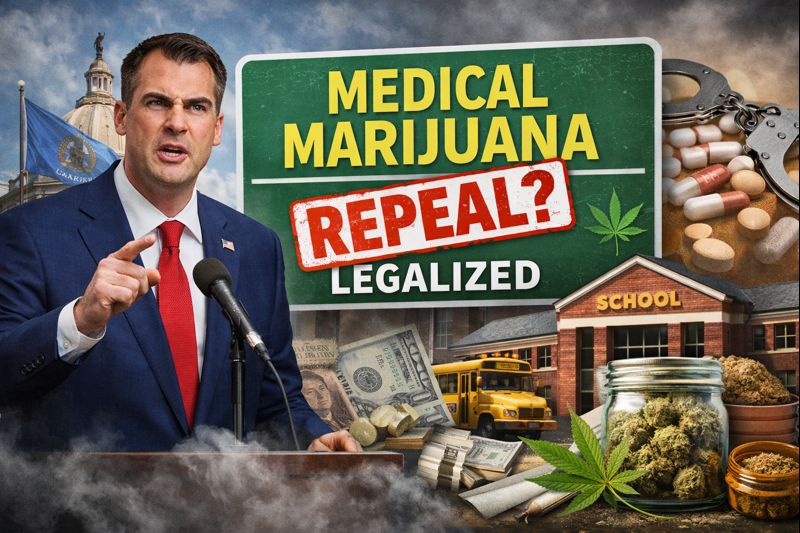
Why shutting down a voter-approved program could be dangerous — and what the numbers really show.
In February 2026, Oklahoma Governor Kevin Stitt publicly called for voters to reconsider and potentially reverse the state’s medical marijuana law, first approved in 2018 under State Question 788 (SQ 788). During his final State of the State address, Stitt argued that the medical marijuana industry had become “out of control” with too many dispensaries and alleged links to criminal activity, and urged lawmakers to send the issue back to voters to shut down the medical program entirely. He claimed Oklahomans were “sold a bill of goods” when they originally voted for legalization and that foreign criminal interests and bad actors now plague the industry (KOCO News 5; State Question 788) (Greco,2026).
Stitt’s push marks a dramatic reversal from his earlier role signing enforcement legislation after SQ 788 passed, and it thrusts Oklahoma — which has one of the most widely used medical marijuana programs in the U.S. — into a contentious public policy debate over voters’ will vs. perceived regulatory excess (Wikipedia).
Background: Oklahoma Voters Approved Medical Marijuana in 2018
On June 26, 2018, Oklahoma voters passed Oklahoma State Question 788 with over 56% “yes” votes, legalizing medical marijuana and creating a licensing and regulatory framework for patients, growers, and dispensaries in the state (Oklahoma State Election Board).
This result reflected broad public support — notably across party lines — including many voters who might be socially conservative on other issues but saw medical marijuana as a compassionate healthcare option or an alternative to opioids and harsh criminal penalties. Commentators have noted that significant support also came from older voters (including Boomers) who historically skew conservative, but who supported the initiative for medical and tax revenue reasons.
Empirical Evidence on Medical Marijuana Benefits
The push to reverse medical marijuana comes amid a growing body of research suggesting real public health and social benefits from legalized medical cannabis. These include:
1. Reduction in Opioid Use & Overdose Deaths
Studies have repeatedly found medical marijuana laws are linked to reductions in opioid prescribing and opioid overdose deaths. Research published in The Journal of Health Economics and other reviews shows that states with medical marijuana laws saw fewer opioid prescriptions and lower opioid overdose fatality rates; this effect is especially notable where dispensaries are legally operating, suggesting accessibility matters (Powell, Liccardo Pacula, & Jacobson, 2018).
One comprehensive review found that broader access to medical cannabis correlated with reduced prescription pain medication use among Medicare and Medicaid patients and population-wide declines in opioid deaths (Powell et al., 2018).
2. Criminal Justice Impacts
Legalization and regulation can reduce burden on criminal justice systems. Legal access typically leads to fewer marijuana arrests and prosecutions, freeing up law enforcement resources for more serious crimes (Dills et al., 2021).
3. Economic Value and Public Funding
States with medical marijuana programs generate tax revenue used for public services including education, infrastructure, and healthcare. While data vary by state and tax structure, studies find legal cannabis markets contribute to state revenues through licensing fees and sales taxes, which can reduce pressure on other revenue sources (Dills et al., 2021).
Although exact figures depend on policy design and local economic conditions, Colorado generated hundreds of millions annually in cannabis tax revenue after legalization, with significant allocations to schools and community programs in early years (California tax estimates provide comparisons).
Dangers and Concerns of Reversing Medical Marijuana
Calls by Govner Kevin Stitt to dismantle Oklahoma’s voter-approved medical marijuana program raise serious concerns that extend well beyond regulatory frustration. Reversal would not be a neutral policy adjustment — it would introduce substantial risks to public health, patient safety, economic stability, and democratic governance.
1. Increased Health Risks for Patients
Medical marijuana serves as a critical treatment option for patients managing chronic pain, cancer-related symptoms, epilepsy, PTSD, and other debilitating conditions. Reversing legalization would abruptly remove legal access for tens of thousands of patients, forcing many to choose between untreated symptoms or more dangerous pharmaceutical alternatives.
Research consistently indicates that medical cannabis functions as a substitute for higher-risk medications, particularly opioids. Eliminating access increases the likelihood that patients will return to opioid-based pain management, heightening risks of dependency, overdose, and adverse side effects. For a state already grappling with opioid-related harm, this represents a serious public health setback rather than a solution.
2. Return to Criminalization and Law Enforcement Strain
Before medical marijuana legalization, cannabis enforcement consumed substantial law enforcement and judicial resources. Reversal would reinstate criminal penalties for patients and caregivers, effectively recriminalizing medical behavior that voters explicitly chose to legalize.
This shift would:
- Increase arrests and court caseloads
- Divert law enforcement from violent and property crimes
- Disproportionately impact rural and lower-income communities
Rather than improving public safety, repeal risks reviving the failed enforcement models that medical marijuana was designed to replace.
3. Expansion of the Illicit Market
Prohibition does not eliminate demand — it pushes it underground. Reversing medical marijuana would likely expand Oklahoma’s black market, reducing consumer safety and eliminating regulatory safeguards such as product testing, labeling, and age verification.
Unregulated markets expose patients to:
- Contaminated or mislabeled products
- Inconsistent potency and dosage
- Increased risk of criminal exploitation
Ironically, dismantling the regulated system may increase the very criminal activity policymakers claim to oppose.
4. Economic Harm and Industry Collapse
Oklahoma’s medical marijuana sector supports thousands of jobs and small businesses across cultivation, retail, agriculture, compliance, and security. Reversal would instantly destabilize an entire legal industry, leading to job losses, business closures, and financial harm to communities statewide.
Additionally, the state would lose:
- Licensing and regulatory revenue
- Sales tax contributions
- Ancillary economic activity tied to the industry
The financial burden would not disappear — it would shift back onto taxpayers or result in reduced funding for public services.
5. Undermining Voter Confidence and Democratic Legitimacy
Perhaps the most dangerous consequence is the precedent reversal would set. Medical marijuana was legalized through a ballot initiative, representing a direct expression of voter will. Overturning it signals that voter-approved laws can be discarded when politically inconvenient.
This undermines:
- Public trust in elections and ballot measures
- Civic participation
- The legitimacy of future voter-led reforms
Once trust in democratic processes erodes, it is difficult to restore.
6. Legal Chaos and Regulatory Uncertainty
Repealing medical marijuana after years of implementation would invite legal challenges, constitutional questions, and regulatory confusion. Courts, agencies, and municipalities would be forced to untangle years of established law, creating uncertainty for patients, businesses, and regulators alike.
Policy instability of this scale discourages investment and weakens governance capacity.
In Summary
Reversing medical marijuana is not a corrective policy — it is a high-risk reversal with predictable negative outcomes. The dangers include worsened public health, renewed criminalization, economic disruption, and damage to democratic trust. Evidence shows that regulated medical cannabis works better than prohibition, and dismantling it would reintroduce problems Oklahoma voters already chose to move past.
Political Context: Boomers, Republicans, and Voter Will
While Oklahoma skews conservative overall, the passage of SQ 788 demonstrated medical marijuana was a cross-ideological issue. Many older voters and Republican-leaning constituencies, including Boomer Republicans who typically oppose drug liberalization, supported the measure due to its medicinal framing — distinguishing it from recreational marijuana legalization.
National figures like U.S. Senator James Lankford opposed medical marijuana in 2018, arguing it would harm families and schools, yet it still passed with a majority vote — suggesting voter preferences were not strictly partisan on this question (Lankford biographical entry).
Future Implications: What Reversal Could Mean for Oklahoma
The push by Kevin Stitt to reverse Oklahoma’s medical marijuana program carries implications that extend far beyond cannabis policy itself. At stake are public health outcomes, economic stability, democratic trust, and Oklahoma’s long-term governance model.
1. Public Health Setbacks and Increased Opioid Risk
One of the most immediate consequences of reversing medical marijuana would likely be a public health regression. Empirical research consistently shows that medical cannabis access is associated with reduced opioid prescriptions and lower overdose mortality. If medical marijuana access is removed, patients managing chronic pain, PTSD, cancer-related symptoms, or neurological disorders may be pushed back toward opioids, benzodiazepines, or other higher-risk pharmaceuticals.
This is particularly concerning in Oklahoma, a state that has long struggled with opioid misuse and overdose deaths. A repeal could unintentionally exacerbate the very public health crises policymakers claim to be addressing, shifting costs onto hospitals, emergency services, and families.
2. Economic Disruption and Loss of Public Revenue
Oklahoma’s medical marijuana industry supports tens of thousands of jobs, from cultivation and retail to compliance, security, and agriculture-adjacent sectors. Reversing legalization would dismantle an entire regulated market almost overnight, creating widespread job losses and business closures.
Additionally, medical marijuana generates tax and licensing revenue that supports public services, including education and regulatory oversight. Eliminating this revenue stream would force lawmakers to either cut funding or raise taxes elsewhere, burdening residents who never benefited from the program’s repeal.
3. Expansion of the Illicit Market
History shows that prohibition does not eliminate demand — it drives it underground. Reversing medical marijuana would likely expand the black market, reduce consumer safety, and increase law enforcement costs. Without regulated testing, labeling, and oversight, patients would face higher risks from contaminated or mislabeled products, while law enforcement would again be tasked with policing low-level cannabis offenses.
Rather than reducing crime, repeal may recreate the same enforcement failures that medical legalization was designed to solve.
4. Erosion of Trust in Direct Democracy
Perhaps the most far-reaching implication is the erosion of public trust. Oklahoma voters approved medical marijuana through a ballot initiative — a direct expression of democratic will. Overturning that decision sends a clear message: voter mandates can be undone when they become politically inconvenient.
This precedent could discourage civic participation, weaken confidence in ballot initiatives, and damage the legitimacy of future voter-led reforms on issues such as healthcare, criminal justice, and education.
5. National Policy Ramifications
Oklahoma’s decision will not occur in isolation. A successful rollback could embolden similar efforts in other states, shifting the national conversation away from evidence-based policy and toward ideological retrenchment. Conversely, preserving voter-approved medical marijuana would reaffirm the importance of data-driven governance and respect for democratic outcomes.
Looking Ahead
The future of medical marijuana in Oklahoma is about more than cannabis. It is about whether policy will be guided by empirical evidence, public health priorities, and voter intent, or by reactionary politics and misinformation. Reversal risks undoing years of progress and replacing a regulated system with uncertainty, harm, and distrust.
The choices made now will shape Oklahoma’s public health, economy, and democratic credibility for decades to come.
Call to Action: Protect Voter Choice and Evidence-Based Policy
Medical marijuana in Oklahoma was not imposed by politicians — it was approved by the people. When voters passed State Question 788, they made a clear decision grounded in compassion, public health, and personal freedom. Calls by leaders such as Kevin Stitt to reverse that decision raise serious concerns about democratic integrity, patient access, and evidence-based policymaking.
Now is the time for Oklahomans — patients, families, veterans, healthcare professionals, and voters — to stay informed and engaged.
You can take action by:
- 📖 Educating yourself and others about the proven benefits of medical marijuana
- 🗣️ Speaking up at town halls, public meetings, and community forums
- 🗳️ Holding elected officials accountable to voter-approved laws
- 🔁 Sharing this information with friends and family to keep the conversation fact-based
- ✍️ Contacting your representatives to express opposition to reversing voter mandates
Public policy should move forward — not backward — especially when the data shows improved public health outcomes, reduced opioid harm, and meaningful economic benefits.
Respect the vote. Protect patients. Defend evidence-based policy.
Conclusion
Governor Stitt’s call to reverse medical marijuana in Oklahoma contrasts sharply with empirical evidence showing health, economic, and criminal justice benefits of legalized medical cannabis. Given that a majority of Oklahomans — across age and ideological lines — voted for State Question 788, moving to undo that decision raises serious policy, legal, and public trust questions. Evidence suggests that maintaining regulated medical cannabis access can reduce opioid harms, lower criminal justice burdens, and generate public revenue — outcomes at risk if the current movement to repeal is successful.
We Want to Hear From You
Public policy does not exist in a vacuum — it affects real people, real families, and real communities. As Oklahoma faces renewed debate over the future of medical marijuana following calls for reversal by Kevin Stitt, it is critical that the voices of those most impacted are heard.
Whether you are:
- A patient who relies on medical marijuana for relief
- A caregiver or family member
- A healthcare professional
- A business owner or worker in the industry
- Or simply a voter concerned about democratic accountability
Your perspective matters.
We believe meaningful policy decisions should be informed not only by political talking points, but by evidence, lived experience, and community input.
Share Your Thoughts
We invite you to:
- 💬 Leave a comment sharing your experience or viewpoint
- 📩 Reach out with personal stories or concerns
- 🗳️ Engage respectfully in discussion about the future of medical marijuana in Oklahoma
Your insights help ensure this conversation stays grounded in reality — not fear, misinformation, or political convenience.
Democracy works best when people speak up.
Patients deserve to be heard.
Voters deserve to be respected.
References
- Powell, D., Liccardo Pacula, R., & Jacobson, M. (2018). Do medical marijuana laws reduce addictions and death related to pain killers? Journal of Health Economics, 58, 29–42.
- Dills, A., et al. (2021). The effect of state marijuana legalizations: 2021 update. Cato Institute.
- 2018 Oklahoma State Question 788. (n.d.). In Wikipedia.
- KOCO News 5. (2026). Gov. Kevin Stitt calls for the end of Oklahoma’s medical marijuana industry.
- Kevin Stitt. (n.d.). In Wikipedia.
- James Lankford. (n.d.). In Wikipedia.
- California Proposition 19 fiscal estimates. (n.d.). In Wikipedia.