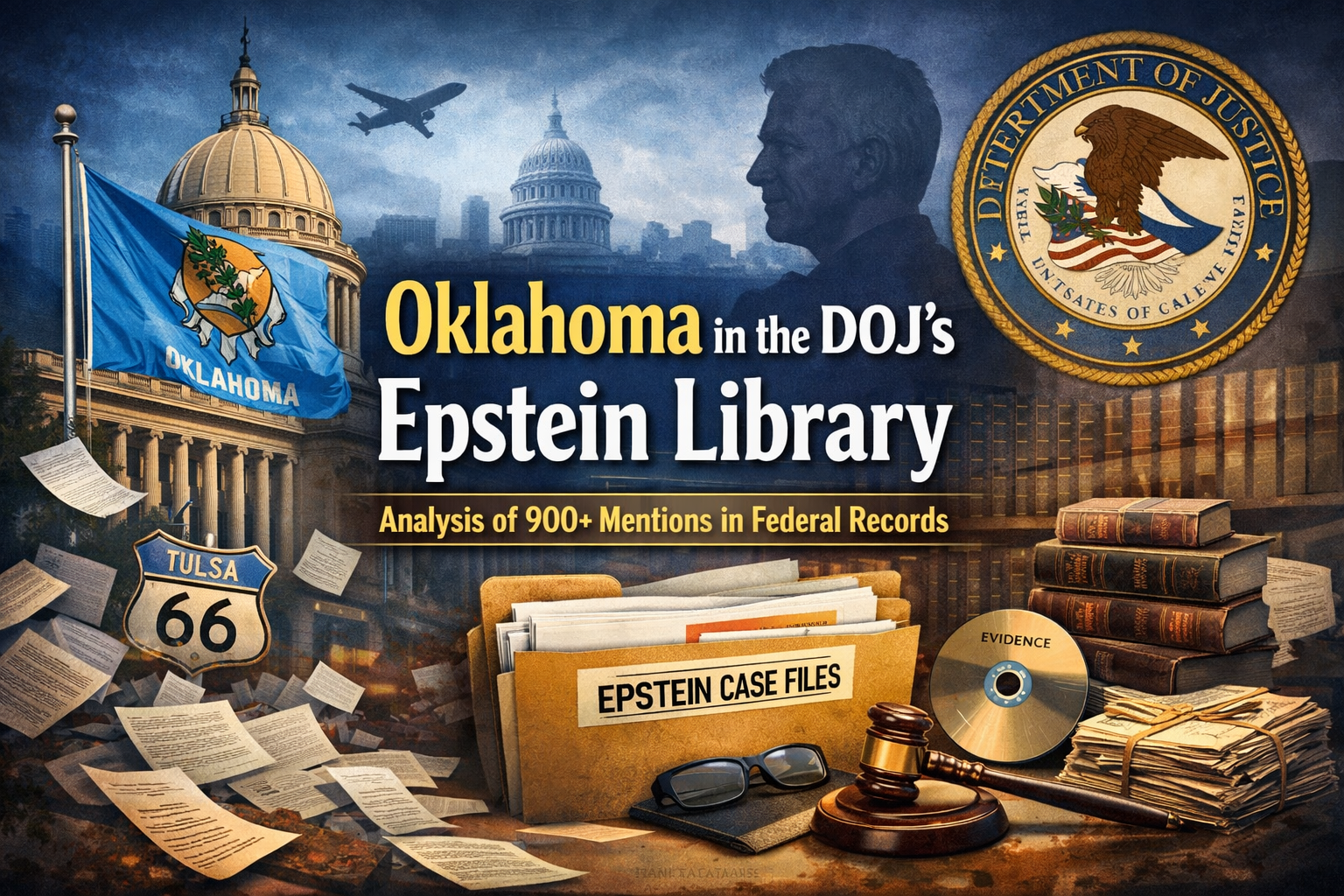
What More Than 900 Mentions Reveal—and Do Not Reveal—About Geography, Records, and Federal Documentation
The claim that Oklahoma appears more than 900 times in U.S. Department of Justice materials related to Jeffrey Epstein has generated significant public attention. Numerical prominence, however, does not inherently indicate substantive relevance. In large federal document ecosystems, repetition is often an artifact of administrative systems rather than evidentiary weight. This essay examines how such counts arise, how they should be interpreted, and why methodological rigor is essential before drawing conclusions.
What Is the “Epstein Library”?
The term “Epstein Library” is not an official DOJ designation. Rather, it is a colloquial label used to describe a diffuse aggregation of:
- Criminal and civil case files
- Discovery exhibits
- Email archives
- Financial compliance records
- FOIA-released materials
These records span multiple decades, jurisdictions, and investigative scopes. Importantly, they were not produced as a single, unified archive, which complicates interpretation.
The Documentary Scale of the U.S. Department of Justice
The DOJ is among the largest document-producing institutions in the United States. Large investigations generate:
- Millions of pages of material
- Repeated administrative templates
- Redundant references across systems
Within this scale, geographic names function as routing markers, not narrative signifiers.
What Does “Mentioned” Actually Mean in Federal Records?
A “mention” can include:
- File headers and footers
- Email routing paths
- Address fields
- Database metadata
- OCR-recognized text fragments
Crucially, most mentions are not analytical statements. They are structural components of information systems.
Metadata Inflation and the Illusion of Significance
Metadata repetition is one of the most common causes of high-frequency references. When a location appears in:
- An office address
- A jurisdictional tag
- A standardized form
It may be replicated hundreds of times across thousands of files. This phenomenon is well-documented in archival science and digital humanities research.
Oklahoma’s Role in Federal Administrative Geography
Oklahoma is home to:
- Multiple federal judicial districts
- U.S. Attorney offices
- Federal law enforcement facilities
As a result, Oklahoma frequently appears in DOJ records unrelated to substantive allegations. Administrative geography alone can generate extensive textual presence.
Inter-District Case Routing and Task Force Coordination
Large federal cases often involve:
- Temporary transfers between districts
- Joint task forces
- Parallel investigations
When files are routed or mirrored across districts, location identifiers persist—even when the underlying activity occurred elsewhere.
Financial Compliance Records and Geographic Echoes
Investigations involving financial misconduct generate extensive compliance documentation. These records reference:
- Bank headquarters
- Clearing institutions
- Compliance offices
If any of these entities list Oklahoma addresses, the state name may recur extensively in transaction logs without indicating activity tied to the investigation’s core allegations.
FOIA Releases and Template Replication Effects
FOIA responses frequently bundle documents using standardized formats. Each document may repeat:
- Agency identifiers
- Office locations
- Distribution lists
When released at scale, these repetitions dramatically inflate mention counts.
OCR Technology and False Positives
Optical Character Recognition (OCR), commonly used to digitize scanned documents, can:
- Misread partial text
- Duplicate strings across pages
- Create fragmented references
Thus, frequency metrics may include machine-generated artifacts, not intentional references.
Distinguishing Substantive References from Structural Noise
A rigorous analysis must separate:
- Substantive references (discussion of actions, events, or decisions)
- Structural references (addresses, routing data, metadata)
Failure to make this distinction leads to interpretive error.
Comparative Context: Geographic Frequency Across DOJ Datasets
In unrelated DOJ cases, states such as Virginia, New York, and California routinely appear thousands of times due to:
- Federal infrastructure density
- Financial institutions
- Court jurisdictions
High frequency is therefore common, not exceptional.
Media Narratives and the Pitfall of Numerical Emphasis
Public discourse often privileges large numbers without context. Academic standards require:
- Denominator awareness (mentions per page or per file)
- Functional analysis of document structure
- Transparency about uncertainty
Absent these, numbers risk becoming rhetorical devices rather than evidence.
Ethical Constraints and Due Process Considerations
Associating a place with alleged wrongdoing based solely on document frequency raises ethical concerns. Scholarly analysis must avoid:
- Guilt by association
- Geographic stigmatization
- Inferential leaps unsupported by evidence
What Rigorous Research Would Actually Require
To draw defensible conclusions, researchers would need:
- A stratified sample of documents
- Manual coding of reference types
- Temporal analysis of mentions
- Cross-validation by independent analysts
Without this, claims remain speculative.
Conclusion: Interpreting the 900+ Mentions Responsibly
The appearance of Oklahoma more than 900 times in DOJ materials associated with the “Epstein Library” is best understood as a byproduct of federal documentation systems, not as prima facie evidence of substantive involvement. In large bureaucratic archives, frequency reflects structure more often than meaning. Responsible, non-partisan scholarship demands that numbers be contextualized, methods disclosed, and conclusions restrained by evidence.
References
I. Archival Science & Records Theory
These works establish how frequency, metadata, and repetition arise in large bureaucratic archives and why raw counts are analytically weak.
- Cook, T. (1997).
What Is Past Is Prologue: A History of Archival Ideas Since 1898, and the Future Paradigm Shift.
Archivaria, 43, 17–63. Foundational text explaining how archival structures shape meaning independently of content. - Yakel, E. (2003).
Archival Representation.
Archival Science, 3(1), 1–25. Demonstrates how descriptive systems and metadata frames influence interpretation. - Duranti, L. (1998).
Diplomatics: New Uses for an Old Science.
Society of American Archivists. Essential for understanding how document form, not just content, conveys administrative function. - Gilliland, A. J. (2016).
Setting the Stage. In Introduction to Metadata (3rd ed.). Getty Research Institute. Explains metadata replication and why location fields proliferate across records.
II. Digital Archives, OCR, and Computational Artifacts
These sources address false positives, OCR noise, and machine-generated repetition in digitized document collections.
- Smith, A. (2007).
Preservation in the Age of Large-Scale Digitization.
Council on Library and Information Resources. Details systemic distortions introduced by mass digitization. - Tanner, S., Muñoz, T., & Ros, P. (2009).
Measuring Mass Text Digitization Quality.
D-Lib Magazine, 15(7/8). Empirical evidence of OCR error rates affecting keyword frequency. - Cordell, R. (2017).
“Q i-jtb the Raven”: Taking Dirty OCR Seriously.
Book History, 20, 188–225. Demonstrates how OCR artifacts distort textual analysis.
III. Legal Methodology & Federal Record-Keeping
These works explain how DOJ and federal legal records are generated, routed, and replicated.
- Posner, R. A. (1999).
An Economic Approach to the Law of Evidence.
Stanford Law Review, 51(6), 1477–1546. Provides a framework for distinguishing probative from non-probative information. - Wigmore, J. H. (1940).
The Science of Judicial Proof.
Little, Brown & Company. Classic text emphasizing relevance over volume. - Federal Judicial Center (2011).
Managing Complex Litigation: A Practical Guide.
Washington, D.C. Explains multi-district document replication and administrative routing.
IV. FOIA, Bureaucratic Transparency & Document Dumps
These sources contextualize FOIA releases and bulk disclosures.
- Pozen, D. E. (2017).
Freedom of Information Beyond the Freedom of Information Act.
University of Pennsylvania Law Review, 165(5), 1097–1158. Shows how transparency mechanisms create interpretive challenges. - Roberts, A. (2006).
Blacked Out: Government Secrecy in the Information Age.
Cambridge University Press. Discusses structural opacity even in large-scale disclosures. - Kreimer, S. F. (2008).
The Freedom of Information Act and the Ecology of Transparency.
University of Pennsylvania Law Review, 154, 1–65. Explains why raw access does not equal understanding.
V. Quantification, Numeracy & Misinterpretation
These sources caution against numerical overreach in legal and media contexts.
- Porter, T. M. (1995).
Trust in Numbers: The Pursuit of Objectivity in Science and Public Life.
Princeton University Press. Seminal critique of numerical authority without context. - Best, J. (2001).
Damned Lies and Statistics.
University of California Press. Accessible but rigorous discussion of misleading numerical claims.
VI. Ethics, Due Process & Associational Harm
These works ground the ethical restraint emphasized in the blog.
- Sunstein, C. R. (2002).
The Law of Group Polarization.
Journal of Political Philosophy, 10(2), 175–195. Explains how information clustering fuels unjust inference. - Dworkin, R. (1986).
Law’s Empire.
Harvard University Press. Establishes interpretive responsibility in legal reasoning.