What We Get Wrong About Gendered Racism—and What the Evidence Shows
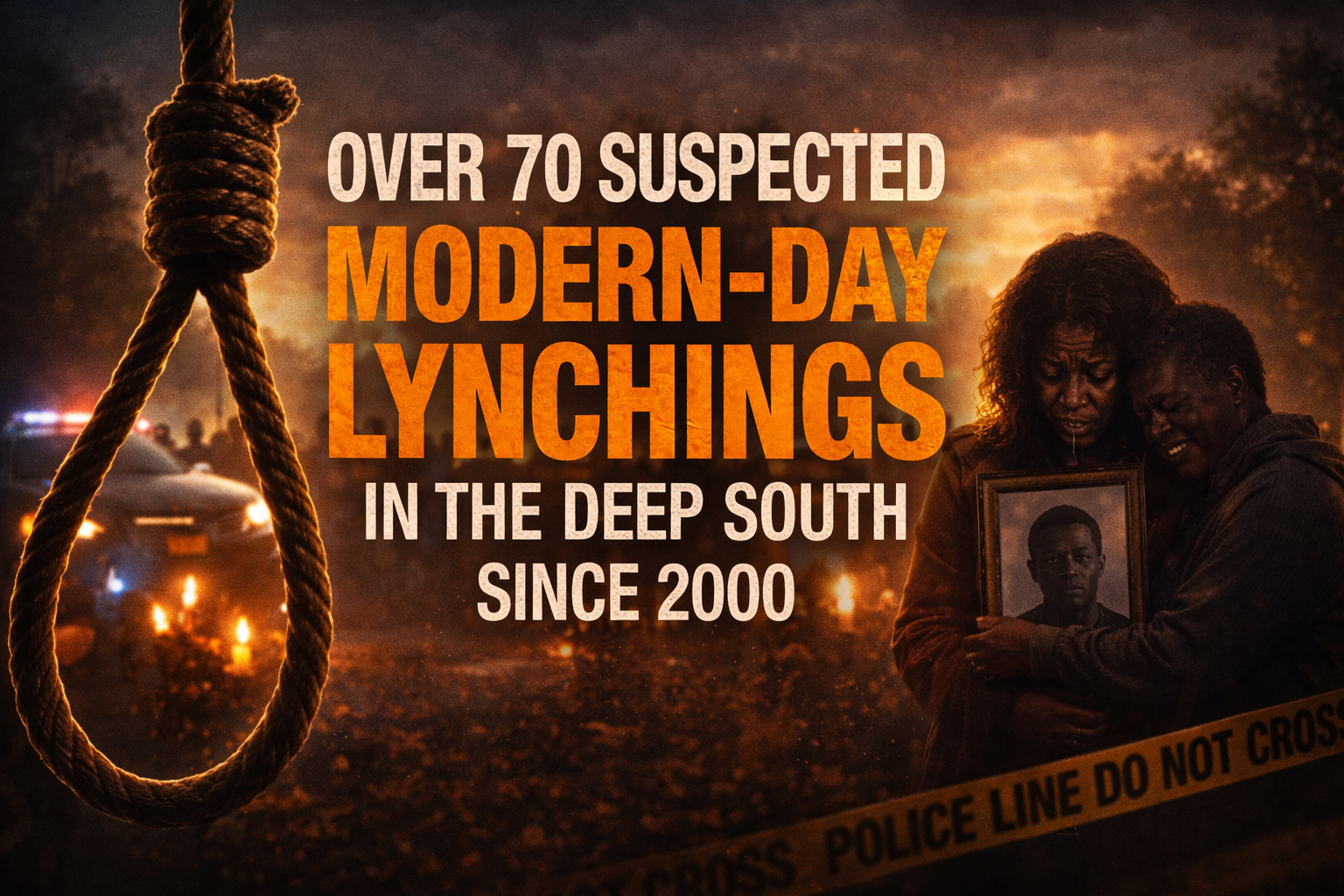
The word lynching has a specific historic meaning in the U.S.: extrajudicial, public, terror-based killing—often targeting Black people—used to enforce racial hierarchy. The challenge today is that suspected “modern-day lynchings” are frequently reported as:
- Hangings ruled suicide despite contested circumstances
- Deaths in custody with disputed narratives
- Disappearances and recovered bodies with incomplete investigations
- Hate-motivated homicides where intent is hard to prove
A careful, nonpartisan approach starts with clear case criteria. Researchers typically look for indicators such as: evidence of coercion, inconsistent scene findings, prior threats, hate symbols or patterns, and investigative irregularities. Definitions don’t “water down” the moral urgency—they increase accuracy and protect credibility, which is crucial when communities already distrust institutions.
The Deep South context—history isn’t “over,” it echoes
Empirical historical research shows lynching was not random violence; it was organized social control. The Equal Justice Initiative documented thousands of racial terror lynchings, emphasizing how these acts shaped civic life and legal systems for generations (Equal Justice Initiative, 2015). That legacy matters because modern “suspected lynchings” often emerge in places where:
- historical racial terror was concentrated, and
- institutional trust remains fragile.
This isn’t about blaming today’s residents for yesterday’s crimes. It’s about recognizing that institutional memory, local power structures, and community fear can persist—especially when accountability was never fully established.
Equal Justice Initiative Lynching Project: https://eji.org/issues/lynching-in-america/
What the data says about hate violence since 2000
If a report claims 70+ suspected lynchings since 2000, one way to assess plausibility is to compare to broader patterns of hate violence and homicide.
The FBI’s hate crime data consistently shows thousands of hate crime incidents reported annually in the U.S., with race/ethnicity/ancestry among the most common motivating categories (Federal Bureau of Investigation, n.d.). Hate crime data is imperfect—underreporting is a known limitation—but it provides baseline context: severe bias-related violence is not rare enough to dismiss out of hand.
At the same time, homicide trends vary significantly by region, poverty levels, firearm prevalence, and local policing practices. So a claim about 70+ suspected cases across 25 years in a multi-state region could be within the realm of possibility—but the question becomes: how were cases identified, classified, and verified?
FBI Hate Crime Data: https://cde.ucr.cjis.gov/
A feminist lens—why “gender-neutral” analysis misses key harms
A feminist lens here doesn’t mean “about women only.” It means asking: How do power, violence, and institutions affect people differently by gender, race, class, and sexuality? This approach is strongly supported by intersectionality scholarship, which shows that harms intensify at the intersections of identity and structural inequality (Crenshaw, 1989).
In suspected modern-day lynching cases, feminist analysis adds critical questions:
- How are Black women and gender-diverse people affected as victims, witnesses, organizers, and family advocates?
- How do “credible victim” stereotypes shape media coverage and investigative urgency?
- How do caregiving roles place disproportionate burdens on women when families pursue answers?
Intersectionality helps keep the focus on both the individual case and the structural environment that shapes whether truth is discoverable.
The overlooked victims and survivors—women, LGBTQ+ people, and “secondary victimization”
Even when victims are men (as in many historic lynchings), the violence radiates outward. Feminist research calls this secondary victimization: the trauma and harm experienced by family members through institutions—dismissive treatment, poor communication, blame, and bureaucratic stonewalling.
Families—often led by mothers, partners, sisters, and daughters—frequently become de facto investigators and advocates. That unpaid labor is a gendered burden. Add stigma (poverty, substance use allegations, sexual orientation, trans identity), and the likelihood of respectful treatment can drop further.
This is one reason feminist-informed policy emphasizes:
- trauma-informed communication,
- family liaison services,
- transparent timelines,
- independent review pathways.
“Suicide” vs. homicide—how investigative uncertainty becomes a justice issue
Many suspected modern-day lynching allegations involve cases officially ruled suicide. The core issue is not to deny suicide exists—it does, and it is tragically common—but to insist on robust, standardized death investigations.
Two empirical realities can coexist:
- Suicide is a major cause of death; and
- Some deaths are misclassified due to inadequate investigation resources, bias, or procedural gaps.
A credible report should describe:
- how it distinguishes contested suicides from likely self-harm,
- what forensic thresholds it uses,
- how it treats missing data, and
- whether independent medical examiners were involved.
When local systems lack resources or face conflicts of interest, uncertainty hardens into official “closure,” and families experience that as institutional abandonment—a justice issue, not merely a technical error.
Deaths involving law enforcement—why this belongs in the conversation
Another set of cases sometimes discussed alongside “modern-day lynchings” includes deaths during arrest or in custody. Federal statistical programs track deaths in custody and arrest-related deaths, though these datasets have faced reporting gaps over time (e.g., Bureau of Justice Statistics systems and revisions).
A feminist, nonpartisan take doesn’t assume guilt; it insists on systems that reliably find facts:
- independent investigations,
- body-camera policies with enforceable compliance,
- transparent release of records,
- consistent medical and forensic standards.
This is also where race and gender interact: research and public health scholarship repeatedly emphasizes that state violence and community violence are not separate universes—they can compound in the same communities, eroding trust and cooperation needed for solving any violent death.
Bureau of Justice Statistics: https://bjs.ojp.gov/
Media patterns—whose death becomes “a story,” and whose becomes “a footnote”?
A feminist lens pays attention to narrative power. Empirically, media coverage tends to be uneven: some victims receive sustained attention, while others disappear from headlines quickly—especially if they’re poor, rural, Black, Indigenous, LGBTQ+, formerly incarcerated, or labeled “high risk.”
This matters because media attention affects:
- political pressure to investigate,
- willingness of witnesses to come forward,
- resource allocation,
- and long-term accountability.
Nonpartisan doesn’t mean neutral about injustice; it means committed to consistent standards: every suspicious death deserves the same investigative seriousness.
What “evidence-based accountability” looks like (without turning this into a political team sport)
If a region has 70+ suspected cases since 2000 (as your referenced report claims), the most constructive question is: What would reduce the chance that suspicious deaths go unresolved or misclassified?
Here are evidence-aligned reforms that don’t require partisan framing:
- Independent death investigation capacity
Regional medical examiner systems insulated from local conflicts of interest; consistent funding for forensic labs. - Standardized protocols for staged-hanging scenes
Clear minimum requirements for scene documentation, autopsy standards, chain-of-custody, and digital evidence retention. - Family rights and transparency
Timelines for updates, access to records, and a mechanism to request independent review. - Data quality upgrades
Better reporting to federal systems (violent death reporting, hate crime systems, deaths in custody), with audits for completeness. - Community-based violence interruption + survivor supports
Trauma services and legal aid for families—because truth-seeking is expensive and exhausting.
CDC National Violent Death Reporting System (NVDRS): https://www.cdc.gov/violenceprevention/datasources/nvdrs/
Where we go from here—holding two truths at once
If that “new report” is right, then the number—70+ suspected modern-day lynchings since 2000—is not just a statistic. It’s a warning about unresolved violent death, incomplete accountability, and community trauma.
And even if the exact count changes under scrutiny (as counts sometimes do), the underlying imperatives remain:
- Investigations must be rigorous and transparent.
- Families deserve dignity and timely truth.
- Gendered burdens of advocacy must be recognized and supported.
- Bias violence must be documented with higher fidelity, not lower.
A feminist, nonpartisan lens doesn’t ask anyone to join a political tribe. It asks us to join a standard of care: for truth, for justice, for the living, and for the dead.
FAQs
What’s the difference between a hate crime and a lynching?
A hate crime is a legal category tied to a criminal offense motivated by bias. Lynching historically refers to extrajudicial terror violence, often public and symbolic. A modern case could potentially overlap with hate crime indicators, but “lynching” is not consistently a legal category today.
Does calling something a “suspected lynching” risk spreading misinformation?
It can—if the claim is made without transparent criteria. The ethical approach is to use clear standards, cite evidence, and distinguish between confirmed facts and unresolved questions.
How can communities push for answers without assuming outcomes?
By demanding process integrity: independent review, full forensic documentation, transparent timelines, and consistent public reporting—without declaring conclusions before evidence is evaluated.
Why bring feminism into this at all?
Because violence and accountability are shaped by power. Feminist and intersectional research helps explain why some families bear heavier burdens, why some victims are taken less seriously, and how institutions can unintentionally reproduce inequality (Crenshaw, 1989; Collins, 2000).
Future Implications: What this moment could shape next
If the reported figure—70+ suspected modern-day lynchings in the Deep South since 2000—continues to circulate and be investigated, the next few years will likely hinge on whether institutions respond with better evidence systems or more defensiveness. Either path has real-world consequences.
1) Public trust will rise or fall based on investigative transparency.
Communities don’t need perfect systems to trust them—but they do need visible signs of integrity: timely updates, clear explanations of findings, and independent review options. When families experience secrecy or dismissal, distrust can become generational, reducing cooperation in all serious-crime investigations and weakening community safety overall.
2) Data quality will increasingly determine policy.
National datasets on violent deaths and hate crimes are improving, but gaps remain (Centers for Disease Control and Prevention [CDC], n.d.; Federal Bureau of Investigation [FBI], n.d.). If jurisdictions standardize death investigations and reporting, the U.S. will get closer to answering basic questions—how many suspicious hangings occur, where patterns cluster, and which prevention strategies work.
3) A feminist lens will likely become more central—not optional.
As more families (often women) organize, fundraise, and advocate, the “secondary harm” of opaque systems becomes harder to ignore. Expect growing pressure for trauma-informed practices, family liaison roles, and resources for survivors—approaches consistent with intersectional scholarship that emphasizes how race, gender, and class shape institutional outcomes (Crenshaw, 1989; Collins, 2000).
4) Legal and forensic reforms may expand—especially around independent review.
Where local conflicts of interest are suspected, states may face calls for regional medical examiner systems, standardized protocols, and independent investigative bodies. These aren’t inherently partisan ideas; they’re governance choices about credibility, capacity, and accountability.
5) The narrative stakes are high.
If public discourse frames these cases as “culture war,” the likely result is stalemate. If the frame remains evidence-centered—focused on protocols, records, and independent oversight—reform becomes more achievable, even among people who disagree politically.
A Different Kind of Wrap-Up: What we can say with intellectual honesty
Even without unanimous agreement on every case label, one truth is hard to dodge: suspicious deaths that leave families without credible answers are a public failure—a failure of process, transparency, and care.
A nonpartisan feminist lens doesn’t ask readers to adopt a single ideology. It asks for something more practical and measurable: consistent standards that treat every contested death with seriousness, especially when historical patterns and present-day distrust make “business as usual” morally and empirically inadequate.
If the “new report” is accurate, the number is alarming. If the number changes under scrutiny, the underlying demand still stands: we need systems that can withstand scrutiny. That’s the only way truth holds—whether it confirms foul play, misclassification, negligence, or something else entirely.
Call to Action: What readers, institutions, and communities can do now
Here are concrete, evidence-aligned actions that don’t require partisan alignment—just commitment to truth and humane treatment:
For readers and community members
- Support family-led advocacy and legal aid funds in cases involving contested death determinations (records requests, independent autopsies, expert review).
- Attend public meetings (county commissions, oversight boards) and ask for specific improvements: timelines, transparency, and independent review pathways.
- Practice “responsible amplification.” Share verified details, link to primary documents when available, and distinguish between confirmed facts and unresolved claims.
For journalists and media outlets
- Report the methodology, not just the headline number. Explain how cases were selected, what “suspected” means, and what evidence is publicly documented.
- Follow up months later. Accountability coverage requires time, not just breaking news.
For law enforcement, medical examiners, and local officials
- Adopt standardized protocols for hanging deaths and other contested scenes (documentation, evidence retention, independent consultation).
- Create a family liaison process with written expectations: update frequency, point of contact, and how to request review.
- Commit to data completeness in reporting systems used for violent death and hate crime tracking (CDC, n.d.; FBI, n.d.).
For state policymakers and funders
- Resource independent death investigation capacity (regional ME offices, forensic labs, training, and audit systems).
- Establish an independent review mechanism for contested death classifications—especially when conflicts of interest are alleged.
If you want one simple, high-impact step: advocate for independent review + standardized protocols. Those two changes alone can reduce misclassification risk, strengthen credibility, and lower the long-run temperature of public conflict.
About the Author: Why This Isn’t Abstract for Me
I’m writing this with a knot in my stomach—and with my eyes wide open—because the dangers we’re talking about aren’t confined to history books or distant headlines. They’re woven into family stories, community silences, and the quiet calculations people still make every day just to feel safe.
My own family history is complicated. I’m white, and I grew up with the knowledge that my 4th and 6th great-grandfathers were colonels in the Confederacy. That fact sits heavy. It’s not “fun trivia,” and it’s not something I can reframe into a feel-good narrative. It’s a reminder that the ideology behind racial hierarchy wasn’t just something “other people” believed—it lived in the choices, ambitions, and social worlds of people whose bloodline I carry.
And now I’m raising mixed children.
That single truth reshapes everything. It makes the stakes painfully concrete. It forces me to confront how easily ideology becomes inheritance—not through DNA, but through stories we tell, what we excuse, what we leave unchallenged, and what we teach kids to accept as “normal.” If we’re not careful, the past doesn’t stay in the past. It gets repackaged into folklore, pride, “heritage,” or coded phrases that sound harmless until you see what they permit.
This is the danger of ignorant ideology: it doesn’t always show up wearing a hood. Sometimes it shows up as:
- dismissing suspicious deaths as “probably nothing,”
- treating fear as overreaction,
- stereotyping who is “credible,” “innocent,” or “worth investigating,”
- insisting we should “move on” without ever dealing with what happened—or what’s still happening.
When violence is minimized, or when truth-seeking is treated like a nuisance, it creates an environment where intimidation can thrive. That’s one reason this conversation matters even for people who don’t see themselves as political: if institutions can’t—or won’t—deliver clear, transparent answers in contested deaths, communities learn a brutal lesson about whose safety is negotiable.
And yes, many people are still living in fear.
Not always the dramatic kind you see on television—more like the daily, grinding kind:
- choosing routes home,
- avoiding certain towns after dark,
- worrying about how a traffic stop could turn,
- hesitating before reporting threats,
- weighing whether speaking up will make things worse.
Fear changes behavior. It shrinks lives. It keeps people quiet. And when fear becomes normal, it becomes easier for cruelty—individual or institutional—to operate without consequences.
I’m not writing this to perform guilt or to claim moral purity. I’m writing because my family history reminds me how ordinary people can be folded into harmful systems, and my children remind me that the price of denial is never theoretical. If we want a future where fewer families are left pleading for answers, we have to reject the lazy comfort of ignorance—especially when it comes dressed as tradition, “common sense,” or neutrality.
Because neutrality toward injustice doesn’t stay neutral. It becomes permission.
References
Collins, P. H. (2000). Black feminist thought: Knowledge, consciousness, and the politics of empowerment (2nd ed.). Routledge.
Crenshaw, K. (1989). Demarginalizing the intersection of race and sex: A Black feminist critique of antidiscrimination doctrine, feminist theory and antiracist politics. University of Chicago Legal Forum, 1989(1), 139–167.
Equal Justice Initiative. (2015). Lynching in America: Confronting the legacy of racial terror (Report). https://eji.org/reports/lynching-in-america/
Federal Bureau of Investigation. (n.d.). Hate crime data. FBI Crime Data Explorer. https://cde.ucr.cjis.gov/
Centers for Disease Control and Prevention. (n.d.). National Violent Death Reporting System (NVDRS). https://www.cdc.gov/violenceprevention/datasources/nvdrs/
Bureau of Justice Statistics. (n.d.). Data collections and statistical reports. https://bjs.ojp.gov/
Centers for Disease Control and Prevention. (n.d.). National Violent Death Reporting System (NVDRS). https://www.cdc.gov/violenceprevention/datasources/nvdrs/
Collins, P. H. (2000). Black feminist thought: Knowledge, consciousness, and the politics of empowerment (2nd ed.). Routledge.
Crenshaw, K. (1989). Demarginalizing the intersection of race and sex: A Black feminist critique of antidiscrimination doctrine, feminist theory and antiracist politics. University of Chicago Legal Forum, 1989(1), 139–167.
Federal Bureau of Investigation. (n.d.). Hate crime data. FBI Crime Data Explorer. https://cde.ucr.cjis.gov/