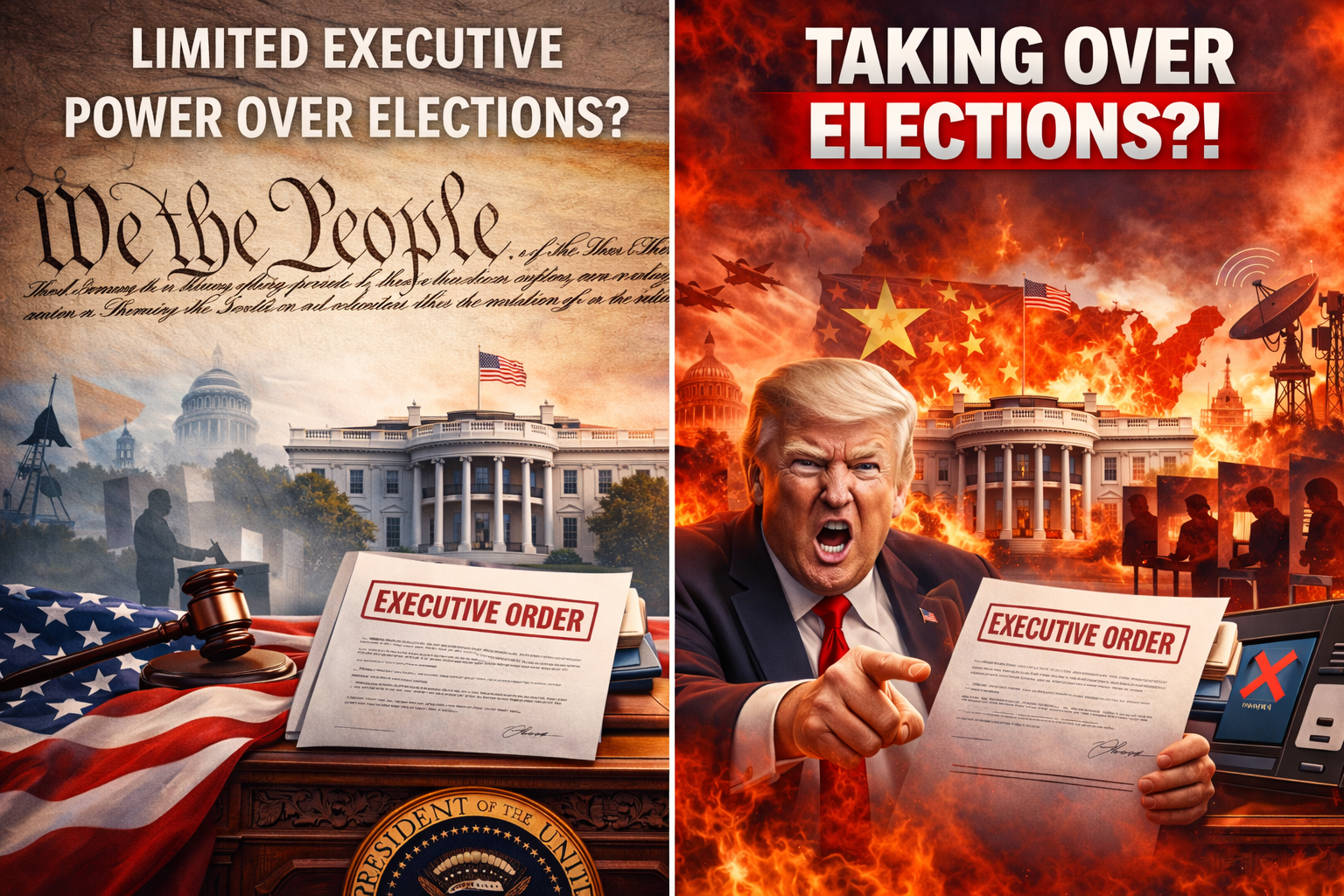
Why Presidents Need a Role in Protecting Elections—but Not in Running Them
A new round of reporting has revived an old constitutional question: How much power should the executive branch have over elections? The immediate trigger is reporting that allies of President Donald Trump have circulated a draft emergency-based plan that would claim extraordinary presidential authority over voting administration ahead of the 2026 midterms. PBS reported on February 27, 2026, that the proposal would give the president unusually broad control over election rules, while The Washington Post reported on February 26, 2026, that the draft order would invoke alleged foreign interference as the basis for a national emergency.
That controversy matters beyond any one president or party. The real issue is institutional: Should the branch that is itself headed by a candidate or party leader gain more direct authority over the machinery of elections? A nonpartisan answer begins with first principles. In the American system, the executive branch should have meaningful but limited election power: strong authority to protect elections, enforce duly enacted federal law, and support state and local administrators; weak authority to rewrite election rules unilaterally, especially through emergency claims. The constitutional structure, empirical evidence on election administration, and recent court decisions all point in that direction.
The Constitutional Baseline: Elections Are Mostly State-Run, with Congress Above the President
The Constitution does not place ordinary election administration primarily in the president’s hands. For congressional elections, the Elections Clause gives state legislatures the initial power to set the “Times, Places and Manner” of elections, while giving Congress authority to “make or alter” those rules. The president’s constitutional role is different: Article II vests executive power in the president, but that is not the same thing as a freestanding power to design election rules.
That distinction is not technical; it is foundational. It means election administration in the United States is intentionally decentralized. The U.S. Election Assistance Commission and National Conference of State Legislatures note that the country has more than 8,000 election administration jurisdictions, with authority spread across states, counties, municipalities, boards, and secretaries of state.
This structure is often messy, but it serves an anti-concentration purpose. No single national executive can easily control every polling place, registration form, ballot-counting process, recount, canvass, or certification decision. That fragmentation can frustrate uniformity, yet it also reduces the danger that one officeholder can tilt the system in his or her own favor. In constitutional design terms, that is a feature, not a bug.
The Federal Government Already Has an Important Role—Just Not a Blank Check
Limiting presidential control does not mean the federal government should be absent from elections. Congress has long created federal guardrails. The National Voter Registration Act, the Help America Vote Act (HAVA), the Voting Rights Act, and disability-access laws all shape election administration. GAO similarly notes that federal law regulates major aspects of election administration and that multiple federal agencies already have responsibilities in this area.
The EAC is especially important here. Congress created it as an independent, bipartisan agency to assist with election administration, develop voluntary voting system guidelines, certify systems, and distribute certain funds. Its 2025 annual materials describe it as the only federal agency focused solely on election administration and emphasize its bipartisan structure.
That institutional design reflects a sound principle: federal support is often necessary, but direct presidential control is not. Election systems benefit from national coordination on cybersecurity, accessibility, equipment standards, and voter information. Yet those same functions are safer when lodged in bodies that are bipartisan, statutory, and constrained, rather than directly subordinated to a president with immediate electoral incentives.
What the Evidence Says: Administrative Capacity Matters More Than Presidential Command
Empirical research on elections rarely supports the idea that stronger presidential control produces better administration. What it does show is that capacity, professionalism, and resources matter.
The EAC’s 2024 Election Administration and Voting Survey reported that about three in ten ballots in 2024 were cast by mail and that nearly 15 million ballots were returned at drop boxes in the 36 states allowing them; in states with comparable data from both 2022 and 2024, the share of mail ballots returned via drop boxes increased by an average of 9.2 percentage points. These are not marginal systems anymore. They are embedded parts of modern election administration, and they depend on clear rules and stable administration rather than abrupt executive improvisation.
MIT Election Lab’s 2024 voter-experience reporting likewise found that roughly seven in ten voters cast ballots in person, either early or on Election Day. That means U.S. election administration must manage both large in-person operations and large absentee/mail systems at once. The administrative challenge is substantial and ongoing.
Research also suggests that the quality of administration is linked to institutional design and professional management. A recent study on local election administration found that appointed local election officials were associated with greater administrative resources, more voter communication, and shorter wait times. That finding does not settle every governance question, but it does reinforce a broader lesson: election performance improves when institutions reward competence and neutrality, not when they become extensions of campaign politics.
The Best Case for Stronger Executive Power
A fair analysis should acknowledge the strongest argument on the other side. Advocates of expanded executive authority often argue that the United States needs faster, more unified responses to threats such as cyberattacks, foreign interference, disinformation campaigns, inconsistent state practices, and outdated voter rolls. That argument is not frivolous. DHS and CISA both state that elections are part of critical infrastructure and that federal support is central to securing election systems against cyber and physical threats.
There is real evidence that national support can help. The decentralized nature of American elections creates resilience, but it also leaves many local jurisdictions with uneven staffing, technology, and expertise. AP reported before the 2024 election that election security officials emphasized the strain on thousands of local jurisdictions and the need for continuing federal support.
This is the best argument for executive involvement: in a crisis, fragmented local systems may need national coordination. A president can direct agencies, marshal resources, and communicate quickly in ways Congress and the states sometimes cannot. That is a genuine governance advantage.
Why the Strongest Argument Still Has a Clear Limit
The problem is that the same urgency that makes executive action attractive in a crisis also makes it dangerous in elections. Elections determine who controls executive power. That creates a built-in conflict of interest. A president is not just a neutral manager of the system; the president is often the de facto leader of one of the competing political coalitions.
That conflict is one reason courts have been skeptical when presidents attempt to impose election rules without clear statutory authorization. In 2025, President Trump issued the executive order “Preserving and Protecting the Integrity of American Elections,” which sought, among other things, to require documentary proof of citizenship for the federal registration form and to pressure changes in ballot-receipt rules. Federal courts blocked major parts of that order, with Reuters reporting on October 31, 2025, that a judge permanently blocked the proof-of-citizenship mandate because it unlawfully encroached on state and congressional authority over election procedures. AP similarly reported in April 2025 that a federal judge concluded the president had overstepped under the Elections Clause.
That is the key constitutional line: the executive branch may execute election law, but it may not simply invent or rewrite it. Emergency rhetoric does not erase that line. Even if one believes stronger safeguards are needed, the Constitution generally assigns the rulemaking burden to Congress and, in the first instance, the states—not to unilateral presidential decree.
Emergency Powers Are the Wrong Tool for Ordinary Election Governance
Recent reporting makes this question even more urgent because it centers on emergency-based presidential power. According to The Washington Post and PBS, the draft plan now in circulation would use alleged Chinese interference as a basis for declaring a national emergency and asserting sweeping authority over voting procedures.
Emergency powers are always constitutionally sensitive, but they are especially fraught in election law. The Brennan Center’s guide to emergency powers notes that the president’s emergency authority depends on statutes Congress has enacted; it is not a general license to govern outside ordinary law. In other words, a declaration can unlock powers Congress has already granted, but it cannot magically create new election powers out of thin air.
That matters because election emergencies invite self-serving definitions. A president could characterize routine policy disagreement, unverified fraud claims, or generalized security fears as justification for extraordinary intervention. Once that model is normalized, every close election could become an occasion for claimed executive necessity. That is not a stable republic-friendly norm. It is a recipe for recurrent legitimacy crises. The constitutional problem is not just abuse by one leader; it is the precedent the office would inherit.
But Doesn’t the Executive Need Power to Prevent Fraud?
Yes—within law. The executive branch has important and legitimate anti-fraud functions: criminal enforcement, intelligence sharing, cybersecurity assistance, prosecution of threats against election workers, and interagency support for accurate voter information and list maintenance where authorized by statute. GAO has long recognized that federal data and federal agencies can help states improve registration accuracy and compliance.
But here the empirical record again counsels restraint. Studies and reviews consistently find that in-person voter fraud and noncitizen voting are rare, not nonexistent but uncommon enough that broad structural restrictions can create larger burdens than the underlying problem warrants. GAO’s work on voter identification laws found few instances of the kinds of fraud those laws target, and GAO’s voter-registration review similarly described noncitizen-voting cases as very few in the jurisdictions studied.
Recent state-level reporting points the same way. AP reported that Wisconsin election officials referred 46 cases of suspected fraud or irregularities tied to the 2024 presidential election out of more than 3.4 million ballots cast, a rate of about 0.002%. That does not prove every state looks identical, but it is a useful reminder that actual fraud patterns are generally measured in tiny fractions, not in systemwide distortions requiring presidential takeover.
A prudent system therefore distinguishes between targeted enforcement and rule-by-emergency. The former is compatible with democracy; the latter risks overwhelming it.
What the Executive Branch Should Be Allowed to Do
A balanced institutional answer is not “none” and not “whatever it takes.” The executive branch should have robust authority in five areas.
1. Protect election infrastructure
CISA, DHS, the FBI, and other agencies should help states and localities defend against cyber threats, physical threats, and foreign interference. Elections are designated as critical infrastructure for good reason.
2. Enforce existing federal law
The Department of Justice should continue enforcing voting-rights statutes, criminal election laws, and protections for election workers and voters. That is classic executive work: enforcing law enacted elsewhere.
3. Support administrative competence
The federal government should fund upgrades, research, standards, accessibility work, and training through congressionally authorized channels such as HAVA and the EAC.
4. Share data and intelligence lawfully
Where Congress has authorized it and privacy protections are respected, federal-state data sharing can improve list maintenance, cybersecurity awareness, and threat response.
5. Communicate accurate public information
Presidents and agencies can use the bully pulpit to reduce confusion and encourage lawful participation—but they should do so within legal and ethical constraints, not through partisan mobilization disguised as neutral administration. EO 14019 illustrated how even access-oriented executive initiatives can become politically contested when they blur the line between voter service and perceived electoral advantage.
What the Executive Branch Should Not Be Allowed to Do
The executive should not have unilateral authority to:
- impose national voter-eligibility documentation rules without congressional authorization;
- set or override ballot-receipt deadlines by decree;
- federalize ordinary state election administration through emergency declaration;
- direct nominally independent election bodies as if they were campaign instruments; or
- condition election legitimacy on compliance with the incumbent president’s preferred procedures.
Those powers are dangerous not only because they might be abused, but because they would alter the constitutional balance in favor of the official with the greatest immediate stake in the result. Recent litigation over the 2025 executive order shows that federal courts remain alert to this separation-of-powers problem.
The Nonpartisan Standard We Actually Need
A sound democratic rule should be acceptable whether one’s preferred party controls the White House or not. That is the core nonpartisan test. If a power would seem intolerable in the hands of one’s opponents, it is probably too broad.
By that standard, the answer is relatively clear: the executive branch should have enough power to protect elections, but not enough power to control their rules or outcomes. Presidents should be guardians of lawful process, not architects of unilateral election regimes. The Constitution’s allocation of authority, the bipartisan structure of the EAC, the decentralized reality of American election administration, and the recent judicial pushback against unilateral election orders all point to the same conclusion.
In practical terms, that means strengthening administration without centralizing partisan control: more funding, more professionalization, more cybersecurity support, clearer statutory rules, faster courts, and better data. What it should not mean is giving any president—Republican or Democrat—a shortcut around Congress and the states whenever “emergency” becomes politically convenient.
The best safeguard for election legitimacy is not a powerful president. It is a system in which no president can easily bend election administration to personal advantage.
Future Implications for American Democracy
The long-term stakes of expanding executive power over elections extend far beyond any single administration. If presidents are able to claim broader authority over election administration through emergency declarations, agency directives, or unilateral executive action, the balance of constitutional power could shift in ways that are difficult to reverse. What begins as a temporary response to a perceived crisis may become a precedent for future leaders of either party. In that sense, the real danger is not only abuse in one moment, but normalization over time.
American democracy depends not just on voting, but on public confidence that election rules are stable, transparent, and not manipulated by those seeking office. When the executive branch gains greater influence over registration standards, ballot access, vote counting procedures, certification processes, or federal election oversight, it can blur the line between administering elections and shaping them. Even the appearance of that conflict can deepen public distrust, increase polarization, and weaken faith in democratic legitimacy.
There are also broader institutional implications. If Congress continues to struggle to legislate in this area, presidents may be tempted to fill the vacuum through executive orders and emergency-based justifications. Courts may then become the primary referees of election governance, producing a cycle in which fundamental democratic rules are settled through litigation rather than democratic consensus. That is an unstable model for a constitutional republic.
The future health of American democracy will likely depend on whether the country can reaffirm a simple but essential principle: elections should be protected by government, but not controlled by any single political actor within it. Preserving that distinction is not a partisan cause. It is a democratic necessity.
Call to Action
At this moment, the most constructive response is not panic, but civic seriousness. Americans do not need to agree on every election policy to agree that the rules of democracy should not be rewritten through unilateral executive power. Citizens, journalists, scholars, election officials, and lawmakers all have a role to play in defending constitutional boundaries and demanding transparency.
That means paying close attention to proposed changes in election governance, especially those framed as emergency measures. It means supporting evidence-based reforms rather than rhetoric-driven ones. It means insisting that Congress, not the presidency alone, set the broad legal rules that govern federal elections. It also means protecting the professional independence of state and local election administrators, whose work is often overlooked but remains central to electoral legitimacy.
Democracy is strongest when citizens stay informed, challenge claims that lack evidence, and reject the idea that democratic integrity can be secured by concentrating more power in the hands of those already competing for it. The question is not whether elections should be secure. Of course they should. The question is whether the nation will pursue security in a way that strengthens democratic institutions rather than weakening them.
We Want to Hear From You
How much power do you think the executive branch should have over elections?
Should presidents have broader authority during alleged election emergencies, or should those powers remain tightly constrained by Congress and the courts? Where do you think the line should be drawn between federal protection of elections and federal control over them?
Share your perspective in the comments. Thoughtful disagreement is welcome. In a moment when democratic trust feels increasingly fragile, open and informed public debate matters more than ever.
References
American Civil Liberties Union. (2025, April 24). Court blocks documentary proof-of-citizenship provision in voting executive order. https://www.aclu.org/press-releases/court-blocks-documentary-proof-of-citizenship-provision-in-voting-executive-order
Associated Press. (2025, April 24). Judge halts parts of Trump’s overhaul of US elections, including proof-of-citizenship requirement.
Associated Press. (2025, August 19). Trump moves to use the levers of presidential power to help his party in the 2026 midterms.
Associated Press. (2026, February 27). Wisconsin clerks refer 46 cases of suspected fraud, irregularities in 2024 presidential election.
Cybersecurity and Infrastructure Security Agency. (n.d.). Election security. U.S. Department of Homeland Security. https://www.cisa.gov/topics/election-security
Election Assistance Commission. (2025). 2024 Election Administration and Voting Survey (EAVS) report.
Election Assistance Commission. (2026a). 2025 annual report.
Election Assistance Commission. (2026b). Agency financial report.
Election Assistance Commission. (n.d.-a). Help America Vote Act. https://www.eac.gov/about/help_america_vote_act.aspx
Election Assistance Commission. (n.d.-b). Elections critical infrastructure. https://www.eac.gov/election-officials/elections-critical-infrastructure
Election Assistance Commission & National Conference of State Legislatures. (2025). Helping America Vote: Election administration in the United States.
Government Accountability Office. (2014). Elections: Issues related to state voter identification laws (GAO-14-634).
Government Accountability Office. (2019). Voter registration: Information on list maintenance and data sharing (GAO-19-485).
Government Accountability Office. (n.d.). Elections and campaign finance. https://www.gao.gov/elections-and-campaign-finance
Library of Congress, Constitution Annotated. (n.d.-a). Article I, Section 4, Clause 1: States and the Elections Clause. https://constitution.congress.gov/browse/essay/artI-S4-C1-2/ALDE_00013577/
Library of Congress, Constitution Annotated. (n.d.-b). Article II. https://constitution.congress.gov/constitution/article-2/
MIT Election Data and Science Lab. (2024, June 12). How long did it take to count the vote in 2024?
MIT Election Data and Science Lab. (2025a). How we voted in 2024.
MIT Election Data and Science Lab. (2025b, July 21). New report: How we voted in 2024.
National Conference of State Legislatures. (n.d.). Election administration at state and local levels. https://www.ncsl.org/elections-and-campaigns/election-administration-at-state-and-local-levels
PBS News. (2026, February 27). Trump says he’s not mulling a draft executive order to seize control over elections. Here’s what we know.
Reuters. (2025, October 31). US judge permanently blocks Trump order requiring voters to prove citizenship.
The White House. (2025, March 25). Preserving and protecting the integrity of American elections.
The Washington Post. (2026, February 26). Trump, seeking executive power over elections, is urged to declare emergency.