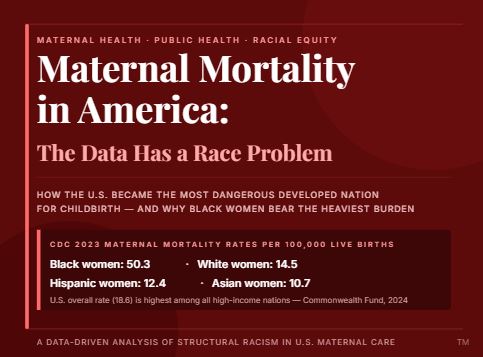
How the United States became the deadliest developed nation for childbirth — and why Black women bear the heaviest burden
A Number Behind Every Name
Every year in the United States, hundreds of women die from causes directly related to or aggravated by pregnancy and childbirth. In 2023, that number was 669 — down from a peak of 817 in 2022 but still a figure that should shock the conscience of a wealthy nation (Centers for Disease Control and Prevention [CDC], 2025). Translated into a rate, the United States recorded 18.6 maternal deaths per 100,000 live births in 2023. That is not a statistic confined to a spreadsheet. Each data point is a mother who will never hold her newborn, a family that will never be complete.
Behind the headline number, however, is a starker truth: the modest overall decline masks a deepening divide by race. While maternal deaths fell for white, Hispanic, and Asian women in 2023, the rate for Black women did not decline — it nudged upward, from 49.5 to 50.3 deaths per 100,000 live births (CDC, 2025). In a country that spends more on healthcare than any other high-income nation, that trajectory is not an accident of nature. It is a consequence of documented, structural inequities — and the data, when examined honestly, makes that impossible to ignore.
The Racial Breakdown in 2023 CDC Data

The most recent comprehensive figures from the CDC’s National Vital Statistics System paint an unambiguous picture of racial stratification in maternal survival (Hoyert, 2025). In 2023, maternal mortality rates by race and Hispanic origin were as follows:
• Non-Hispanic Black women: 50.3 deaths per 100,000 live births
• Non-Hispanic White women: 14.5 deaths per 100,000 live births
• Hispanic women: 12.4 deaths per 100,000 live births
• Non-Hispanic Asian women: 10.7 deaths per 100,000 live births (CDC, 2025)
The disparity is not a marginal difference — it is a chasm. The maternal mortality rate for Black women is more than 4.5 times the rate for Asian women and more than three times the rate for white women (Office of Disease Prevention and Health Promotion [ODPHP], 2025). Expressed differently: if Black women in America died during and after childbirth at the same rate as white women, more than two-thirds of Black maternal deaths would not occur.
The CDC’s own reporting notes a critical limitation: the data shown covers only the four largest racial and Hispanic-origin groups for which statistically reliable rates can be calculated. Native American and Alaska Native (AIAN) women — who research consistently shows bear some of the highest maternal mortality burdens of any group — are excluded from this published rate data due to small sample sizes, meaning the published figures almost certainly understate the true breadth of the racial disparity (CDC, 2025).
The International Comparison — Worst in the Developed World

The United States spends approximately 17 percent of its gross domestic product on healthcare — more than any peer nation (Commonwealth Fund, 2024). Yet it is also the most dangerous high-income country in the world in which to give birth. A 2024 analysis by the Commonwealth Fund comparing maternal mortality across 14 high-income nations found that the U.S. rate far exceeded every comparable country, despite a post-pandemic decline (Gunja et al., 2024).
For context, Norway reported zero maternal deaths per 100,000 live births. Switzerland recorded 1.2. Sweden reported approximately 3 per 100,000 (Gunja et al., 2024). The United States, at 22.3 per 100,000 in 2022 (the most recent year of comparable international data used in the report), had a maternal mortality rate more than 55 percent higher than Chile — the country with the second-highest rate among those analyzed (Gunja et al., 2024).
Half of the 14 countries in the Commonwealth Fund comparison had maternal mortality rates below five per 100,000 live births. Virtually every demographic subset of American mothers — including white women and Hispanic women — dies at higher rates than all mothers in the majority of peer nations (Commonwealth Fund, 2024). This finding underscores that the crisis is systemic to the American healthcare system as a whole, even before accounting for the racial layers within it.
What Counts as a Maternal Death — and Why the Data May Be an Undercount

Understanding the racial mortality gap requires understanding what the data captures — and what it does not. The standard definition of a maternal death, from the World Health Organization, covers the death of a woman while pregnant or within 42 days of termination of pregnancy from causes related to or aggravated by the pregnancy (CDC, 2025). The CDC’s National Vital Statistics System relies on information recorded on death certificates, which many researchers and public health officials consider less reliable than data compiled by state-based maternal mortality review committees (Policy Center for Maternal Mental Health, 2025).
Death certificates depend on attending physicians, medical examiners, and coroners correctly identifying and reporting the pregnancy connection. Studies have consistently found that maternal deaths are undercounted in routine surveillance — a problem that disproportionately affects women of color whose causes of death may be misclassified or whose pregnancy status at the time of death may go unrecorded (Policy Center for Maternal Mental Health, 2025). The result is that the stark disparities visible in current published data may represent a floor, not a ceiling, of the true racial gap.
The Commonwealth Fund and independent researchers have noted that over 80 percent of maternal deaths in the United States are likely preventable — a finding that does not suggest medical mystery, but systemic failure (Gunja et al., 2024). Preventable deaths, by definition, occur not because medicine lacks the tools to stop them, but because those tools are not equitably deployed.
Structural Racism and the Healthcare System

The American College of Obstetricians and Gynecologists (ACOG) published a landmark committee statement in 2024 affirming that racial disparities in obstetric outcomes are not biologically driven. The statement is unequivocal: disparities in clinical outcomes by race ‘are not biologically based. Instead, these racialized differences are a result of multiple factors, including the effects of systemic racism, clinician implicit or explicit bias (or both), and social and structural determinants of health’ (ACOG, 2024a, para. 2).
This position directly dismantles a longstanding — and harmful — myth that Black women’s higher rates of adverse outcomes result from inherent biological differences. The persistence of that myth has real consequences: it enables clinicians to explain away disparities rather than interrogate them, and it frames inequity as immutable rather than as the product of correctable systems and behaviors.
ACOG’s Committee Statement No. 10 calls on obstetrician-gynecologists to engage in lifelong learning to understand how ‘clinician bias and personally mediated, systemic, and structural racism play in creating and perpetuating adverse health outcomes and healthcare experiences’ (ACOG, 2024b, para. 1). The statement further calls for a workforce that reflects the patient populations served — a goal that ACOG noted is increasingly threatened as diversity, equity, and inclusion initiatives in education and professional development face political rollbacks (ACOG, 2024a).
Implicit Bias and the Pain Dismissal Problem

Research has long documented that Black patients, including pregnant women, are systematically less likely to have their pain recognized, believed, and treated compared to white patients presenting with the same symptoms. In obstetric contexts, this translates directly into mortality risk. The dismissal of warning signs — abnormal bleeding, escalating blood pressure, complaints of severe headache or shortness of breath — delays intervention in the window where outcomes are most modifiable.
A 2023 commentary published in Archives of Obstetrics and Gynecology observed that ‘personal implicit bias of some providers may be ultimately responsible for these demonstrated racial/ethnic health disparities’ in severe maternal morbidity and mortality (Levine et al., 2023, para. 5). This finding is consistent with broader evidence from the Commonwealth Fund’s 2024 survey of healthcare workers, in which respondents reported observing discriminatory treatment toward patients based on race — a dynamic that ACOG’s own guidance cites as a driver of unequal outcomes (Gunja et al., 2024).
The ACOG Committee Statement also drew attention to the consequences of race-based clinical algorithms. The VBAC (vaginal birth after cesarean) calculator, for example, previously incorporated race and ethnicity as variables — a design that ACOG found could deter clinicians from recommending a trial of labor for Black or Hispanic patients without any biological justification, effectively embedding discrimination into clinical decision support tools (ACOG, 2024a). ACOG discontinued the use of race variables in the VBAC calculator as part of its equity commitments.
Maternity Care Deserts and Geographic Inequity

Access to any obstetric care at all is increasingly a function of geography — and geography in America correlates heavily with race. An estimated 5.6 million women in the United States live in counties with no or limited access to maternity care services (Manning, 2024, as cited in YIP Institute, 2024). Between 2015 and 2019 alone, 89 obstetric units closed in rural hospitals, and by 2020 more than half of rural hospitals had ceased offering obstetric care entirely (Rabin, 2023, as cited in YIP Institute, 2024).
Black women are significantly more likely to reside in these maternity care deserts. Research published by the March of Dimes found that one in six Black infants is born in a maternity-care desert — counties with no hospitals providing obstetric care and no obstetric providers (McKinsey Institute for Economic Mobility, 2025). From 2020 to 2022, maternity-care deserts were associated with more than 10,000 excess preterm births, and counties without access to maternity care or abortion services were found to be 10 percent more likely to see preterm births — the leading cause of infant mortality among Black infants (McKinsey Institute for Economic Mobility, 2025).
The closure of maternity units in underserved communities is not a natural market correction — it is, in significant part, a consequence of Medicaid reimbursement structures. Rural hospitals that disproportionately serve Medicaid-enrolled patients receive reimbursement rates that, on average, amount to $7,461 less per vaginal birth and $11,084 less per cesarean delivery compared to commercial insurance rates (McKinsey Institute for Economic Mobility, 2025). When revenue does not cover costs, maternity wards close — and Black and low-income women are left to travel hours or deliver in emergency settings with no obstetric infrastructure.
Medicaid as a Lifeline — and a Lever

Medicaid is the single largest payer for maternity care in the United States, covering more than 1.47 million births in 2023 — in some states, funding nearly half of all deliveries (Commonwealth Fund, 2025). For Black women, who are insured through Medicaid at higher rates than white women, the program represents an essential lifeline. Any threat to Medicaid funding is, therefore, a direct threat to Black maternal survival.
One of the most consequential postpartum policy shifts in recent years has been the extension of Medicaid coverage from six weeks to 12 months after birth in most states — a change that allows women to receive coverage for postpartum complications, including emergency care, mental health services, and management of hypertensive disorders, during the period when many maternal deaths occur (Policy Center for Maternal Mental Health, 2025). Researchers have attributed part of the 2023 overall decline in maternal deaths to this expanded coverage window, alongside the reduction in COVID-19-related health system strain (Policy Center for Maternal Mental Health, 2025).
The Commonwealth Fund has warned explicitly that proposed federal Medicaid cuts represent a direct and measurable risk to maternal survival. Given that deaths are especially high among rural, Black, and American Indian/Alaska Native women who rely most heavily on Medicaid for maternity care, any coverage contraction would fall hardest on the populations already experiencing the worst outcomes (Commonwealth Fund, 2025). States that have not expanded Medicaid under the Affordable Care Act have also seen significantly higher rates of rural hospital closures — further compressing access in the communities that need it most (Center for American Progress, 2022).
What International Models Reveal

The countries that have virtually eliminated maternal mortality share several structural features notably absent from the U.S. healthcare system. All 13 countries outperforming the United States in the Commonwealth Fund’s 2024 comparison have universal healthcare systems (Gunja et al., 2024). All of them guarantee postpartum provider home visits. All guarantee paid parental leave. The United States is the only high-income country in the Commonwealth Fund’s analysis with no federal mandate for paid maternity leave — a gap that researchers associate with poorer physiological and psychological postpartum outcomes and higher infant mortality (Gunja et al., 2024).
International comparisons also reveal a workforce problem. The United States has a pronounced shortage of midwives relative to peer nations — a gap the Commonwealth Fund report specifically flagged as a factor that may worsen outcomes (Gunja et al., 2024). Evidence consistently shows that midwife-led maternity care is associated with lower rates of emergency intervention, cesarean delivery, and preterm birth. Countries like the Netherlands, where midwives play a central role in routine obstetric care, achieve some of the lowest maternal mortality rates in the developed world. In the U.S., scope-of-practice restrictions in roughly half of states limit what certified midwives are permitted to do, constraining a workforce that could help fill both geographic and racial care gaps (Regulatory Review, 2024).
Doulas represent another evidence-based intervention with a strong track record in reducing adverse outcomes for Black mothers in particular. Yet most state Medicaid programs do not reimburse doula services, placing them out of financial reach for the women who would benefit most (Regulatory Review, 2024). The gap between what evidence shows works and what policy funds is, itself, a structural decision.
Closing the Gap — From Data to Action

The data is not neutral. When the CDC publishes a rate of 50.3 per 100,000 for Black women and 14.5 for white women in the same country in the same year, it is documenting the outcome of a system in which race shapes survival. ACOG’s 2024 committee statement frames the problem in terms of obligation: obstetrician-gynecologists must not only provide care but must actively work to understand and dismantle the structural forces that cause inequitable outcomes (ACOG, 2024b).
The research points toward a cluster of interconnected interventions. Expanding and protecting Medicaid coverage — including the 12-month postpartum extension — is the most immediate lever for reducing preventable deaths among the highest-risk populations. Investing in the midwifery workforce and reforming scope-of-practice laws would extend quality care into maternity care deserts where hospital-based obstetric units have closed. Mandating implicit bias training for obstetric providers and removing race from clinical algorithms would address the point-of-care discrimination that the evidence documents. And creating pathways for Medicaid reimbursement of doula services would expand access to a model with demonstrated efficacy in improving Black maternal outcomes.
None of these interventions are experimental. All of them have supporting evidence. What has been lacking is political will proportionate to the scale of the crisis. When more than 80 percent of maternal deaths are preventable and Black women are dying at three times the rate of white women in a country that spends more on healthcare than any other, the conclusion is unavoidable: the problem is not a lack of knowledge. It is a failure of priority.
The data has a race problem because the system has a race problem. Closing the gap requires naming it — clearly, with numbers, and without qualification.
References
- American College of Obstetricians and Gynecologists. (2024a). Racial and ethnic inequities in obstetrics and gynecology. Committee Statement No. 10. Obstetrics & Gynecology. https://www.acog.org/clinical/clinical-guidance/committee-statement/articles/2024/09/racial-and-ethnic-inequities-in-obstetrics-and-gynecology
- American College of Obstetricians and Gynecologists. (2024b). Addressing social and structural determinants of health in the delivery of reproductive health care. https://www.acog.org/clinical/clinical-guidance/committee-statement/articles/2024/11/addressing-social-and-structural-determinants-of-health-in-the-delivery-of-reproductive-health-care
- Center for American Progress. (2022). Eliminating racial disparities in maternal and infant mortality. https://www.americanprogress.org/article/eliminating-racial-disparities-maternal-infant-mortality/
- Centers for Disease Control and Prevention, National Center for Health Statistics. (2025). Health E-Stat 100: Maternal mortality rates in the United States, 2023. https://www.cdc.gov/nchs/data/hestat/maternal-mortality/2023/maternal-mortality-rates-2023.htm
- Commonwealth Fund. (2024, May 20). Medicaid cuts could increase maternal mortality and jeopardize women’s health. https://www.commonwealthfund.org/blog/2025/medicaid-cuts-could-increase-maternal-mortality-and-jeopardize-womens-health
- Gunja, M. Z., Collins, S. R., Doty, M. M., & Bhupal, H. K. (2024). Insights into the U.S. maternal mortality crisis: An international comparison. Commonwealth Fund. https://www.commonwealthfund.org/publications/issue-briefs/2024/jun/insights-us-maternal-mortality-crisis-international-comparison
- Hoyert, D. L. (2025). Health E-Stat 113: Maternal mortality rates in the United States, 2024. National Center for Health Statistics. https://www.cdc.gov/nchs/data/hestat/hestat113.pdf
- Levine, E. M., Glantz, J. C., & Cabral, H. (2023). Racial/ethnic bias and its role in severe maternal morbidity. Archives of Obstetrics and Gynecology, 4(1), 4–6. https://www.scientificarchives.com/article/racial-ethnic-bias-and-its-role-in-severe-maternal-morbidity
- McKinsey Institute for Economic Mobility. (2025). Closing the Black maternal health gap: Healthier lives, stronger economies. https://www.mckinsey.com/institute-for-economic-mobility/our-insights/closing-the-black-maternal-health-gap-healthier-lives-stronger-economies
- Office of Disease Prevention and Health Promotion. (2025). Reduce maternal deaths. Healthy People 2030. https://odphp.health.gov/healthypeople/objectives-and-data/browse-objectives/pregnancy-and-childbirth/reduce-maternal-deaths-mich-04/infographic
- Policy Center for Maternal Mental Health. (2025, February 7). Maternal mortality in the U.S.: A declining trend with persistent racial disparities in the Black population. https://policycentermmh.org/maternal-mortality-in-the-u-s-a-declining-trend-with-persistent-racial-disparities-in-the-black-population/
- The Regulatory Review. (2024, August 3). The growing crisis of maternity care deserts. https://www.theregreview.org/2024/08/03/the-growing-crisis-of-maternity-care-deserts/
- YIP Institute. (2024). Lost mothers: Addressing the Black maternal mortality crisis in the United States. https://yipinstitute.org/journal/lost-mothers-addressing-the-black-maternal-mortality-crisis-in-the-united-states